Democracies Die in the Shadows: How the Conservative Supreme Court Is Abusing Its Emergency Docket to Give Trump a Law-Free Zone

Today, not only are all three branches of the federal government under the control of the Republican party, they are all acting in obedient servitude to a single individual, President Donald J. Trump. To compound the problem, the U.S. Supreme Court is employing a rarely used procedure to create a law-free zone to help Trump aggressively implement his executive orders despite the fact that they have already been found unconstitutional by numerous federal judges.

Tackling Structural Barriers—60 Years of the Voting Rights Act

Weekend Reading for Women’s Representation is a compilation of stories about women’s representation in politics, sports and entertainment, judicial offices and the private sector—with a little gardening mixed in!

This week:
—Sixty years have passed since the Voting Rights Act was passed on Aug. 5, 1965. The success of intentional policies like the Voting Rights Act grounds my belief that systems change is not only possible but necessary.
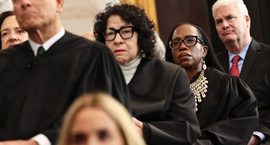
—This month marks the swearing in anniversaries for Supreme Court Justices Sotomayor, Kagan and Ginsburg.
—Detroit City Council President Mary Sheffield will advance to the general election this November.
—Women won nearly 20 percent of seats in the Lower House in Jordan’s 2024 parliamentary elections, up from 13.8 percent.
—Women hold just 8 percent of negotiator roles, 9 percent of mediator roles, and less than 5 percent of peace agreement signatories in major conflict resolutions since 1990, despite evidence that their inclusion improves outcomes dramatically.

… and more.

War on Women Report: MAGA Republicans Hope to Turn Miscarriage Into a Crime and Gut Planned Parenthood

MAGA Republicans are back in the White House, and Project 2025 is their guide—the right-wing plan to turn back the clock on women’s rights, remove abortion access, and force women into roles as wives and mothers in the “ideal, natural family structure.” We know an empowered female electorate is essential to democracy. That’s why day after day, we stay vigilant in our goals to dismantle patriarchy at every turn. We are watching, and we refuse to go back. This is the War on Women Report.

Since our last report:
—On June 14, between 4 and 13 million people attended No Kings rallies nationwide to protest President Trump’s immigration and economic policies.
—Four states—California, Massachusetts, New York and New Jersey—have petitioned the FDA to undo restrictions on the abortion pill mifepristone.
—Some good news out of Montana: This month, the state supreme court struck down three abortion restrictions that Republican lawmakers passed in 2021.

… and more.

The Supreme Court’s Ruling on National Injunctions Will Hurt Us All—Immigrants First

In a 6-3 decision last Friday, the Supreme Court granted the Trump administration a partial, but crucial, victory in its efforts to stop federal courts from blocking Trump’s agenda.

The vehicle for this power grab, CASA v. Trump, is a case about the legality of denying citizenship to children born to parents who are in the U.S. unlawfully or temporarily. In the majority’s ruling that nationwide injunctions were probably outside the federal judiciary’s authority, and therefore, judges should limit their orders to the parties and plaintiffs before them, it has tipped the balance of power to the president. And that is going to make many people’s lives—immigrants and nonimmigrants alike—much more difficult.

As Support for Abortion Grows, the Court Doubles Down on Restricting Care

In its Medina v. Planned Parenthood South Atlantic ruling last week, the U.S. Supreme Court issued a devastating blow to reproductive health clinics across the nation. A substantial slate of decisions issued by the Court Friday dealt several more severe blows to the rule of law and our constitutional rights—though a silver lining was the Court’s decision to uphold the Affordable Care Act’s preventive-care mandate.

Grassroots Power: How Amarillo Became the First City to Reject an Abortion Travel Ban

On Nov. 5, 2024, voters in the Texas Panhandle city of Amarillo resoundingly defeated (59 to 41 percent) a proposition that would have declared their town a “sanctuary city for the unborn.” Amarillo now enjoys the distinction of being the first city in the U.S. where voters rejected a post-Roe abortion travel ban.

The defeat marks a powerful repudiation of Mark Lee Dickson, founder of the antiabortion group Sanctuary Cities for the Unborn—due in large measure to the activism of the Amarillo Reproductive Freedom Alliance. The alliance was launched when six local women met at a coffee shop to debrief after Dickson’s initial presentation, which several of them had attended. The women immediately recognized that the ordinance posed a threat they needed to take seriously.

Feminist Roundup: The Best and Worst Quotes of 2024

“A bird may sing in Kabul, but a girl may not.”

“I want all women who have been raped to say: Madame Pelicot did it, I can too.”

“Our ability to end a pregnancy with just a few pills—safely, privately, at home and without shame—was too much for them to take.”

“The rules were that you guys weren’t going to fact check.”

“Birth control really screws up female brains.”

A collection of this year’s most inspiring and infuriating things said by and about women.

Conservative Supreme Court to Rule on Right to Be Trans, Medical Care, Parents’ Rights, Constitutional Sex Discrimination—and the Right to Be Different

“I’m here to stand up for my kid,” Brian Williams told me outside the Supreme Court on Dec. 4. Williams and his wife Samantha have been fighting for their daughter—known as L.W. in the legal papers the ACLU filed to challenge Tennessee’s ban on gender-affirming medical care for minors—for years.

Though difficult to sit through, the two-plus hours of argument in United States v. Skrmetti—a challenge by trans youth, their families, the ACLU, Lambda Legal and the Biden administration to Tennessee’s ban on gender-affirming care for minors—was a nearly perfect distillation of this moment in our gender politics.

The Future of Judicial Reform 

Come Jan. 3, 2025, both the Senate and the House will be in Republican hands. A few weeks later, on Jan. 20, Donald Trump will return to the White House. With a slim Democratic majority in the Senate and a Republican House, the likelihood Democrats could make headway on judicial ethics over the last four years was never high. It’s now nil. The need for reform, however, is greater than ever—as is public support for it.

Power will shift in January, but conversation about the necessity of and path to judicial reform as a way of laying the legislative groundwork must continue.