Texas and Florida Sue FDA in New Bid to Block Abortion Pill Access

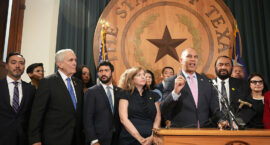
Texas launched a lawsuit against the U.S. Food and Drug Administration last week over the agency’s approval of mifepristone, marking the state’s latest effort to crack down on access to abortion pills.

Joined by Florida, Texas Attorney General Ken Paxton filed the case on Dec. 9 in federal court in Wichita Falls. The two states argued in a 120-page complaint that the FDA did not properly evaluate mifepristone’s safety and effectiveness when approving the drug in 2000 and its subsequent generic versions. They also challenged the agency’s moves that expanded access to the pills, including the ability to dispense them by mail.

Abortion access advocates have blasted the lawsuit.

“If they succeed in restricting access to mifepristone, abortion access will be devastated across the country, even in states where abortion remains legal,” Shellie Hayes-McMahon, executive director of Planned Parenthood Advocates of Texas. “This lawsuit is not about safety or healthcare; it is about control. And nothing short of full control over our bodies will satisfy them.”

A Houston Mother Held by ICE Must Choose: Indefinite Detention or Be Deported Without Her Family

Margarita Avila, a Houston mother of nine, was detained by ICE after an altercation that led to no charges. Her close-knit family weigh their futures if she is deported.

Margarita requested asylum in the U.S. more than a decade ago, and her case has been pending ever since. Meanwhile, she and José have grown their family in Texas, and like many other immigrants, they have put down deep roots. They bought a house in Houston’s Independence Heights neighborhood, started a landscaping business that grew to hundreds of customers and had five U.S.-born sons who are American citizens.

Because of their various immigration statuses (some undocumented, some pending asylum, some U.S. citizens) Margarita’s deportation would make it difficult and in some cases impossible to see her close-knit family. Her husband would have to decide whether to stay in the U.S. with their two youngest children or follow his wife to Belize so they can raise the boys together in a country Isaac and Jeremiah have never known. For the oldest children born in Belize, it could mean not seeing their mother for years because they don’t have permanent legal status.

Margarita Avila, 50, is among the tens of thousands of immigrants in the U.S. targeted for deportation in President Donald Trump’s second term. Trump has said his administration is going after “the worst of the worst” in an attempt to deport 1 million immigrants annually. But six months into Trump’s second administration, at least 70 percent of the more than 56,000 immigrants detained across the country didn’t have a criminal record.

Abortion Pill Crackdown, Anti-Trans Bathroom Bill and Discriminatory Maps: Texas GOP Escalates Retaliation After Democratic Walkout

When Texas House Democrats returned to the Capitol after walking out over the GOP’s new congressional map, they were cheered by supporters as bulwarks of democracy—then promptly bulldozed by Republicans fed up with their protest and intent on further marginalizing the minority party.

Republicans moved quickly to drive the map through both chambers of the legislature within a week of the Democrats’ return. But they also wasted no time advancing a host of conservative priorities that Democrats vehemently oppose, including bills cracking down on the manufacturing and distribution of abortion pills and requiring transgender people to use the bathroom aligned with their sex assigned at birth in government and school buildings.

Those measures stalled in the House during the regular session. And while Gov. Greg Abbott, who controls the special session agenda, had put them on the to-do list from the start, Democrats’ protest has only increased the GOP appetite to push them all through as retribution for the walkout.

“Now we’re not even going to negotiate,” said Rep. Tom Oliverson of Cypress and chair of the House Republican Caucus. “We’re just going to slam it through, too bad.”

Denying Quorum Has Been a Texas Political Strategy Since 1870

In June 1870, 13 Texas senators walked out of the Capitol to block a bill giving the governor wartime powers, depriving the upper chamber of the two-thirds quorum required for voting. Though the fleeing members were arrested, and the bill eventually passed, the “Rump Senate incident” established quorum-breaking as a minority party tactic that has persisted in Texas politics ever since.

After significant quorum breaks in 1979, 2003 and 2021, Texas House Democrats are once again employing this nuclear option, fleeing the state Sunday to block passage of a congressional redistricting map that would give Republicans five additional seats in the U.S. House. The attempt represents the latest chapter for the maneuver that political scientists say, barring exceptional endurance on the part of the democratic delegation, is likely to be symbolic rather than directly effective in preventing redistricting.

“It’s a messaging move,” said Brandon Rottinghaus, a political science professor at the University of Houston. “It’s a last resort for Democrats who have run out of options legislatively and even legally.”

Texas Lawmakers Propose Abortion Pill Bill That Can’t Be Challenged in State Courts

In 2021, when Texas passed an abortion ban enforced through private lawsuits, U.S. Supreme Court Justice Elena Kagan sarcastically derided the architects of the law as “some geniuses” who’d found the “chink in the armor” to sidestep Roe v. Wade. Four years later, those same folks are back with a new play to restrict the flow of abortion-inducing drugs into the state and a fresh set of never-before-seen legal tools that experts say would undermine the balance of power in the state.

Senate Bill 2880, which passed the Senate last week, allows anyone who manufactures, distributes, mails, prescribes or provides an abortion-inducing drug to be sued for up to $100,000. It expands the wrongful death statute to encourage family members, especially men who believe their partner had an abortion, to sue up to six years after the event, and empowers the Texas attorney general to bring lawsuits on behalf of “unborn children of residents of this state.”

That the Texas Senate passed a bill to crack down on abortion pills isn’t surprising. But the protections written into this bill, which says the law cannot be challenged as unconstitutional in state court, could have ripple effects far beyond the question of abortion access.

Amid Support from Doctors Group, Bill to Clarify Texas’ Abortion Ban Does Little to Save Lives, Critics Say

A bipartisan bill to clarify exceptions to the state’s near-total abortion ban garnered widespread support Thursday from healthcare professionals and abortion opponents who said the bill would remove any hesitation doctors might have to save a pregnant woman’s life.

Critics, meanwhile, told lawmakers that Senate Bill 31 doesn’t go far enough to protect women facing pregnancy-related medical emergencies and even quietly resurrects 160-year-old laws that could be used to criminalize those who have undergone an abortion or have helped those who receive an out-of-state abortion.

Texas Lt. Gov. Dan Patrick Says Legislature Should Clarify Abortion Law to Protect Mothers at Risk

Lt. Gov. Dan Patrick on Sunday said the legislature should amend the language of the state’s near-total abortion ban to address confusion over when doctors may terminate pregnancies. Patrick is the first major state elected official to offer support for changing the state’s abortion law in this legislative session.

“I do think we need to clarify any language so that doctors are not in fear of being penalized if they think the life of the mother is at risk,” Patrick said on the WFAA program Inside Texas Politics.

How an Antiabortion Doctor Joined Texas’ Maternal Mortality Committee

Texas’ maternal mortality and morbidity review committee was created in 2013 to track and study maternal deaths and near-misses. Dr. Ingrid Skop, a San Antonio OB-GYN, was chosen to represent rural areas on the committee, over an obstetrics nurse from the Rio Grande Valley.

Skop is not just any antiabortion doctor. She is the face of a small but powerful medical lobby that has helped restrict abortion access across the country. Skop has testified to state legislatures and before Congress, and been called as an expert witness in court cases. She is one of the doctors who sued to have mifepristone, a common abortion-inducing drug, moved off the market, a case that ultimately failed at the U.S. Supreme Court.

Two More Texas Women Say Delayed Care Due to Abortion Laws Endangered Their Fertility

Two women have filed federal complaints against Texas hospitals they say refused to treat their ectopic pregnancies, leading both women to lose their fallopian tubes and endanger their future fertility.

Texas law allows doctors to terminate ectopic pregnancies, a condition in which the fertilized egg implants in the fallopian tubes, instead of the uterus. Ectopic pregnancies are always non-viable and can quickly become life-threatening if left untreated. Despite these protections, these women say they were turned away from two separate hospitals that refused to treat them. The complaint alleges that the doctors and hospitals are so fearful of the state’s abortion laws, which carry penalties of up to life in prison when violated, that they are hesitating to perform even protected abortions.

“Texas officials have put doctors in an impossible situation. It is clear that these exceptions are a farce, and that these laws are putting countless lives in jeopardy.”