The report reveals how racism, human error and official misconduct make wrongful convictions—and wrongful executions—an unavoidable feature of capital punishment.
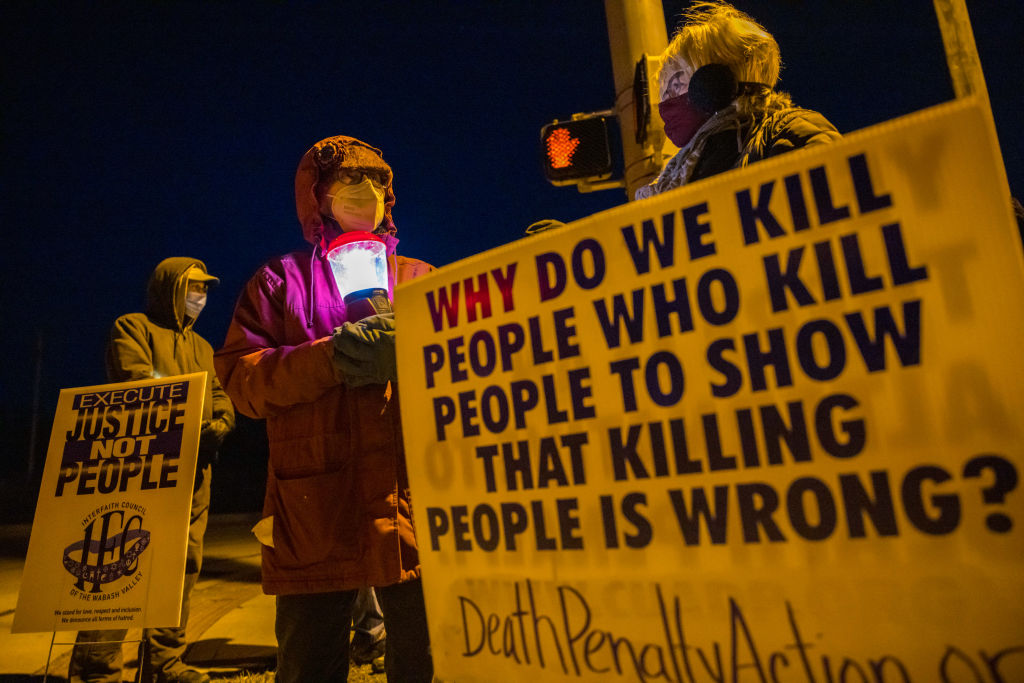
On the first day of his second term, President Donald J. Trump issued an executive order entitled Restoring The Death Penalty And Protecting Public Safety. In doing so, he chose to ignore the mounting and irrefutable evidence, recently highlighted in a new report from the American Civil Liberties Union (ACLU), that the death penalty is riddled with human error and poses the undeniable risk of executing innocent people.
Trump complained that in 2021, the Department of Justice under former President Joe Biden had issued a moratorium on federal executions, and on Dec. 23, 2024, President Biden had commuted the sentences of 37 of the 40 inmates on federal death row. Trump’s order not only instructed the attorney general to pursue the death penalty wherever possible, it singled out the murder of law-enforcement officers and any capital crime committed “by an alien illegally present in this country.” It even instructed the attorney general to reach beyond federal jurisdiction and encourage state attorneys general and district attorneys to pursue the death penalty in all capital crimes.
On Feb. 5, 2025—her very first day as attorney general—Pam Bondi lifted the moratorium on federal executions that had been imposed by Attorney General Merrick Garland.
Trump’s utter disregard for the sanctity of human life is no surprise. To date, he has ordered the execution of at least 80 people in at least 20 strikes in the Caribbean Sea and Eastern Pacific Ocean.
And in the waning days of his first term, the Trump administration executed 12 men and one woman within six months—the most consecutive civilian executions by the federal government or any state in the then 244-year history of the United States. As I wrote for Ms. at the time, this “unprecedented killing spree ended a 17-year bipartisan federal moratorium. Betraying the racist nature of the death penalty, six of the executed men were Black and one was Native American. And in a further shocking display of racist cruelty, the last execution—of Dustin John Higgs, a Black man—took place on the birthday of Dr. Martin Luther King Jr.” Among those killed was Lisa Montgomery, the first woman executed by the federal government since 1953.

Fatal Flaws: Innocence, Race and Wrongful Convictions
On Nov. 19, 2025, the ACLU’s Capital Punishment Project issued a new comprehensive 24-page report (accompanied by 134 endnotes): “Fatal Flaws: Innocence, Race, and Wrongful Convictions.” The strength of the report is how effectively it gathers and updates information that tragically we have known for far too long.
“In a criminal legal system created and administered by humans with enormous power and discretion—including police, prosecutors, and judges—the risk of error and arbitrariness is inherent and inescapable. Since the modern period of the death penalty began in 1973, at least 200 innocent people have been exonerated from death rows across America.”
Despite this harsh reality, the ACLU notes that the death penalty is still retained at the federal level along with 27 states dispite evidence that innocent people are being sentenced and executed. Imposing the death penalty requires a host of steps, the report explains, “from investigating a homicide, to charging, trying, sentencing, and eventually scheduling an execution,” and these decisions are “all made by fallible humans, which means they are vulnerable to error and bias at best and malice and overt animus at worst.” Because of this inevitable error, “any capital punishment system necessarily risks sentencing innocent people to death.”
Around 72 percent of lynching victims in the United States were Black, a number that closely resembles the 75 percent of executions that were of Black people in the South between the years 1910 and 1950.
The ACLU describes—with glaring examples—five major factors that drive wrongful convictions: official misconduct by police and prosecutors, perjury or false testimony, eyewitness misidentification, unreliable expert witness and non-diverse juries.
Racism and the Death Penalty
Given the reality of America’s racism, these risks result in the disproportionate conviction and execution of innocent Black people. According to a 2022 report by the National Registry of Exonerations (NRE), Black people are over seven times more likely to be wrongfully convicted of serious crimes than white people. And while it is impossible to say how many innocent Black people have been sentenced to death, over half of the people exonerated from death row—108—have been Black.
The race of victims also affects who gets wrongfully sentenced to death in the United States. According to the ACLU’s research, those accused of murdering a white victim have a disproportionately higher risk of wrongful conviction. And conversely, though Black people represent over 50 percent of murder victims in the United States, their cases account for only a small percentage of executions. Even when factual innocence seems manifestly apparent, true exonerations remain hard to come by for many Black men, especially those wrongfully convicted of killing white victims.
Even when factual innocence seems manifestly apparent, true exonerations remain hard to come by for many Black men, especially those wrongfully convicted of killing white victims.
Race and wrongful accusations have been intertwined throughout the history of lynchings and executions, the report explains. Early slave codes made the attempted rape of a white woman a capital offense for Black defendants, but not white men. “Black Laws,” adopted in the wake of the Civil War, “prohibited Black citizens from testifying in criminal court cases, unmistakably prioritizing white supremacy over fact-finding.”
The death penalty “grew out of this country’s brutal practice of lynching, with the former gradually replacing the latter in the early 1900s.” After the Civil War, “lynchings against Black Americans skyrocketed, particularly in the South” and “early death penalty trials echoed characteristics of lynchings.” Around 72 percent of lynching victims in the United States were Black, a number that closely resembles the 75 percent of executions that were of Black people in the South between the years 1910 and 1950. A person could be lynched based on the word of a single white person, a truth that persisted as white lynch mobs turned into the all-white juries in death penalty trials.
The ACLU recognizes the cruel reality that “not every innocent person on death row escapes alive.” While it is impossible to determine just how many innocent people have been executed since the modern death penalty was introduced in 1973 (because upon the execution the investigation stops), the ACLU concludes that innocent people have almost certainly been executed. The Death Penalty Information Center identifies at least 21 people who very likely were innocent and were wrongfully executed in the modern era. Of those cases, 11—over half—were cases in which people of color were wrongfully executed, and 16 of the cases (76 percent) involved a white victim.
As examples, the report highlights three harrowing cases.
In 1998, Florida executed Leo Jones, a Black man, who was convicted of killing a white police officer based in part on a coerced confession. Under Florida’s unique perversion of the law, Jones was convicted by 9-3 vote by an all-white, non-unanimous jury. In the years after his conviction, his attorneys uncovered evidence of police misconduct. One of the officers bragged that he had beaten Jones and extracted a confession. Additionally, multiple people identified another person as the likely suspect in the killing. The Florida Supreme Court denied Mr. Jones a new trial and refused to give him an opportunity to present a full picture of the case.
Texas executed Carlos DeLuna, a Latino, in 1989. Columbia University Professor James Liebman and 12 of his students extensively investigated DeLuna’s case. They concluded DeLuna “almost certainly was innocent,” a victim of mistaken identity. Carlos DeLuna and Carlos Hernandez, an alternate suspect, looked remarkably similar—so much so that their family members mistook their photographs for each others’. During the police investigation, an eyewitness reported that he wasn’t sure about the identification. Despite copious blood at the crime scene, police investigators conducted no blood analysis to determine the perpetrator’s blood type. When Liebman asked to review the evidence and subject it to DNA testing, authorities told him it had “disappeared.” Police and prosecutors knew Carlos Hernandez had a history of violence, including assaulting women with a knife. But as a police informant, he remained protected from prosecution and incarceration despite multiple arrests and crimes.
Missouri executed Marcellus Williams, a Black man, in September 2024 for the 2001 robbery and murder of a white woman. Although no physical evidence linked Williams to the crime, he was convicted largely based on the testimony of two witnesses who claimed that Williams had confessed to them—one of whom was paid $5,000 for his testimony. DNA tests on the murder weapon conducted in 2015 showed not only that Williams was definitively excluded as the DNA’s source, but that the prosecutors had contaminated it with their own DNA.
In January 2024, St. Louis prosecutor Wesley Bell moved to vacate Williams’ conviction, citing potential weaknesses in his legal defense and the police investigation, as well as bias in jury selection. But the motion was denied. A month before the execution was set to take place, Williams accepted an Alford plea so he could receive a sentence of life without parole while maintaining his innocence. However, Missouri Attorney General Andrew Bailey convinced the Missouri Supreme Court to block the agreement. Williams was executed on Sept. 24, 2024.
Death Penalty Remains Fraught with “Arbitrariness, Discrimination and Mistake”
The ACLU report concludes with 34 specific recommendations to address the serious flaws in the system, beginning, of course, by noting the obvious: The only true protection against wrongful convictions and executions is the abolition of the death penalty.
The reforms include expanding post-conviction relief and accountability, ensuring fair and diverse juries, strengthening forensic and investigative integrity, providing meaningful remedies for wrongful convictions, and promoting executive clemency and transparency.
Over 30 years ago, Supreme Court Justice Harry A. Blackmun announced that he could no longer tolerate the death penalty:
“[T]wenty years have passed since this court declared that the death penalty must be imposed fairly and with reasonable consistency or not at all, and despite the effort of the states and courts to devise legal formulas and procedural rules to meet this challenge, the death penalty remains fraught with arbitrariness, discrimination and mistake.”
“From this day forward … I no longer shall tinker with the machinery of death. I feel obligated simply to concede that the death penalty experiment has failed. It is virtually self evident to me now that no combination of procedural rules or substantive regulations ever can save the death penalty from its inherent constitutional deficiencies.”
The death penalty is a perfect punishment in an all too imperfect system. It imposes a final, unalterable punishment which can never be reversed. And when the state kills, it buries its mistakes. At least 150 countries have abolished the death penalty, by law or by practice. Resisting the humanitarian trend around the world, the United States remains part of a gruesome club, along with China, Iran, Saudi Arabia and Iraq.
We must no longer tinker with the machinery of death. We must abolish capital punishment now.