For Rachana Desai Martin, voting rights and reproductive rights have always been the same battle. The SAVE America Act just proved her right.

This piece is part of an ongoing series, “Redefining Power: How Indian American Women Are Rewriting the Rules of Leadership, Identity and Care.” The series explores what it means to modernize without losing our roots—through candid conversations with Indian American women reshaping culture, power and possibility. Have a story to share or want to be interviewed? Reach the series author Jaime Patel at redefiningpower@msmagazine.com.
It was the morning after Election Day 2000, and Rachana Desai Martin was standing in a parking lot in West Palm Beach, Fla., outside a Democratic field office. She was 22, a junior at the University of South Carolina who had taken a semester off to work on the Al Gore campaign, and she had been awake for over 24 hours.
She hadn’t planned to be in Florida. The night before, someone had handed her a carry-on bag and put her on a plane without much explanation. She had landed not knowing what she was walking into.
What she found was a parking lot full of people. People who hadn’t been able to vote. People who were afraid they’d been disenfranchised. They hadn’t been organized or mobilized or asked to show up. They just came because their vote had been taken from them, and they wanted someone to fix it.
I thought voting meant something. … I thought that when you have a right to something in America, you actually have it.
Rachana Desai Martin
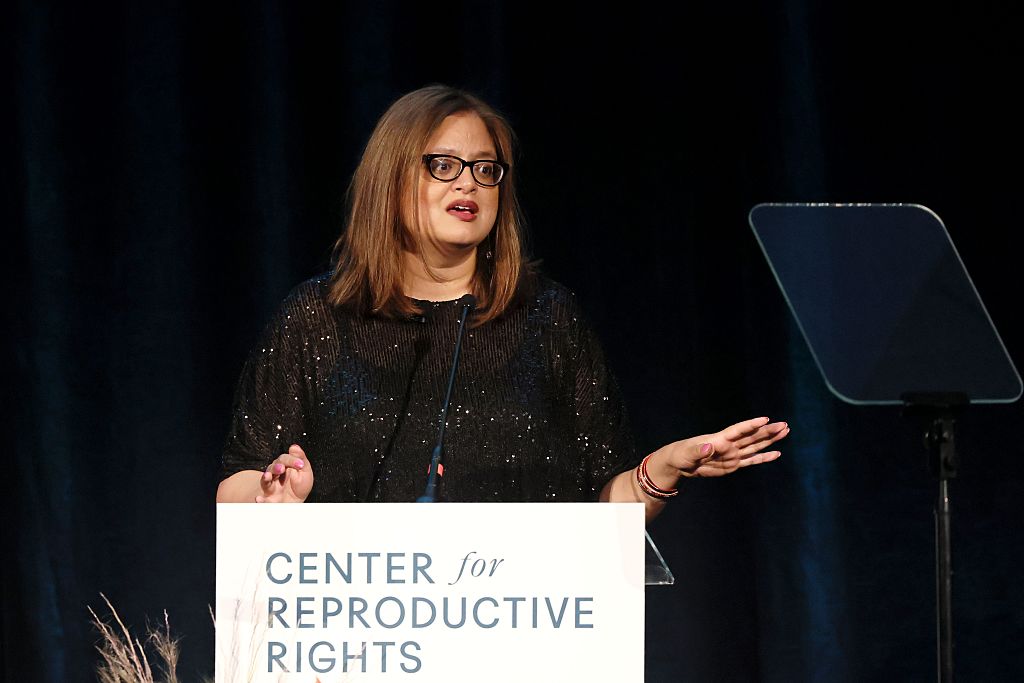
“Every single one of those people had a problem,” she told me recently. “And every single one of those people wanted to talk to a lawyer.”
That morning changed the course of Desai Martin’s life. Not because it radicalized her—she’d grown up Indian American in South Carolina, one of the only brown families in her town, navigating a world that was never built to center her—but because it shattered a particular kind of naivety she hadn’t even known she carried.
“I thought voting meant something,” she said. “I thought that when you have a right to something in America, you actually have it.”
Twenty-five years later, in March 2026, the Senate is now debating the SAVE America Act—a bill that would require Americans to show a birth certificate or passport just to register to vote.
And even as that debate begins, Republicans are already looking for ways to go further: Senate Majority Leader John Thune signaled this week that GOP leaders are exploring folding portions of the SAVE America Act into a separate party-line reconciliation bill (which only requires a simple majority to pass, and unlike most bills, can bypass the filibuster and avoid needing to garner 60 votes to get to the floor for a final vote)—one that would fund immigration enforcement and potentially push states toward stricter proof-of-citizenship requirements.
The proposal, discussed in a closed-door meeting with Donald Trump and top allies, reflects a broader strategy: If the full elections bill can’t survive Senate rules, key provisions could still move forward through the budget process, embedding voting restrictions inside must-pass funding legislation.
Desai Martin is not surprised. She has spent her entire career watching exactly this happen.
Desai Martin is chief program officer of the Center for Reproductive Rights.
Before that, she ran the nationwide voter protection program for the Democratic National Committee during the 2018 midterms—the cycle that flipped the House—and then became its chief operating officer. By 2020, she was overseeing what she describes as the largest voter protection operation in presidential campaign history. She ran it from her basement during a global pandemic.
I say all of that not to rattle off a résumé, but because it matters. Desai Martin is one of the only people in the country who has spent her career building the infrastructure to protect both voting rights and reproductive rights. She has seen both fights from the inside. And what she sees—clearly, consistently, without drama—is that these are not two separate battles.
“At base, both of these things are really about power and control,” she told me. “When we’re advocating for reproductive rights, it’s to give people power over their own bodies and their lives and their families and their futures. When we’re talking about voting rights, it’s to give people the power to pick their representatives and have their government work for them.”
Here is what that playbook looks like in practice—and why the SAVE America Act is a textbook example of it.
The bill doesn’t eliminate the right to vote. It never would—that would be too visible, too legally vulnerable, too easy to fight. Instead it attacks access. It requires proof of citizenship—a passport or birth certificate—in person, just to register. It eliminates online and mail registration for most voters. It forces anyone who moves, changes their name or re-registers to start the documentation process from scratch.
On March 17, on the Senate floor, Sen. Alex Padilla (D-Calif.) named the specific population most at risk:
“Think of a married woman who chose to change her last name when she got married and now the name listed on the birth certificate and the name on their ID no longer match and have hurdles to jump over simply to register to vote.”
He’s right. An estimated 69 million married women in this country hold birth certificates that no longer match their legal names. The bill doesn’t say they can’t vote. It just makes voting require a bureaucratic process that many won’t have the time, resources or information to complete. That is not a side effect. That is the mechanism.
A six-week abortion ban doesn’t eliminate the right to an abortion—it eliminates the access. The SAVE America Act doesn’t eliminate the right to vote—it eliminates the access.
Desai Martin has watched this mechanism operate for decades. She watched it in the years of aggressive voter purges that followed. She watched it in the wave of restrictive voting laws after the Supreme Court gutted the Voting Rights Act in 2013. The right remained on paper. The access was quietly, systematically dismantled.
And since Dobbs in 2022, she’s watching the same thing happen in reproductive rights.
“Even when we have it—it still doesn’t take care of the access issues,” she said. “People can’t afford it. People don’t know what reproductive healthcare even means.”
A six-week abortion ban doesn’t eliminate the right to an abortion—it eliminates the access. The SAVE America Act doesn’t eliminate the right to vote—it eliminates the access.
“The very first thing authoritarian governments come for,” Desai Martin told me, “is the rights of women, the rights of LGBTQ people, the rights of marginalized communities. The attacks on reproductive rights are a sign that your government is backsliding. They are taking power away from you.”
She said it before the Senate vote. It lands differently now.
Earlier this month, Desai Martin was in Arizona, training activists on the abortion access campaign following the state’s successful constitutional amendment ballot measure. That win—which voters passed with significant support—is not the end of the story. Now comes the work of making it real. Of closing the gap between what the law says and what a woman in rural Arizona can actually access.
And that is where the longer game begins. Too often, we pass a law and mobilize for access, but we rarely measure the impact. In my conversation with Reshma Saujani for this series, she put it bluntly: A passed policy means nothing if its intended benefit is not measured. You have to keep showing everyone who rallied for that right the results. Otherwise, it will be at risk again.
I’ve been thinking about that a lot since our conversation with Desai Martin. Because I think one of the most disorienting things about this moment—for advocates, for donors, for people who care deeply and are watching and waiting—is that the wins don’t feel like wins.
“We need to reframe what it looks like to win in the immediate moment,” Desai Martin told me. “Anything we can do to make those bad laws a little less bad—that is a mini win, and that is how you build.”
That is not a message of resignation. It is a message of strategy from someone who has been in enough parking lots, enough basements, enough war rooms, to know how change actually works. It is slow. It requires everyone to do their part. It requires a tolerance for the long game that our culture, with its news cycles and rage scrolling, makes genuinely difficult.
Anything we can do to make those bad laws a little less bad—that is a mini win, and that is how you build.
Rachana Desai Martin
I asked her how she stays steady through all of it. Her answer was immediate: “I’ve just committed to doing this forever. Once you actually believe that we will always have to fight for these things—then you just keep doing the work.”
After all, this is a democracy, and it only works if we are all participating in it.
I’ve been writing this series for over a year now, profiling Indian American women who are reshaping power in this country, and I keep finding the same thing: They are almost never the ones making the most noise. They are in the infrastructure. They are building the systems. They are the ones who showed up in Florida in 2000 with no playbook and figured it out anyway.
Rachana Desai Martin is one of those women. She doesn’t have a silver bullet. She has something more durable: a clear-eyed understanding of how rights are won, lost and—slowly, stubbornly, collectively—reclaimed.
Twenty-five years ago, she was standing in a parking lot in Florida, watching people line up because their right had been taken from them. The Senate floor is live right now. The 2026 midterms are coming. And the woman who knows better than almost anyone how this fight goes is already on the ground, training the next wave.