The best laboratories for democracy show what can be done when women’s health is a priority.
This article was originally published by The Contrarian.
For all the around-the-clock chaos spurred by the federal government, disdain for reproductive health and rights is an omnipresent and defining feature.
Two examples from the past week:
- On issuing a lengthy report accusing the Biden administration of unfair treatment of antiabortion protestors, the Department of Justice fired at least four prosecutors for enforcing the Freedom of Access to Clinic Entrances (FACE) Act during his tenure.
- In a House hearing for the Committee on Education and Workforce, “Examining the Policies and Priorities of the Department of Health and Human Services,” HHS Secretary Robert F. Kennedy Jr. refused to acknowledge the well-established, shameful statistic that Black women in the United States are at least three times more likely to die from pregnancy-related causes than their white counterparts—even as Rep. Summer Lee (D-Pa.) called out that it was Black Maternal Health Week and asked, point-blank, “Do you have an idea of how we could solve the Black maternal mortality crisis if we can’t say Black?”
That’s why it is a relief to point to bona fide good news coming from the states, often some of the best laboratories for democracy.
In Pennsylvania on Monday, an appeals court struck down a decades-old law banning the use of state Medicaid funding to cover abortion. Truly remarkable is the majority’s decree that reproductive autonomy is enshrined in the equal protection provision of the Pennsylvania Constitution, guaranteed under its Equal Rights Amendment. As the ruling states, “There is no comparable exclusion of any health coverage—reproductive or otherwise—for men.” The case could still be appealed to Pennsylvania’s supreme court, but for now it is a noteworthy win with even bigger implications than just abortion.
OG Contrarian readers may recall that among the site’s inaugural posts was professor Laurence Tribe’s summary of the status of the federal Equal Rights Amendment and obvious roadblocks in the immediate future. But 29 states have some form of an ERA (e.g., broader sex equality language than the U.S. Constitution) written into their constitutions—enabling an alternate path forward, as the Pennsylvania ruling demonstrates.
ERAs can be game-changing for bolstering legal protection against a wide array of discrimination—including on the basis of pregnancy, age, disability, and immigration status—as well as for addressing adjacent issues such as pay equity and transparency and gender-based violence. (If you’re looking to know more, the Center I lead at NYU Law is home to the Marcy Syms Equality Initiative, a law and policy think tank that provides expert analysis on the mobilization of state ERAs, among other work; check it out.)
In other state headlines, upcoming judicial elections in Georgia are fast becoming a reproductive rights referendum, as happened last year in Wisconsin, given two of the incumbent judges were instrumental in reinstating Georgia’s highly restrictive abortion ban in 2024. Activists are raising funds in force.
Idaho voters will likely get to weigh in directly on abortion rights: Earlier this week, organizers of a 2026 ballot initiative say they’ve now collected enough signatures to qualify (6 percent of the total registered voters at the time of the last general election, or about 70,000+ signatures). The proposed measure would establish a right to “private reproductive health care decisions,” including abortion, contraception, fertility treatment, miscarriage care and prenatal through postpartum care.
California, which has sought to be a safe haven for reproductive rights, is poised to pass legislation requiring in-state medical providers and affiliated businesses to notify the state attorney general and patients on compliance with any federal subpoena seeking abortion, gender-affirming or reproductive health information. “No one should have to fear that seeking lawful medical care in the state of California could put their privacy and their safety at risk,” the bill’s sponsor told the Assembly Judiciary Committee at a hearing last week.
And on Tuesday, the Illinois House passed a bill that would create a statewide abortion access fund to assist patients who are underinsured or uninsured; already existing insurance-based funds that offer this service would be turned over to the state to run instead. (Maryland already does the same.) Illinois plays a key role in the national abortion landscape, given its central geography—it is where nearly one in four out-of-state patients go for care, according the Guttmacher Institute—making its policies have exponential impact. “Illinois really became kind of a haven state for the Midwest and much of the South immediately post-Dobbs,” Megan Jeyifo, executive director of the Chicago Abortion Fund, told Stateline.
Finally, a follow-up to a recent Contrarian column on women in the U.S. military and the Department of Veterans Affairs’ (VA) strict abortion ban that is now in place. Last week, two organizations—Vet Voice Foundation and The Brigid Alliance—launched a billboard campaign near major VA clinics in Georgia, New Mexico and Virginia. The bad-ass signs include user-friendly information for how to access abortion and other reproductive healthcare.
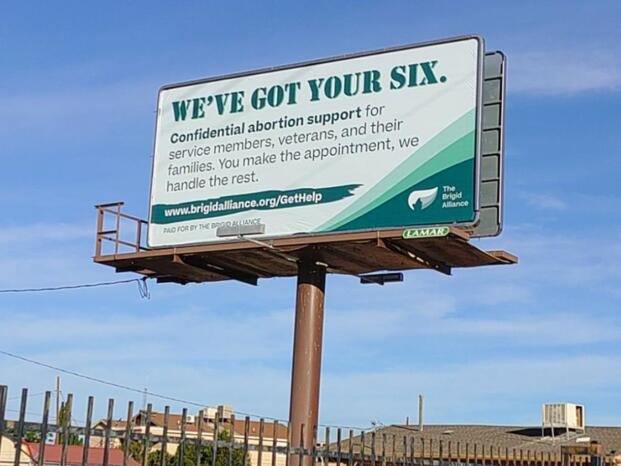
“The main idea is to let veterans know that there are organizations out there who will help them get the healthcare they need, even though the VA has abandoned its obligation to take care of them in this regard,” Janessa Goldbeck, a Marine Corps veteran and CEO of Vet Voice Foundation, told Military.com.
The lesson in all of this? We’ve got this—and each other. Our commitment will only get more creative, more intentional, more bold.