By making discrimination harder to prove, the Callais ruling puts women—especially women of color—at greater risk of losing the districts that made their election possible.

This Wednesday, the Supreme Court dealt a serious blow to voting rights and to the women whose political representation is shaped by the structural safeguards this decision has now drastically narrowed.
In a 6-3 ruling in Louisiana v. Callais, the Court’s majority struck down Louisiana’s congressional map, which had created a second majority-Black district in 2024. Although the decision did not formally strike down Section 2 of the Voting Rights Act, Justice Elena Kagan warned in her dissent that “the majority opinion had rendered the provision ‘all but a dead letter.’”
For four decades, Section 2 allowed courts to examine whether district lines produced discriminatory results—recognizing that intentional discrimination rarely announces itself. This week’s ruling reinstates an intent standard that Congress explicitly rejected in 1982 precisely because it was unworkable.
Writing for the majority, Justice Samuel Alito held that a violation of Section 2 only occurs “when the circumstances give rise to a strong inference that intentional discrimination occurred.”
The statute remains on the books, but its practical force does not.
Kagan was not alone in this interpretation. She was joined by Justices Sonia Sotomayor and Ketanji Brown Jackson, who co-authored the dissent.
Notably, all three justices who opposed the weakening of Section 2 were women—a fact that may say something about who most clearly sees what’s at stake when the structural protections of democratic participation are stripped away.
The data offers one answer as to why.
RepresentWomen’s analysis found that 54 of 148 majority-minority districts—or 36 percent—are currently represented by women in Congress.
In the 11 states most likely to face redistricting pressure following an adverse ruling in Callais, up to 36 majority-minority districts could be redrawn, 12 of which are currently represented by women in the House of Representatives.
Those women, and the communities they represent, now face real and immediate uncertainty.
—Courtney Lamendola, director of research at RepresentWomen
Florida makes that uncertainty immediate. Hours after the Supreme Court’s ruling, the Florida Legislature approved a new congressional map proposed by Gov. Ron DeSantis aimed at giving Republicans additional seats ahead of the 2026 midterms. The map specifically targets five incumbent Democrats representing majority-minority districts, three of whom are women.
This is the clearest illustration yet of what is at stake, and it happened within hours of the ruling.
For the women targeted in Florida’s new map, the majority opinion offered what appeared to be a possible line of defense—its several references to the 2022 map’s failure to protect incumbents.

RepresentWomen asked constitutional and voting rights litigator Yael Bromberg to analyze whether incumbency protection—a traditionally recognized redistricting criterion—could be used to shield women officeholders in majority-minority districts from the worst effects of this ruling. Her answer was sobering.
While the Court affirmed today that incumbency protection remains a legitimate redistricting criterion for states to consider, it also narrowed what that means in practice, focusing on the ability to win reelection rather than simply preventing competition. She noted that a state legislature can choose to protect some incumbents and not others, leaving substantial room for maps that disadvantage women who currently hold those seats.
As Bromberg put it:
“SCOTUS is looking for a ‘smoking gun’ of intentional discrimination to invalidate redistricting efforts. Legislators will now simply redistrict based on partisan lines, and it will be permissible, even if it has a racial impact.”
For the women in Florida currently holding these seats, and for the voters of color who elected them, that impact is already taking shape. And Florida is only the beginning.
With federal legal protections severely weakened, advocates and legislators say the most immediate recourse lies not in the courts, but in the statehouses. State-level Voting Rights Acts are emerging as a critical line of defense, and in states that have already acted, the evidence of what is possible is clear.
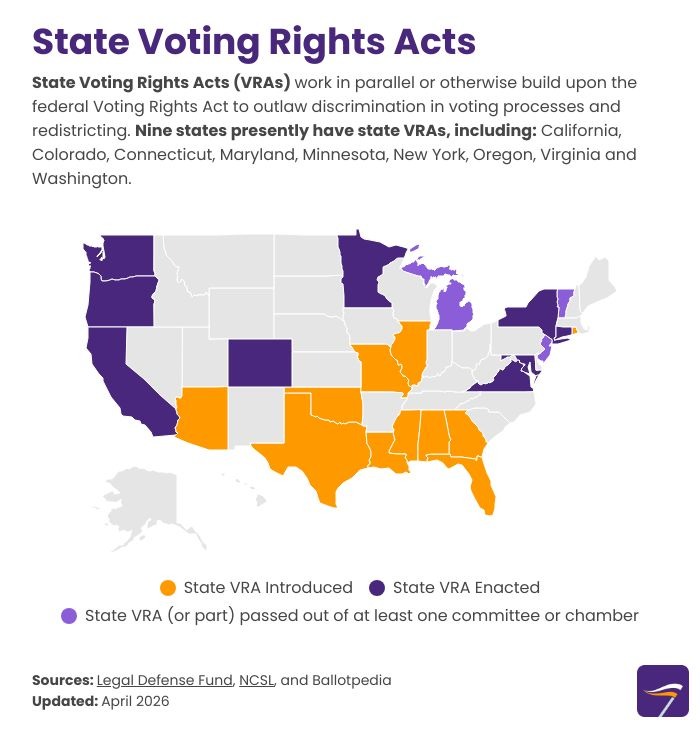
Virginia, which passed its state VRA in 2021, offers the clearest picture. Delegate Marcia Price, who sponsored that legislation, described it as a “labor of love” and “woman-led,” built on a framework designed to address the specific failures communities were experiencing at the polls, from polling place intimidation to language access barriers to disinformation.
The results speak for themselves.
“The first Black woman to ever serve in the Virginia General Assembly happened in my lifetime,” Price remarked during a recent webinar on the Voting Rights Act. “And now we’ve had 36 Black women serve—16 of which are serving right now. It’s not disconnected.”
For Price, those numbers are not just measures of progress—they are proof of what structural protection makes possible. And she is clear that Virginia was never meant to be the exception.
“Even if this becomes a dream for the future, you’ve still got to do the groundwork so that when the people wake up, and things are shifting, when that shift actually occurs, you’re ready,” she said. “In Virginia, we want to be a beacon of democracy, but we don’t want to be alone in the South. We want other southern states to join us.”

States are listening, but not yet the ones she had in mind. Just this month, Maryland passed Senate Bill 255, becoming the ninth state to enact a state VRA, banning cities and counties from using any election system or district map that results in racial vote dilution. Other states are considering following suit, although the recent decision has set back some initiatives due to concerns it raised.
Within a day of the ruling, both Illinois and Vermont have paused their current bills due to uncertainty about the Supreme Court decision. However, hope remains that states will move forward with legislation despite the recent ruling and that momentum will continue.
The real question, however, remains whether southern states will consider state-based solutions. While momentum is real, Maryland is not Mississippi. The states moving toward stronger protections are largely not the ones where the threat is most acute.
For April England-Albright, legal director of the Black Voters Matter Fund, that reality only sharpens the urgency of who needs to be at the table when those protections are built. In her view, it’s time we have the necessary and difficult discussions as a country about what we want from the Constitution itself.
”People brag that this is 250 years and we celebrate that this year, but it’s one of the oldest constitutions in the world and has been changed very little, even though many [Americans] were not imagined as citizens in it,” said England-Albright. “Those who were marginalized, not considered the citizens of this country, need to play a part in drafting the constitution of this country, so that we can create the nation that we need and that the world needs.”
That question—who shapes the rules of representation, and who is included in that process—is now moving from theory into practice. As states begin to redraw maps and consider new protections, the implications of Callais are likely to extend beyond racial representation alone.
What comes next will not be decided in a single ruling, but in a series of quieter choices: how lines are drawn, which voices are protected, and who is able to compete under a new set of rules. And in those choices, whether women remain represented at all will be part of what is decided.