Good news: A new Smithsonian exhibit highlights overlooked women. Bad news: Political battles threaten efforts to give their stories a permanent home.
Unhidden Heroines, the Smithsonian American Women’s History Museum’s (SAWHM) latest virtual exhibit, profiles five exceptional women whose substantial contributions to American history have been largely unrecognized or obscured in the historical record:
- Mary Katharine Goddard, the printer who published the first signed copy of the Declaration of Independence
- Dr. Dorothy Height, a civil and women’s rights activist known as the “Godmother of the Civil Rights Movement”
- Julia Ward Howe, creator of a rallying cry, “The Battle Hymn of the Republic,” for the Union cause during the Civil War
- Elizebeth Smith Friedman, a cryptanalyst central to cracking Nazi code during World War II
- Polly Cooper, an Oneida woman pivotal to the success of Washington’s Continental Army
The exhibit’s opening last month was bookended in May by a politicized and failed vote to finalize SAWHM’s location on the National Mall.

It was also followed by the July 4 weekend release of a scathing White House report on another Smithsonian Institution: the National Museum of American History. The report accuses the museum of “denigrating the nation’s founders and its founding” as “inherently racist, sexist, oppressive or otherwise irredeemably flawed.”
The SAWHM’s stated foundational purpose is “to create space for women’s history on the National Mall in Washington, D.C.” and make women visible in American history.
The Smithsonian Institution, founded in 1846 for “the increase and diffusion of knowledge,” now includes 21 museums; SAWHM and the National Museum of the American Latino are the newest. Both were established by Congress in 2020 and are yet to be built.
Despite strong bipartisan support for the brick-and-mortar women’s museum project—and having raised tens of millions of dollars for its establishment—momentum for the public-private partnership suffered a setback on the Hill: The bill that would have finalized the museum’s location on the Mall was scuttled after Republicans added anti-trans language barring the depiction of “any biological male as a female” in its exhibits and giving President Trump control over selection of its location.
Democrats then withdrew their support for the amended bill, led by Rep. Nicole Malliotakis (R-N.Y.), stating that the changes, added via amendment by Rep. Mary Miller (R-Ill.), would give the administration too much influence over the museum’s development. Democratic opposition was led publicly by figures including Democratic Women’s Caucus chair Rep. Teresa Leger Fernández (D-N.M.) and Rep. Judy Chu (D-Calif.).
An official Statement of Administration Policy from the Office of Management and Budget (OMB) on the bill—HR 1329—claimed the added provisions were “essential to ensure the museum is not used to … harm women in athletic and many other contexts … depriving them of their dignity, safety and well-being,” without explaining what such purported harms would be or how they could be brought about.
This is not the first time the administration has claimed to protect women’s rights while actually setting back their interests or causing them harm.
In this case, by interjecting a “poison pill partisan amendment” into previously bipartisan legislation, the administration halted progress on an initiative it had claimed to support:
“To select a site for, and the construction to begin on, a national museum dedicated to American women’s history in Washington, D.C…” recognizing “…the essential role that women have played in shaping our Nation” and ensuring that “their many contributions are permanently and prominently featured in our national cultural institutions” to “enrich public understanding of American history, strengthen the Smithsonian Institution’s educational mission and inspire future generations.”
The tactics of scapegoating trans people and inserting paternalistic “protections” in policy as a power play comports with the administration’s broader campaign against so-called “woke” institutions. They claim such institutions are anti-American or divisive and don’t sufficiently endorse their view of what constitutes patriotic history.
Some Republican lawmakers have also “questioned the necessity of a separate museum just for women” (according to NBC) and argued women are adequately represented across the other Smithsonian museums.
Many of those same lawmakers oppose any construction centering women among the major monuments in the nation’s capital.
“If they want to build it in some dark corner of D.C., fine, but I don’t want it on the National Mall,” said Rep. Keith Self (R-Texas), who characterized support for a women’s museum as buying into divisive “identity politics.”
In the meantime, it remains evident that “most of the monuments in D.C. are to men,” as one girl interviewed at the National Mall in a YouTube video announcing the Unhidden Heroines exhibit observed.
“There is no monument for girls,” a young boy observed.
As Anna Laymon, president and CEO of the Women’s Suffrage National Monument Foundation, puts it: “There are more statues of mermaids in Washington, D.C., than real women. And more statues of dogs than first ladies.”
The only current exceptions are: the “the tucked-away likeness of Eleanor Roosevelt” in the Franklin Delano Roosevelt Memorial; and “the powerful statue of Vietnam War nurses” of the Vietnam Women’s Memorial, dedicated in “1993 to honor the 265,000 military and civilian women who served,” after a “long and arduous” process with 10 years of pushback from opponents who similarly argued that a women’s memorial was not needed.

A National Women’s Suffrage Monument is also in the works but not yet in existence. The product of two congressional acts signed by two presidents (Trump in 2020 and Biden in 2025), it has received National Capital Planning Commission approval for eventual placement on the National Mall in Constitution Gardens. Like the Vietnam Women’s Memorial and SAWHM, the project is expected to take at least a decade to open and—like most national monuments in D.C.—is dependent on private funding for completion.
“The recent setback in Congress has not changed anything about the museum’s mandate or mission,” SAWHM interim director Melanie Adams told The Art Newspaper in an interview, “which continues as before, even without a designated site.”
Until sufficient philanthropic support and political will can be marshaled to fulfill SAWHM’s mission and vision to create space for women’s history on the National Mall and expand “the story of America through the often-untold accounts and accomplishments of women,” the enterprise and its exhibits will continue to exist only virtually.
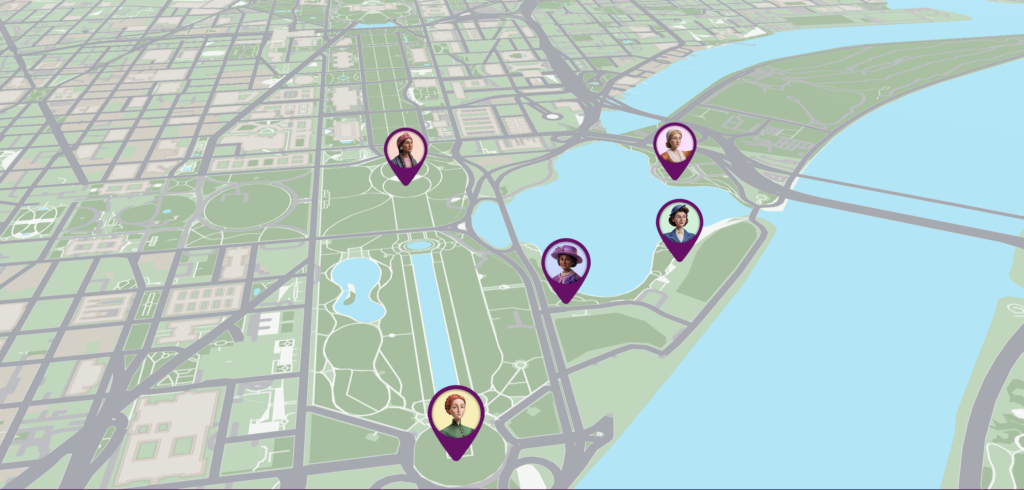
In addition to SAWHM’s more conventional ongoing digital exhibitions, the current Unhidden Heroines exhibit is an augmented reality experience. Using geolocation and animation, it enables visitors to scan a QR code and see avatars of remarkable women standing shoulder to shoulder. The women stand on the National Mall with the towering stone and bronze monuments to male figures commemorated there, each in the era to which their life’s work contributed.
“The Mall reflects what’s been happening overall in society,” Adams told Axios on the eve of Unhidden Heroines’ opening. “Women account for only about 10 percent of the stories taught in many history textbooks.” A women’s museum deserves to share space with “monuments to Washington, Jefferson, Lincoln and MLK … on the National Mall.”
The recent advance of policy and rhetoric encouraging women’s retreat from public life can be seen as making the work of highlighting women’s historical contributions even more urgent.
Since the beginning of Trump’s second term, there has been is a systematic erasure of women’s achievements from the public record and more women getting shut out from senior positions in public service, including “a string of top military women” who were “fired or moved to largely invisible roles,” according to The Hill.
Following President Trump’s executive order terminating diversity, equity and inclusion initiatives in January 2025, sheets of paper were taped over plaques at the National Cryptologic Museum commemorating the exemplary service of women and people of color who had served the National Security Agency to hide them from view.
Further examples of such symbolic erasure followed subsequent policy pronouncements.
The executive order “Restoring Truth and Sanity to American History,” requiring the removal of content expressing “improper ideology” or disparaging “Americans past or living” from federal parks and museums, somehow resulted in the removal of signage explaining women’s contributions to the founding of Muir Woods National Monument in California and information at a Pennsylvania national park about a woman who had been enslaved by President George Washington and escaped on the Underground Railroad.
In June 2026, the National Park Service targeted signs related to “abolition, women’s suffrage and immigration” for removal in advance of the observance of the 251st anniversary of the Battle of Bunker Hill before a Boston judge ruled that they be reinstalled.
The current SAWHM exhibit endeavors to make more visible the historic, often unrecorded, contributions of the profiled women to the American story by their roles in:
- Orchestrating the civil rights movement and the historic “March on Washington for Jobs and Freedom” attended by more than 250,000 on the National Mall. (Dorothy Height)
- Saving an estimated 8,000 lives through Nazi code-breaking during World War II. (Elizebeth Smith Friedman)
- Feeding countless starving troops in George Washington’s Continental Army during the Revolutionary War and teaching them how to survive. (Polly Cooper)
- Printing—and signing—the Declaration of Independence and publishing Thomas Paine’s Common Sense. (Mary Katharine Goddard)
- Authoring an abolitionist Civil War anthem and building the women’s suffrage movement. (Julia Ward Howe)
Their contributions were made despite having their personal, educational and professional opportunities controlled and curtailed by the legal and social conventions of their times, with their husbands, fathers or brothers as gatekeepers. This led to them being silenced or ignored at times, their contributions minimized and attributed to others.
Telling “the complex history of our nation” honors the heroines of the past so that their legacy is more than A Footnote to History (the title of Friedman’s unfinished memoir). It also inspires younger generations to make an impact and enables all to “benefit from a deeper historical understanding of our nation” as SAWHM envisions.
Ensure work like this article continues
At Ms., we believe the stories that shape women’s lives deserve serious, sustained coverage. That’s why, since 1972, we’ve reported on gender, politics, democracy, reproductive freedom, economic justice and culture long before the mainstream press caught up. Our journalism remains independent because it is funded by readers—not advertisers, corporations or billionaires. If this story mattered to you, please consider supporting Ms. by making a tax-deductible donation, becoming a member to receive a magazine subscription, or gifting a membership to a friend. Your support helps ensure that feminist journalism not only survives, but thrives.