The 1990s showed that when women organize, vote and win political power, they can transform representation into lasting policy change and reshape the direction of American democracy.

One of the defining lessons of the 1990s is that representation matters. When women organize, vote, run for office and gain political power, they do more than change who occupies seats in government—they change the policies that shape people’s lives. The 1990s demonstrated how feminist activism could be transformed into electoral power, legislative victories and lasting political influence.
This essay is part of Feminist Lessons, a series from Ms.’ FEMINIST 250 project exploring what each decade of modern feminist history can teach us about power, democracy, backlash and social change. Drawing on more than 50 years of reporting, organizing and activism, the series examines how feminists transformed American life—and what those victories and setbacks can teach us today.
“Here we are, stubborn as hell, committed to helping you feel validated, informed, furious, joyous, argumentative, and hopeful,” Robin Morgan wrote in the July/August 1990 issue of Ms. The launch of “The New Ms.” that year sold out its 60,000-count print run on newsstands and was delivered to 200,000 subscribers in 117 countries. It was a prescient way to enter the 1990s, which saw feminist values burst into the mainstream and triumph over the still-increasing tide of right-wing backlash that shaped the 1980s.

Feminist power on Capitol Hill became a visible force in the ’90s, beginning with the sight in 1991 of seven women House members—Barbara Boxer, Pat Schroeder, Barbara Kennelly, Louise Slaughter, Jolene Unsoeld, Patsy Mink, and Eleanor Holmes Norton—walking to the Senate in protest of Clarence Thomas’ nomination to the Supreme Court and in support of Anita Hill, who, 14 years after Ms. put sexual harassment on the cover, broadcast the issue into homes across the country during her televised testimony against him. (Just one month later, President George H.W. Bush ironically signed the 1991 Civil Rights Act into law, giving women the power to collect punitive damages when suing for sex discrimination in employment.)
“Anita Hill was everybody’s daughter, every community’s model student, every sister,” U.S. House Delegate Eleanor Holmes Norton, who walked to the Senate that day, wrote in the January/February issue of Ms. “At the same time, she was an enigma in the African American community, still struggling with racism, still searching for its rightful place in its own country, still sorting out race and sex and class. Anita was ahead of a time she has helped define—a time to be black and a woman.”
And when, despite Hill’s testimony, Thomas was advanced by an all-male Senate Judiciary Committee to a full vote in the Senate and confirmed, women fought back—at the ballot box and on the campaign trail.
In 1991, there were just two women in the Senate and 29 in the House; in the 1992 primaries, 27 launched bids for the Senate and 219 did the same for House seats.
The following November, voters tripled the number of women in the Senate and made history by electing Carol Moseley Braun, the first Black woman elected to the body; voters also increased the number of women in the House by 38 percent.
The 1992 “Year of the Woman” was made possible by women voters, a majority of whom cast ballots for female candidates. That year, the gender gap also decided the presidential election, carrying Bill Clinton to victory.
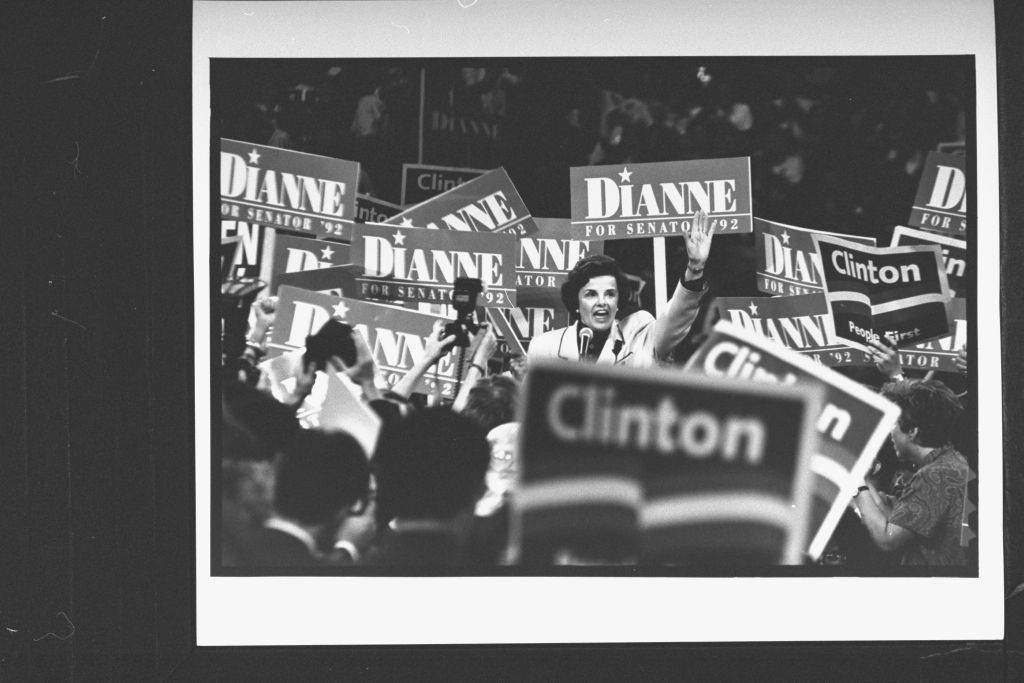
These victories were more than symbolic. In a January 1995 report for Ms., journalists Teresa Riordan and Sue Kirchhoff found that the 103rd Congress in which the new cohort of women served passed 66 feminist bills—doubling the number of such policies passed by the 102nd and nearly tripling that of the 101st. Studies continue to affirm that women lawmakers are more likely to deliver for underrepresented communities and prioritize women’s issues.
During Senate orientation for the 103rd Congress, Barbara Mikulski, who was elected in 1986, invited the new women of the chamber to her office.
“The media wanted to know: Was I giving them a tea?” Mikulski told Ms. “I said, ‘No. I’m having an empowerment workshop.’”
Women in both chambers took empowerment seriously, advancing landmark victories for women’s rights. They championed the Family Medical Leave Act (FMLA), which had been vetoed twice by President George H.W. Bush; the Freedom of Access to Clinic Entrances (FACE) Act, which directly confronted growing instances of antiabortion violence; and the Violence Against Women Act (VAWA), which was the first federal law to address gender-based violence.
They also successfully narrowed the Hyde Amendment’s ban on Medicaid funding for abortions and expanded funding for breast cancer research, women’s health services and resources for survivors of gender-based violence. Clinton additionally ended the global gag rule.
Clinton signed each breakthrough bill into law and additionally used his own power to end the global gag rule. (In 1992, the Supreme Court had also upheld Roe in its decision in Planned Parenthood v. Casey.) He also made history by appointing 13 women over his two terms to Cabinet positions, including Madeleine Albright, the first female secretary of state, and Janet Reno, the first female attorney general. Clinton additionally appointed Ruth Bader Ginsburg, a women’s rights champion, to the Supreme Court.
Clinton’s economic policies, however, were far less feminist.
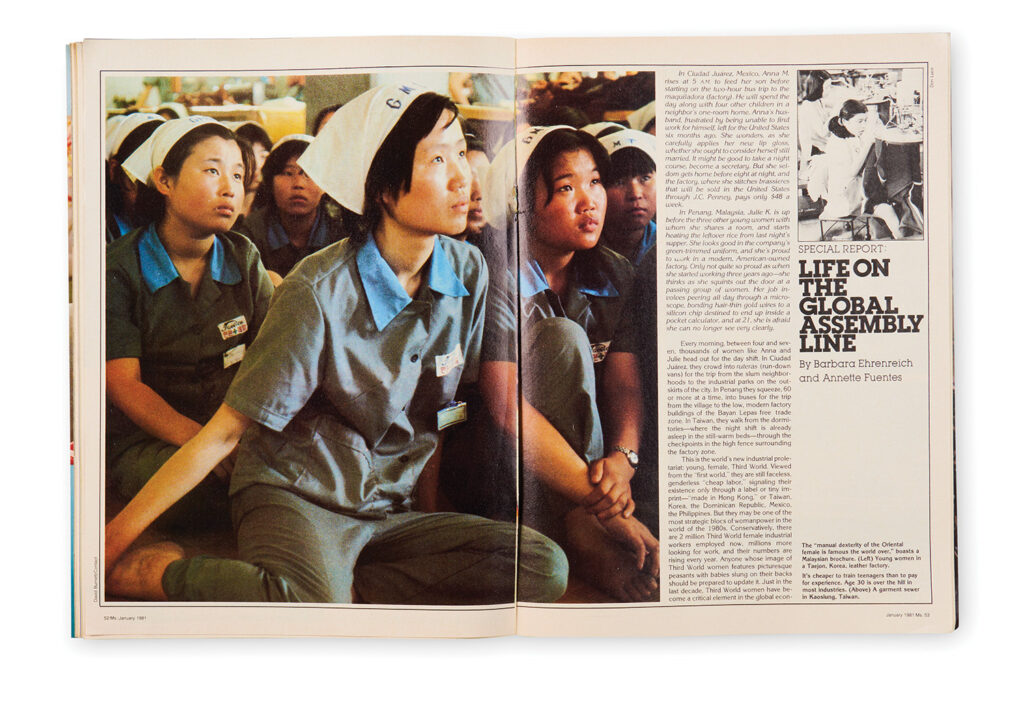
In January 1981, Babrara Ehrenreich and Annette Fuentes declared in Ms. that the “the world’s new industrial proletariat” was “young, female, Third World”—and exposed the hazardous, exploitative conditions women faced in assembly jobs overseas funded by U.S. investments.
In the January/February 1996 of Ms., Helen Zia continued to thread the needle in an exposé into the sweatshop conditions faced by garment workers in the U.S., thanks in large part to Clinton’s approval of the North American Free Trade Agreement (NAFTA), which extended Reagan’s economic vision, and a renegotiated General Agreement on Tariffs and Trade. Clinton’s welfare policies also stripped critical poor women of critical support.
And despite the FACE Act, antiabortion violence escalated in the 1990s. Extremists murdered a series of doctors, clinic escorts, and clinic staff throughout the decade; others still survived arsons, bombings, shootings, stabbings, acid attacks, and assaults.
In 1996, Clinton also signed into law the Defense of Marriage Act, which gave states the power to refuse marriage licenses to gay couples and banned recognition of same-sex unions federally. “DOMA’s impact, invisible to most people, was profound in my world,” Sarah Boonin, who married her wife in 2007, recalled in the Summer 2013 issue of Ms. “DOMA made more than 1,000 federal laws referencing marriage inapplicable to us.”
The ’90s also saw the emergence of a far-right media ecosystem that would evolve, largely unchecked, into today’s manosphere. Rush Limbaugh and Howard Stern rose to prominence and mainstreamed hateful, offensive, and regressive beliefs about race, gender and politics.
“The overwhelming response to right-wing excesses in the United States has been to seek an odd sort of comfort in the fact that the First Amendment is working so well that you can’t suppress this sort of thing,” Patricia J. Williams wrote in a prescient piece for the March/April 1994 issue of Ms. “[But] we must begin to think just a little bit about the fiercely coalescing power of media to spark mistrust, to fan it into forest fires of fear and revenge. We must begin to think about the levels of national and social complacence in the face of such resolute ignorance. We must ask ourselves what the expected result is, not of censorship or suppression, but of so much encouragement, so much support, so much investment in the fashionability of hate. What future is it that we are designing with the devotion of such tremendous resources to the disgraceful propaganda of bigotry?”
But in the ’90s, feminism remained more powerful than any shock-jock or right-wing policy: A 1995 Louis Harris poll found that 71 percent of women and 61 percent of men identified as feminists.
“Does this surprise you?” Steinem asked readers in the September/October 1996 issue of Ms. “If so, that’s how effective right-wingers have been in making us believe that they are central and we are marginal. In fact, according to a 1995 Roper Starch Worldwide poll, 78 percent of women and 71 percent of men said that they approve of the feminist movement, but only that hard core of about one third, according to the Harris poll, approve of the antiabortion movement, Newt Gingrich or Rush Limbaugh.”
In the next decade, the challenge to feminists would be raising the volume just as quickly as the right raised the stakes.
The lesson of the 1990s is that political power matters. Feminists did not simply change the conversation—they changed who held office, who made decisions and which issues received national attention. The gains of the decade demonstrated that when women organize politically and exercise their collective power, they can reshape institutions, pass transformative legislation and redefine what is possible in American democracy.