Keeping Score: Trump’s Dangerous Claims About Tylenol; Government Shutdown Begins; Diddy’s Four-Year Sentence

In every issue of Ms., we track research on our progress in the fight for equality, catalogue can’t-miss quotes from feminist voices and keep tabs on the feminist movement’s many milestones. We’re Keeping Score online, too—in this biweekly roundup.

This week:
—Doctors push back against Trump’s dangerous claims that Tylenol in pregnancy increases the risk of autism.
—The U.S. entered a government shutdown, affecting millions of federal workers.
—Sean “Diddy” Combs was sentenced to four years in prison.
—Zoologist and anthropologist Jane Goodall died at age 91.
—University of California students and faculty are suing the Trump administration for violating free speech rights.
—Student activists are stepping up to get around birth control bans on campus.
—Louisiana admits non-citizens voting is not a systemic problem.
—The ACLU and religious freedom organizations are suing to block 14 more Texas school districts from implementing a law requiring classrooms to display Ten Commandments posters.

… and more.

Grief, Power and the Ongoing Fight for Women’s Rights

From daily violence to decisions over their bodies, women’s suffering is ignored and their losses go largely ungrieved—a reflection of a culture that shapes which rights are protected and whose lives are mourned.

The newly released Beijing report warns that progress is not guaranteed, and regression is already underway. This anniversary must be more than a commemoration; it must be a recommitment. As Hillary Clinton cautions: “This is an all-hands-on-deck moment for women across the world who have benefited from the changes in the laws, regulations, and norms over the last 30 years to realize that there are strong forces at work to try and turn the clocks back.”

The clock will not be turned back—not if we raise our voices, grieve loudly for women and refuse silence.

The War on Women Report: New Texas Law Targets Abortion Pills; More Planned Parenthoods Close Amid Federal Funding Cuts

MAGA Republicans are back in the White House, and Project 2025 is their guide—the right-wing plan to turn back the clock on women’s rights, remove abortion access, and force women into roles as wives and mothers in the “ideal, natural family structure.” We know an empowered female electorate is essential to democracy. That’s why day after day, we stay vigilant in our goals to dismantle patriarchy at every turn. We are watching, and we refuse to go back. This is the War on Women Report.

Since our last report:
—A judge in Missouri is currently deciding whether a proposed amendment that would ban abortion in the state’s constitution can appear on the 2026 ballot … even though Missourians voted just last fall to keep abortion legal in the state.
—The Trump administration announced in August that it would remove gender-affirming care from the health services offered to federal workers.
—Mississippi declared a public health emergency as the state’s infant mortality rate soars to a rate nearly double the national average.

… and more.

The Return of the Tradwife Gospel

When Erika Kirk took the stage at her husband’s memorial, dressed in white and preaching about virtue, guardianship and motherhood as women’s highest calling, it was not just a moment of personal grief. It was also a sermon drawn directly from the playbook of the 19th-century Cult of Domesticity, which elevated piety, purity, domesticity and submission as the cornerstones of “true womanhood.” While Kirk framed these ideals as a source of women’s strength, history shows that they have long functioned as tools of confinement and control.

The irony, of course, is that Kirk is now CEO of Turning Point USA—a position she could never hold without the very feminist progress she disavows. Tradwife rhetoric may promise dignity and purpose, but as the Cult of Domesticity and later social purity movements revealed, these ideals have always come at women’s expense. They strip away autonomy, enshrine patriarchal power and ultimately sacrifice women—even those who embrace the gospel themselves.

Strong Women, Loud Backlash. We’re Ready.

Those who raise their voices—whether for equality, democracy or reproductive freedom—are facing escalating threats. Online harassment spills into real-world violence, antiabortion attacks continue, and even professors, journalists and entertainers are being punished for speaking too boldly. Powerful institutions and individuals are working to chill movements for justice.

But history reminds us that these attacks are not signs of our weakness—they are signs of our progress. The louder the backlash, the clearer it is that our words and actions are reshaping the world.

Beneath every battle lies a deeper truth: Without explicit constitutional equality, no right we’ve won is truly safe—not reproductive freedom, not equal pay, not protection from violence. That’s why so many continue to press for recognition of the Equal Rights Amendment as the 28th Amendment to the Constitution. With 38 states already ratified and constitutional scholars confirming the legal foundation is there, what remains is political will—and in this moment, the outcome may be decided in the very districts and states where women’s votes will soon be cast.

Vile Reactions to Strong Women Can’t Silence Our Voices

Being on the receiving end of yet another violent and targeted email from a stranger hit a little differently this week, as the nation grapples with the murder of Charlie Kirk and its fallout.

Mostly what I’m feeling since receiving an email from Robert G. Smith—who signs off as “Bonecrusher Bob”—is a deep sense of obligation to the girls and women in my life. In his message, he attacked me with grotesque language, mocking my intelligence, my sexuality and my writing on menopause, telling me to “stick to brainwashing the little insurrectionist bastards who attend [my] shithouse skool.”

Much of my work is about developing leaders—running a law school center and fellowship program, mentoring high school and college students to become public writers, and helping grassroots leaders use the op-ed as a tool for advocacy. My own writing shines a light on women’s health issues that have long been ignored, like menopause, highlighting not just problems but solutions lawmakers can get behind.

The Bonecrusher Bobs of the world will not deter me, and I see the same resilience in those around me.

Just this past weekend, a teenager I mentor asked how to handle an op-ed she’d drafted about aggressive masculinity at her school; my answer was simple: We keep raising our voices with conviction, exposing lies, and showing up fully as ourselves. And when necessary, yes, we share screenshots.

Whose Violence Is Taken Seriously Is Political

Weeks of shocking political violence has made one thing painfully clear: Whose suffering is taken seriously is deeply political. From the assassination of Charlie Kirk, to attacks on Democratic elected officials like Minnesota’s Melissa Hortman and her husband, the public and media response reveals a stark double standard.

While some deaths are weaponized to fuel extremism, others—like domestic violence victims, immigrants and marginalized communities—are routinely ignored.

This selective attention reflects the gendered and ideological framing of violence in the U.S. Today, more than ever, it’s crucial to recognize how political rhetoric and societal blind spots shape which acts of violence are acknowledged—and which are dismissed, leaving vulnerable populations at heightened risk.

The Kirk Assassination Exposes Media’s Reluctance to Confront Violent Masculinity

The assassination of Charlie Kirk is a major sociocultural event and media spectacle that has generated a tremendous amount of media commentary and social media discourse. 

Unfortunately, much of the analysis suffers from the same blind spot that typically characterizes media narratives about violence: It is de-gendered.

Imagine if women committed the overwhelming majority of political violence, and over 98 percent of mass shootings. Would anyone commenting about the latest violent incident talk about the “shooter,” and fail to mention it’s a woman, and seek to explore the ways in which cultural ideas about femininity might factor in?

Dying to Be Men: American Masculinity as Death Cult

Much as owing guns at home is most likely to injure or kill the people living with those guns than the supposed threats posed by home invaders, the violent discourse espoused by Charlie Kirk and many others has resulted in his murder in front of a crowd of thousands of students.

Kirk built his career on racism and misogyny, encouraging young Americans to the side of a fully radicalized and extremist Republican party that has abandoned any pretense of caring for Americans and instead has become a propaganda machine pathetically flaying to prove that they are all men.

I’m sorry for Charlie Kirk and all the other men like him that have been raised in this America and with these ideals of masculinity. I’m sorry that he decided to adopt this hateful ideology and to profit from it. And as the mother to a boy and a girl, my heart breaks for the America these children are growing up in. Here’s hoping we can save ourselves.

Why Anti-Trans Hate Makes a Toxic Environment for Women Athletes

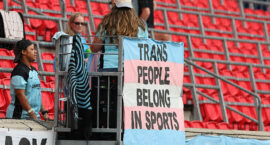
Laws, rules or regulations ban trans athletes from competing in sports consistent with their gender identity in 29 states, with 21 beginning the ban in kindergarten. The majority-conservative Supreme Court announced last month it’ll be taking on the question of the constitutionality of the bans. Meanwhile, the federal government is pressuring states without bans to change their policies in compliance with a Trump executive order that attempts to institute a nationwide ban.

These bans have been successful in part because of a toxic and ruthless ecosystem of far-right influencers, like Riley Gaines, who have formed entire careers around attacking trans athletes by prioritizing hate and misinformation.

“It can be really difficult when [trans athletes] feel like they’re doing everything right … and they still don’t belong.”