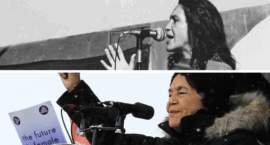


In Her Own Words: Dolores Huerta on Surviving Abuse, Speaking Out at 96 and Honoring the Movement Beyond One Man

In the wake of newly reported sexual abuse allegations against labor leader César Chávez, our hearts are with our long-time Ms. advisor, Feminist Majority Foundation (publisher of Ms.) board member, friend, and feminist and labor icon Dolores Huerta. The fact that she felt she had to bear this in silence speaks to the layers of harm that women who suffer sexual assault must bear.

In the wake of going public for the first time, Huerta writes, “I have never identified myself as a victim, but I now understand that I am a survivor—of violence, of sexual abuse, of domineering men who saw me, and other women, as property, or things to control.”

“The knowledge that he hurt young girls sickens me. My heart aches for everyone who suffered alone and in silence for years. There are no words strong enough to condemn those deplorable actions that he did. César’s actions do not reflect the values of our community and our movement.”


The Ms. Q&A With Democracy Defenders Norm Eisen, Skye Perryman and Jennifer Rubin

In the middle of an accelerating democratic crisis, and a year defined by sweeping attacks on women’s rights, the Feminist Majority Foundation, publisher of Ms. magazine, gathered in Los Angeles to honor some of the most formidable leaders on the front lines of resistance. At the Nov. 18 Global Women’s Rights Awards, journalists, lawyers, artists, organizers, litigators, community activists and movement strategists came together to celebrate what I call the “essential trifecta” for defeating authoritarianism: the law, the press and culture.

We recognized The Contrarian’s Jennifer Rubin and Norm Eisen for building an independent media platform willing to call out authoritarianism plainly; Democracy Forward president and CEO Skye Perryman for her organization’s record-breaking wave of legal challenges against the Trump administration; and the creative team behind the Broadway hit Liberation—playwright Bess Wohl, director Whitney White, and former Ms. writer and editor Lisa Cronin Wohl—for reminding audiences that storytelling is itself a democratic act.

“The number one tool that autocratic actors use to try to consolidate power and take away power from the people, is to convince people that they have no power,” said Perryman. “Their toolbox is one of isolation. They want you to feel alone.”

“I grew up miles from here, family hamburger stand,” said Eisen, “and now to be here, to have this opportunity with my colleagues to fight for this democracy that took my country, and my parents. … When my mother was living, she loved to say the Nazis took us out of Czechoslovakia on cattle cars, and my son flew back on Air Force One. So, how can I not be hopeful?”

The Resistance Is Everywhere

These past 10 months have been tough. Every day a fresh outrage, more trampling of the Constitution and a new attack on common decency. Taking a page from Hollywood, Trump and his administration seem to have embraced a strategy of “everything, everywhere all at once.” 

But, unfortunately for them: The resistance has also been everywhere all at once, too.

There is no doubt that when historians look back on this sordid moment in history, they will conclude that it was women, and feminists, who led the way out of it.

Feminists vs. Authoritarians: Honoring Leaders Holding the Line

Greetings from Los Angeles—on the heels of a very special evening to celebrate the heart and soul of the democracy movement. On Tuesday night, Ms. paid tribute at the Global Women’s Rights Awards to bold leaders operating at the intersection of media, the law and storytelling—recognizing these as the essential trifecta for toppling authoritarianism. And, importantly, for fueling a feminist future.

‘Care Is Baked Into a Healthy, Functioning Economy’: Economists Lenore Palladino and Rakeen Mabud on How to Advance Economic Justice

The experts and Ms. contributors assessed the state of the U.S. care crisis and women’s economic inequality in the latest episode of the Ms. podcast Looking Back, Moving Forward—and broke down why investing in women and care workers is good policy. 

Rakeen Mabud: “We’re at a really pivotal moment and a really complicated moment. We have conservative, pronatalist voices, with more institutional power than they have ever had, at least in modern times. They are advancing an agenda of deep progressive patriarchy, whiteness—and wealth, frankly, is the third prong of that. And they are co-opting progressive policy ideas to do it.”

Lenore Palladino: “There are schools, and there are childcare centers, and there are hospitals being shut down right now. Investing in those would be a really important way to move this whole conversation forward. … Within economic policy, there’s such bifurcation. There’s tax policy over here. There’s care over here. It’s still a women’s issue.”

“Economics is still seen as a man’s game. Women actually make most financial decisions in households, but men are the ones who are seen as the experts, and our financial system is shaped around their life cycles.”

Listen to the latest episode of Looking Back, Moving Forward, “Women Can’t Afford to Wait for a Feminist Economic Future (with Premilla Nadasen, Rakeen Mabud and Lenore Palladino, Aisha Nyandoro, Gaylynn Burroughs, and Dolores Huerta)” on Spotify, Apple Podcasts or wherever you get your podcasts.

‘In Whose Interests Are We Fighting?’ What Historian Premilla Nadasen Learned About Economic Justice from the Domestic Workers’ Rights Movement

Nadasen, who teaches history at Barnard College, offered lessons from the domestic workers’ movement for the current moment in the latest episode of Looking Back, Moving Forward. “We, as feminists today, like domestic workers in the 1970s and in the early 2000s,” she told me, “need to think outside the box.”

Listen to the latest episode of Looking Back, Moving Forward, “Women Can’t Afford to Wait for a Feminist Economic Future (with Premilla Nadasen, Rakeen Mabud and Lenore Palladino, Aisha Nyandoro, Gaylynn Burroughs, and Dolores Huerta)” on Spotify, Apple Podcasts or wherever you get your podcasts.

‘If You’re Not Centering the People Who Are Most Impacted, Your Policy Solution Will Fall Apart’: Gaylynn Burroughs Is Fighting for Economic Justice at the Intersections

Burroughs, the vice president of education and workplace justice at the National Women’s Law Center, connected the dots between poverty, policy and culture change in the latest episode of the Ms. Studios podcast Looking Back, Moving Forward. “Once you start seeing these problems as being problems that policy can solve,” she told me, “a whole world opens up.”

Listen to the latest episode of Looking Back, Moving Forward, “Women Can’t Afford to Wait for a Feminist Economic Future (with Premilla Nadasen, Rakeen Mabud and Lenore Palladino, Aisha Nyandoro, Gaylynn Burroughs, and Dolores Huerta)” on Spotify, Apple Podcasts or wherever you get your podcasts.

‘Poverty Is a Systemic Failing, Not an Individual Failing’: Aisha Nyandoro Is Seeding a Movement to Liberate Financial Capital and Support Black Moms’ Economic Freedom

The founding CEO of Springboard to Opportunities, home to the Magnolia Mother’s Trust guaranteed income program, called out how our economy has left the women she serves behind in the latest episode of Looking Back, Moving Forward—and how our narratives around poverty and deservedness shape what’s possible in the fight for economic justice.

“What would it look like if we gave Black mamas living in affordable housing the financial resources that they needed to be the author of their own lives—trusting that they know better than anyone else what it is that they need for themselves and their families to be successful?”

Listen to the latest episode of Looking Back, Moving Forward, “Women Can’t Afford to Wait for a Feminist Economic Future (with Premilla Nadasen, Rakeen Mabud and Lenore Palladino, Aisha Nyandoro, Gaylynn Burroughs, and Dolores Huerta)” on Spotify, Apple Podcasts or wherever you get your podcasts.

Why Dolores Huerta Is Hopeful About the Fight for a Feminist Future: ‘We’re Going to Be Able to Overcome’

Dolores Huerta has spent 70 years at the frontlines of the intertwined fights for economic justice and women’s rights. Huerta has pioneered campaigns to expand political representation for women and people of color; advance policies that improve the lives of women, LGBTQ+ folks, farmworkers, communities of color, and the poor; and spark dialogue around the intersectional fight for economic justice, and the ways it is intertwined with our democracy.

“This is a very, very scary time—and god knows it’s a time for women to rise up!” Huerta told Ms.

Listen to the latest episode of Looking Back, Moving Forward, “Women Can’t Afford to Wait for a Feminist Economic Future (with Premilla Nadasen, Rakeen Mabud and Lenore Palladino, Aisha Nyandoro, Gaylynn Burroughs, and Dolores Huerta)” on Spotify, Apple Podcasts or wherever you get your podcasts.

Poverty Is a Policy Choice—and Women Deserve More 

In the third episode of the Ms. Studios podcast Looking Back, Moving Forward, economists and advocates break down how our economy is leaving women behind and lay out strategies for advancing a feminist economic future.

“Poverty is the result of systems that have been intentionally put in place that the majority of us benefit from,” said Aisha Nyandoro, founding CEO of Springboard to Opportunities, home to the Magnolia Mother’s Trust guaranteed income program.

“So much of the conversation among economists and among policy people about infrastructure has always been about male-dominated infrastructure,” Lenore Palladino said. “We cannot rebuild our economy or build back better, as it were, with male-dominated sectors and not female-dominated sectors.”

“We have to continually ask: In whose interests are we fighting? Who will benefit from the work that I’m doing right now? Who should we put at the center of our organizing campaigns?” said Premilla Nadasen, labor and women’s historian.

The newest Ms. podcast, Looking Back, Moving Forward is out now on Spotify, Apple Podcasts or wherever you get your podcasts.