Calling Foul: Breaking Down WNBA Pay and Why It Matters

There’s a long history of women in sport fighting for equal pay, and what’s happening with the WNBA today is less of a mirror of the current gender pay gap and more of a throwback to a time when women’s efforts were even more deeply devalued. The WNBA is a visible legacy of Title IX, and an indication of how far there is left to go. 

These are women at a pinnacle of professional achievement, who are still beholden to structural barriers. This is not a sports issue. It is a feminist issue.

Playing Games With Hunger

Gail Todd lives with her husband and three daughters in the southeastern section of Washington, D.C., and works at a Walmart in suburban Maryland. Her husband is a shift manager at a fast-food restaurant. Food stamps—the common name for the vouchers or debit cards supplied by the Supplemental Nutrition Assistance Program, or SNAP—helped Todd when she struggled financially after her first daughter was born. She had to turn to them again four years ago because her job, combined with her husband’s wages, doesn’t pay enough to feed her family.

Before Walmart, Todd, pregnant now with her fourth child, worked for $8.35 an hour at McDonald’s. Walmart’s $10 hourly wage was better. In the beginning she worked roughly 40 hours a week, but since May her weekly hours have been reduced to between 16 and 28, earning her no more than $900 a month. The loss in income coincided with a cut to the family’s monthly food-stamps benefit from $339 down to $239—the lowest she’s ever received—because a temporary boost to the program in the stimulus bill was allowed to expire Nov. 1, 2013.

“The food stamps, they help, but it’s not enough because I can’t feed my family,” she says.

[From the Spring 2014 issue of Ms.]

‘It’s Not Charity, It’s Community’: Why SNAP Benefits Are Helpful for Everyone

As federal SNAP funding stalls amid the shutdown, families, advocates and food banks are stepping up to keep people fed—but they can’t fill all the gaps.

“When we support programs like SNAP—we’re not just feeding families, we’re strengthening the entire community—every child who goes to bed with a full stomach, every parent who can focus on work instead of hunger, every landlord who can count on rent being paid—all of that adds up to a healthier, more resilient community,” said Semone Thomas, a Wisconsin SNAP advocate. “Because in the end, food security is not charity, it’s community.”

Immigrant and First-Generation Women Are Changing What Leadership Looks Like in America

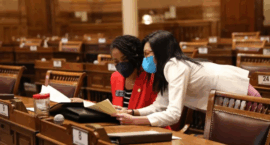
Running for office in the United States has never been an even playing field. Women face steep hurdles including misogyny, difficulties raising money and building political networks, and shouldering the demands of family and work. On top of that, immigrant women often face increased barriers, contending with racism, xenophobia and constant doubts about whether they “fit the image” of a politician.

Men are usually assumed to be qualified. Women have to prove it—over and over again.

At New American Leaders, we prepare women to anticipate these double standards and to campaign with confidence and authenticity. NAL is women-led and stands as the only nonprofit, nonpartisan organization in the United States that trains and supports immigrants, children of immigrants and refugees for civic leadership or running for office.

(This essay is part of a collection presented by Ms. and the Groundswell Fund highlighting the work of Groundswell partners advancing inclusive democracy.)

‘I Don’t Want to Live in Low-Income Housing Forever’: How Guaranteed Income Is Helping One Mom Dream Bigger

Front & Center amplifies the voices of Black women navigating poverty—highlighting their struggles, resilience and dreams as they care for their families, build careers and challenge systems not built for their success. Now in its fourth year, Front & Center is a collaboration between Ms. and Springboard to Opportunities, a nonprofit based in Jackson, Miss., working alongside residents of federally subsidized housing as they pursue their goals.

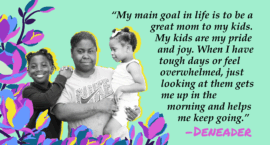
Deneader is a 37-year-old mother of three. She’s a participant in the Magnolia Mother’s Trust, receiving one year of guaranteed income as she searches for stable work and builds a better future for her family.

“I think a lot about going back to school, but my youngest needs me. Tamara is still little and having her at home takes up most of my focus.”

“I also want to get back on my feet fully and become a better person. I know the first step will be finding the right job—something stable, something that allows me to take care of my family. I don’t want to live in low-income housing forever. I know some people do it, but I want more for us.”

Escaping Abuse Isn’t Easy. Here’s What Survivors and Experts Want You to Know.

On Oct. 3, Sean “Diddy” Combs was sentenced to 50 months in federal prison, five years of supervised release and a $500,000 fine. Throughout, the question echoed: “Why didn’t she just leave?” 

“That’s the wrong question,” said Tonya King, vice president of programs at the National Network to End Domestic Violence. “We need to start asking: How can we keep a survivor safe in the first place?”

The Trump Administration Is Paying Children $2,500 to Give Up Their Rights

The Trump administration’s latest immigration scheme offers unaccompanied children $2,500 to “voluntarily” give up their legal rights and return to the very countries they fled. Officials are calling it a resettlement stipend, but in reality, it’s a disingenuous and dangerous form of coercion. Children in federal custody—many without attorneys—are being asked to make life-altering decisions under duress, with money dangled as an incentive to abandon their claims. Far from empowering them with choice, this program undermines the legal protections Congress established to keep children safe.

It’s one more example of the administration’s incremental intimidation of children—this time, with a price tag attached.

What Does a Federal Government Shutdown Mean for Women’s Healthcare? A Stealthy Rollback of Coverage

If cuts to premium tax credits and Medicaid stick, this won’t just be another budget fight. It will be a quiet repeal of the Affordable Care Act (ACA)—and women will bear the brunt of it.

Sen. Chuck Schumer and Rep. Hakeem Jeffries have put forward a reasonable path: Roll back the Medicaid cuts and make premium tax credits permanent. States are bracing for the Medicaid cuts, warning Washington that slashing the program would destabilize families and hospitals in their states. Extending these tax credits has bipartisan support. By any definition of negotiation, the offer has something for both sides.

Yet President Trump has dug in, canceling meetings, while the House has left town. With Republicans in control of all three branches of government, the responsibility for protecting women and families rests squarely with them.

This isn’t about “other people.” It’s about all of us.

New Mexico Will Be the First State to Make Childcare Free

In an unprecedented move, New Mexico is making childcare free. 

Beginning in November, it will be the first state in the nation to provide childcare to all residents regardless of income, Gov. Michelle Lujan Grisham announced this week. The state has been working to lower child care care costs since 2019, when it created the Early Childhood Education and Care Department and started to expand eligibility for universal childcare.

The initiative is expected to save families $12,000 per child annually. 

“Childcare is essential to family stability, workforce participation and New Mexico’s future prosperity,” Lujan Grisham said in her announcement. “By investing in universal childcare, we are giving families financial relief, supporting our economy, and ensuring that every child has the opportunity to grow and thrive.”