Congress holds food stamps hostage while the working poor suffer.
To honor five-plus decades of feminist reporting, rebelling and truth-telling, From the Vault features some of our favorite classics from the pages of Ms. The complete Ms. Magazine Archive—every issue since 1972—is now available digitally on ProQuest: free to students, educators and activists via their libraries. Ask your local or campus librarian about subscriptions or free trial access. (More info here.) For an essential collection you can hold in your hands, don’t miss 50 YEARS OF Ms.: THE BEST OF THE PATHFINDING MAGAZINE THAT IGNITED A REVOLUTION (Alfred A. Knopf)—a stunning anthology of the most audacious, norm-breaking stories Ms. has published.
From the Spring 2014 issue of Ms.
Playing Games With Hunger (Spring 2014)
Gail Todd lives with her husband and three daughters in the southeastern section of Washington, D.C., and works at a Walmart in suburban Maryland. Her husband is a shift manager at a fast-food restaurant. Food stamps—the common name for the vouchers or debit cards supplied by the Supplemental Nutrition Assistance Program, or SNAP—helped Todd when she struggled financially after her first daughter was born. She had to turn to them again four years ago because her job, combined with her husband’s wages, doesn’t pay enough to feed her family.
Before Walmart, Todd, pregnant now with her fourth child, worked for $8.35 an hour at McDonald’s. Walmart’s $10 hourly wage was better. In the beginning she worked roughly 40 hours a week, but since May her weekly hours have been reduced to between 16 and 28, earning her no more than $900 a month. The loss in income coincided with a cut to the family’s monthly food-stamps benefit from $339 down to $239, the lowest she’s ever received, because a temporary boost to the program in the stimulus bill was allowed to expire Nov. 1.
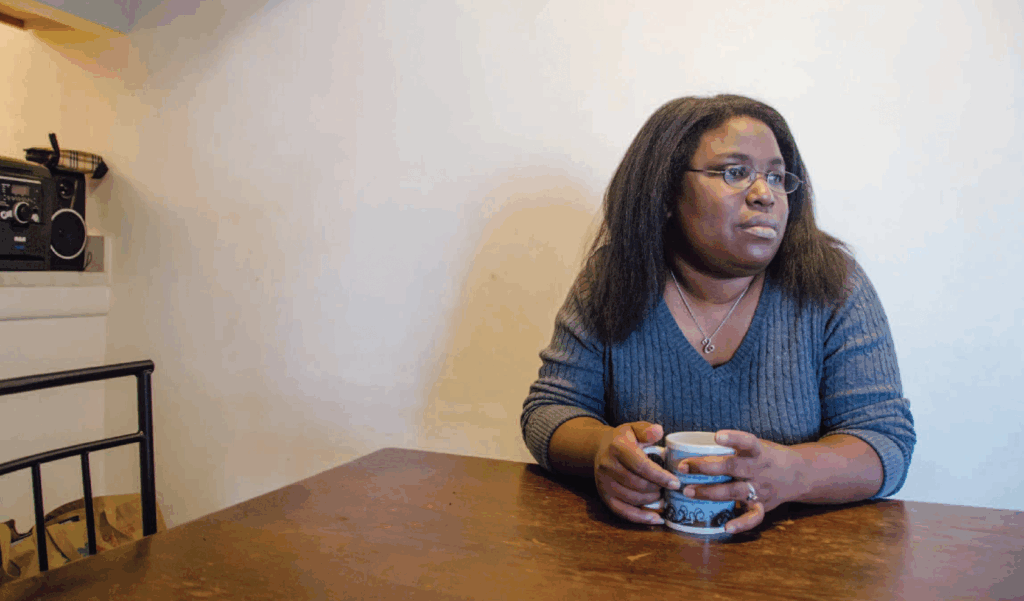
“The food stamps, they help, but it’s not enough because I can’t feed my family,” she says.
Todd likes to make a big beef roast on the first Sunday she gets the benefits, and tries to stretch leftovers till Tuesday. To do so, she and her husband will share a plate so the kids can have more.
“We can survive; they can’t,” Todd says. “I’d rather see them eat and I’ll be OK. But with me being pregnant it’s a little hard: I have to eat.”
Before the benefits cut, she would make homemade lasagna, but she can’t afford the ingredients anymore. She tries to catch sales of Chef Boyardee and peanut butter and jelly, and goes to food pantries for canned goods. She wishes she could buy healthier snacks for her kids.
“I can’t buy fresh fruit,” says Todd. “I try to pick some up when I can, but I can’t every month.”
Todd and her family certainly aren’t alone. The number of people receiving food stamps swelled during the Great Recession from about 20 million to 47 million last year and has remained high during the sluggish recovery.
More people have remained unemployed for long periods of time. The U.S. Congress Joint Economic Committee found that more than one in five workers who had been unemployed for longer than six months turned to food stamps, because the longer workers stay unemployed the more likely they are to exhaust their savings and other resources.
According to the U.S. Department of Agriculture, 15.9 million children in the United States go to bed hungry every night. About 14.5 percent of American households are food insecure, which means they struggle to come up with enough food to feed their families every month.
On average, households have used 75 percent of their food stamp benefits by the end of the second week of the month, according to the government’s data. Those who run out completely turn to charity: Six million households sought emergency food assistance from a food pantry or a soup kitchen in 2012.
… SNAP is one of the federal government’s most efficiently run programs.
Being such a wealthy and “exceptional” nation, you’d think the U.S. government would want to increase support for these hungry Americans. Think again.
When the food-stamp boost was not renewed, families of four lost an average of $36 a week in benefits (the average monthly benefit for a family that in 2013 was only $668 to begin with). Now some in Congress want to cut more.
In June 2013, the Senate passed a farm bill—which reauthorizes food-stamp spending every five years—that would cut SNAP by $4 billion. In September, the House passed a bill that would cut food stamps by $40 billion. The House and Senate spent the autumn months and most of January fighting over the final figure; eventually they settled at cuts of $8 billion over the next 10 years.
That means hardworking families like Todd’s have to work even harder to try to make ends meet.
Because female-headed households are more likely to be poor, single mothers with kids are more likely to qualify and apply for food stamps. (About 35 percent of households headed by a single mother are food insecure.) Most food-stamp recipients are white, but because African Americans and Latinos are more likely to be poor, they’re overrepresented on the food-stamp rolls. About 7 percent of rural residents receive food stamps and 4 percent of city dwellers. More than two-thirds of food-stamp recipients are children, senior citizens or disabled adults.
But of those adults on food stamps who are able to work, 96 percent have continued to hold a job after they received aid. They’re not lazy freeloaders, as many in Congress would have their constituents believe. They’re either temporarily unemployed or working at low-wage retailers such as Walmart or at fast-food restaurants. Most of these workers are women who just can’t earn enough to feed their families.
“We talk a lot about the working poor,” says Mariana Chilton, Ph.D., an associate professor of public health at Drexel University in Philadelphia and director of the Center for Hunger-Free Communities. “The working hungry—that’s what people should be paying attention to.”
Many women rotate in and out of the SNAP system because they have periods when they make more money than the SNAP system allows, then lose their jobs or see their hours cut and have to turn back to it. Sometimes through system failures, they are mistakenly kicked off of the program and spend weeks trying to get their benefits reinstated. In the meantime, their children skip meals. For Chilton, it’s a public-health crisis.
“Nutrition is one of the fundamental building blocks for having a healthy life and healthy population,” she says. “In a young child under the age of 3 the brain is growing so fast—it’s developing 700 neurons a second,” she says. “Without food, the child is not as inclined to interact with the world, and the body’s systems shut down. Less neurons will grow.”
Since 2008, the Center for Hunger-Free Communities has helped those who received food assistance to become advocates for government nutrition programs. The Witnesses to Hunger, as they’re called, travel regularly to Washington, D.C., to lobby in support of SNAP.
But they’re up against conservatives who have spent the past two years decrying “waste, fraud and abuse” in the food-stamp program.
The annual budget for food stamps is now $80 billion, in part because of the recession. House Budget Committee chair Paul Ryan (R-Wis.) calls the growth of the program “relentless and unsustainable.”
Like Sen. Marco Rubio (R-Fla.), he wants to turn food stamps and other antipoverty programs into block grants to states, which would reduce the amount of federal subsidies while relaxing the rules that states must follow to distribute the funds fairly and efficiently.
While Rubio and Ryan gave speeches on how states needed “flexibility” in administering programs like food stamps, House and Senate conservatives actually achieved most of the cuts to food stamps by eliminating programs that made it easier for states to get benefits to senior citizens who qualified for winter-heat assistance and to waive work requirements for childless adults in high-unemployment areas. In other words, Republicans are making the programs less flexible for states to administer, not more so.
But are food stamps really a wasteful program? Actually, according to the Center on Budget and Policy Priorities, a nonpartisan think tank based in Washington, D.C., SNAP is one of the federal government’s most efficiently run programs. Families must reapply (typically every 6 to 12 months), providing financial and work data to their caseworkers, and states regularly review a large sample of cases to make sure families are not receiving too much or too little. In 2011, the error rate for overpayments and underpayments reached an all-time low of 3.8 percent.
State governments have also cut down on the amount of food-stamp money that is “trafficked”—when recipients use benefits to buy food and then sell it to others. That form of fraud has gone down 75 percent over the past 15 years; just 1 percent of benefits are now trafficked. States have also cracked down on retailers, and in 2012 recovered more than $57 million from those convicted of food-stamp fraud.
And the growth in food-stamp spending is probably temporary. As the economy improves—or other initiatives to help the working poor are passed by Congress, like raising the federal minimum wage to $10.10 an hour from the current $7.25—then spending on food stamps would go down. That’s because people would make more money and either become ineligible for the program or see their benefits reduced.
Which isn’t the same as saying that the country’s hunger situation is improving. Food-stamp benefits remain low and don’t last families a whole month; plus some families who suffer from food insecurity technically earn too much to receive aid because the threshold for qualifying is so low.
Rep. Rosa DeLauro (D-Conn.) was one of a few outspoken House Democrats to speak out against the $8 billion in cuts to SNAP, but the bill was approved by Congress in January.
The situation of these families is only going to get worse if more cuts go into effect. The Center for Hunger-Free Communities’ 2011 report investigating the cost of a healthy diet in Philadelphia found that the maximum monthly food-stamp benefit for a family of four, after the stimulus boost ended, was almost $300 short of what it would cost to follow the government’s “thrifty” diet plan.
So why do conservatives want to keep cutting?
“I think that fundamentally there’s a very large ideological difference about what the proper role of government is, and those who believe that government has a limited role in this look to private charities and the religious sector [to pick] up the slack,” says Josh Protas, director of government affairs for MAZON—a Jewish faith-based organization that lobbies in support of food stamps in Washington, D.C., and works to raise awareness and advocacy around hunger issues in faith-based communities around the country.
“It’s not only up to the government—the charitable sector and religious groups and others clearly play a role—but our role is dwarfed by the size of federal programs. There’s no way charities could pick up the slack.”
According to Bread for the World, a Christian-based organization that is similar to MAZON, charities spend about $4 billion annually on food aid, an amount dwarfed by the federal government’s total spending on food-assistance programs, which was more than $96 billion in 2011.
Democrats in the House pushed back against most of the cuts, and a few outspoken members—including Reps. Jim McGovern (D-Mass.) and Rosa DeLauro (D-Conn.)—spoke out against them, but there was still a lot of pressure to pass a farm bill because the last one expired in late 2013.
“Millions of Americans depend on [SNAP], and chief among them are children, seniors, veterans and their families,” said House Minority Leader Nancy Pelosi (D-Calif.) in a statement. “It’s very important that we pass a farm bill for our farmers, ranchers, businesses, researchers and rural community and it is also our responsibility to ensure the most vulnerable in our country do not go hungry.”
Other programs that help feed the poor in the U.S.—such as the Women, Infant and Children’s (WIC) and school-lunch programs—are considered expendable every time Congress debates spending. WIC saw its funding reduced by about half a billion during a recent round of budget fights in Washington, and school-lunch funding will likely be up for debate in 2015, during the heat of the 2016 presidential campaign.
There’s no way charities could pick up the slack.
Josh Protas, MAZON
To Jared Bernstein, an economist who worked under Vice President Joe Biden, conservative lawmakers’ attacks on these nutrition programs seem like a diversionary tactic. “It’s like, don’t look at all the ways in which the economy is underperforming and the benefits are flowing right to the top,” he says. “Look at these people getting $4.50 a day for food stamps. It’s an old trick, but unfortunately it continues to be used.”
MAZON, Bread for the World, the Center for Hunger-Free Communities and other advocates want more spending on food stamps, not less. They’re constantly pushing against the stereotypes about who is on food stamps and other assistance programs in the United States—stereotypes that have persisted since the 1970s and 1980s.
“The stereotypes are… that it’s a matter of being lazy, that they are living not just an adequate but a luxurious lifestyle on government benefits,” says Abby Leibman, MAZON’s president and CEO.
MAZON insists that Americans have a basic “freedom from want” and that freedom from hunger is a basic right.
“Food is the most fundamental of all human needs: Hungry children can’t learn; hungry adults can’t work, create, think or be functioning members of their communities,” adds Leibman. “Not only do food-insecure individuals suffer but our entire country suffers. As a society, how we treat those who are most vulnerable among us defines who we are.”
In the meantime, Gail Todd works as many shifts as her manager gives her. She, her husband, her oldest daughter, her mother and her grandmother take turns watching the young kids, since the family can’t afford childcare. Her oldest daughter has a partial college scholarship, but Todd can’t afford the rest of the tuition. It’s a scramble.
“It works out,” she says, “by the skin of the teeth.”