My Paycheck Covers Rent, Lights and Food. Guaranteed Income Helps Me Dream Bigger.

Front & Center amplifies the voices of Black women navigating poverty—highlighting their struggles, resilience and dreams as they care for their families, build careers and challenge systems not built for their success. Now in its fourth year, Front & Center is a collaboration between Ms. and Springboard to Opportunities, a nonprofit based in Jackson, Miss., working alongside residents of federally subsidized housing as they pursue their goals.

In Jackson, Miss., Latisha juggles full-time work, parenting and rising costs—while a guaranteed income program gives her the breathing room to plan for the future.

“Affordable childcare is [a] big barrier. Right now there aren’t even openings for state childcare vouchers, and when there are, the hoops to qualify … keep a lot of working parents from getting help they really need. …

“If I could tell Congress one thing, it would be this: Don’t cut benefits like SNAP or childcare. Make them stronger, because they fill the gap for working families. In jobs like mine—essential jobs serving food and keeping businesses going—the paychecks often aren’t enough to cover the most basic needs of childcare, food and rent. These programs are a safety net when hours get cut or expenses spike.

“These days, I’m finding joy at home. The money from the Trust has allowed me to scale back my hours a little, which means I can rest and be more present with my kids. Having that time and energy back makes a difference in how I show up for them—and for myself.”

‘Poverty Is a Systemic Failing, Not an Individual Failing’: Aisha Nyandoro Is Seeding a Movement to Liberate Financial Capital and Support Black Moms’ Economic Freedom

The founding CEO of Springboard to Opportunities, home to the Magnolia Mother’s Trust guaranteed income program, called out how our economy has left the women she serves behind in the latest episode of Looking Back, Moving Forward—and how our narratives around poverty and deservedness shape what’s possible in the fight for economic justice.

“What would it look like if we gave Black mamas living in affordable housing the financial resources that they needed to be the author of their own lives—trusting that they know better than anyone else what it is that they need for themselves and their families to be successful?”

Listen to the latest episode of Looking Back, Moving Forward, “Women Can’t Afford to Wait for a Feminist Economic Future (with Premilla Nadasen, Rakeen Mabud and Lenore Palladino, Aisha Nyandoro, Gaylynn Burroughs, and Dolores Huerta)” on Spotify, Apple Podcasts or wherever you get your podcasts.

‘Some Months Are Good, Some Aren’t’: A Mississippi Mom on Security, Self-Reliance and Showing Up for Her Kids

Front & Center amplifies the voices of Black women navigating poverty—highlighting their struggles, resilience and dreams as they care for their families, build careers and challenge systems not built for their success. Now in its fourth year, Front & Center is a collaboration between Ms. and Springboard to Opportunities, a nonprofit based in Jackson, Miss., working alongside residents of federally subsidized housing as they pursue their goals.

Adrian is a mother to three boys and the recipient of one year of guaranteed income from the Magnolia Mother’s Trust.

“My income covers the basics, but sometimes unexpected expenses come up, and then things get hard. Some months are good, some aren’t.”

“Having a bit more cash coming in … has helped my mental and emotional health—I feel like I can breathe a little easier.”

‘Baby, We’ve Been Blessed’: A Mississippi Mother on Family, Faith and Fighting for More

Front & Center amplifies the voices of Black women navigating poverty—highlighting their struggles, resilience and dreams as they care for their families, build careers and challenge systems not built for their success. Now in its fourth year, Front & Center is a collaboration between Ms. and Springboard to Opportunities, a nonprofit based in Jackson, Miss., working alongside residents of federally subsidized housing as they pursue their goals.

Linda, a proud mother and grandmother in Jackson, Miss., dreams of delivering new life as a nurse while building a brighter future for her family today.

“Being a mom makes me feel special and proud. There are little people looking up to me, and I can’t really put it into words, but I’m so grateful I was able to bring life into this world. Sometimes they get on my nerves with their ‘Mama! Mama!’ but it still feels good to hear it. … When people ask me about Black motherhood, I just say: We are survivors. We know how to nurture, we’re proud of our kids and we’re strong. I’m proud to be a Black mother.”

‘It’s Always Been Me and the Boys’: How Guaranteed Income Is Helping Black Mothers Build Stronger Families and Futures

Now in its fourth year, Front & Center is a groundbreaking Ms. series amplifying the voices of Black women navigating poverty—highlighting their struggles, resilience and dreams as they care for their families, build careers and challenge systems not built for their success.

“Every Friday, my boys and I have a special ritual. We go get snow cones and head to the snow park. We walk around, talk about our week and do affirmations. We discuss what we can do better, with each other and for ourselves. If I messed up, they let me know, and we talk about it. If I feel like they need to improve, we discuss that, too. …

“I dream of going back to school and finishing my criminal justice degree. I fell short because of hard times. But I’m going back this year! I want to make my kids proud. If I can do it, they can do it, too. It’s not easy, but it’s not hard, either. You just have to push. As long as you have that mindset, you’re going to make it.”

‘More Cash, Less Paperwork’: Mothers on the Frontlines of Poverty Are Telling Their Stories. Are We Listening?

We are living in challenging times. Fundamental rights are under attack, the economy is teetering on the edge of a recession, and our already-insufficient social safety net’s holes grow larger by the day. It is never easy to live in poverty in America, but the past four-plus months have managed to make a bad situation worse.

As I often say, policy only changes at the speed of narrative. And unless we start truly listening to the real stories of families living in poverty—with all their challenges, joys, complications and layers—we won’t be able to change poverty policy in this country.

‘I Just Want My Babies to Be at Peace’: A Mississippi Single Mom on Surviving the System

Front & Center began as first-person accounts of Black mothers in Jackson, Miss., receiving a guaranteed income. Now in its fourth year, the series is expanding to explore broader systemic issues affecting Black women in poverty, including the safety net, healthcare, caregiving and overall well-being.

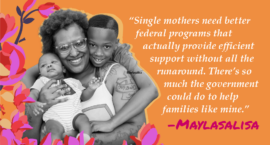
Maylasalisa has a newborn and is juggling school and caretaking while also trying to find work. She is the recipient of one year of guaranteed income from the Magnolia Mother’s Trust.

“Balancing work and motherhood isn’t easy, especially with a newborn. Right now, I have no choice but to stay home … If I could speak directly to the governor or the president, I’d ask for more help for single mothers—better programs that actually provide efficient support without all the runaround. There needs to be real opportunities for people to get and keep jobs, better transportation and more accessible resources. They have the money to do these things, they just don’t want to.”

I’m a Single Mom Raising Three Kids. A Year of Guaranteed Income Gave Us Breathing Room.

Front & Center began as first-person accounts of Black mothers in Jackson, Miss., receiving a guaranteed income. Now in its fourth year, the series is expanding to explore broader systemic issues affecting Black women in poverty, including the safety net, healthcare, caregiving and overall well-being.

“My name is Jasmine, and I’m 33 years old. I’m a mother of three—there’s Nehemiah, my oldest, who is 13. Then there’s my daughter, Harmoni, who is 9, and my youngest, Joshun, is 8 years old. …

“Finding reliable childcare has always been a struggle. There were times when I couldn’t get a job because I couldn’t find childcare or the process of securing a childcare voucher took too long. … My mom isn’t able to help due to being ill, and I don’t hear from my dad much. So, I don’t have a lot of people I can rely on.”

‘It Takes a Village’—But What If You Don’t Have One?

Front & Center began as first-person accounts of Black mothers in Jackson, Miss., receiving a guaranteed income. Now in its fourth year, the series is expanding to explore broader systemic issues affecting Black women in poverty, including the safety net, healthcare, caregiving and overall well-being.

“I’m part of the Magnolia Mother’s Trust this year, so that money will help me offset the lost income of going back to school part time. It was a revelation to be able to cover multiple things in one day that I would’ve had to space out for weeks before. I bought diapers, paid my car note and the light bill. That feeling of being able to take care of things has relieved a lot of stress. Before, it was so hard. I would cry in the shower so my kids wouldn’t hear me.

“I didn’t have paid leave for the first four weeks after DeMarcus was born. … That experience really opened my eyes to how important it is to have better family leave policies in this country. It is not enough to just offer a few weeks of leave. We need to support mothers’ mental health as well. Pregnancy care is focused on prenatal care, but there needs to be more mental health support. I went through postpartum depression myself, and it was so bad that I didn’t want anyone to see my baby. It takes a village to raise a child, but not everyone has that village.”

‘I Felt Like a Human Again’: A Guaranteed Income Program Transformed This Mississippi Mom’s Life

Front & Center began as first-person accounts of Black mothers in Jackson, Miss., receiving a guaranteed income. Now in its fourth year, the series is expanding to explore broader systemic issues affecting Black women in poverty, including the safety net, healthcare, caregiving, and overall well-being.

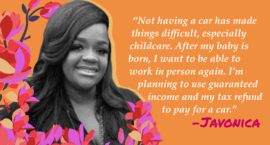
Javonica, a 26-year-old mother in Jackson, Miss., has faced countless obstacles: navigating job instability, unreliable transportation, and a social safety net riddled with barriers. Despite completing technical college, she struggled to pass a certification test, and without a car, accessing childcare and work opportunities became nearly impossible. Now, as she prepares to welcome her third child, a guaranteed income program through the Magnolia Mother’s Trust is providing much-needed financial relief, allowing her to pay bills, care for her children and plan for a more stable future.