

September 2026 Reads for the Rest of Us

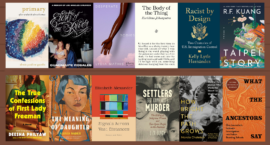
Hello, feminist reader friends! Each month, I provide Ms. readers with a list of new books being published by writers from historically excluded groups. The aims of these lists are threefold:

I want to do my part in the disruption of what has been the acceptable “norm” in the book world for far too long—white, cis, heterosexual, male;

I want to amplify indie publishers and amazing works by writers who are women, Black, Indigenous, Latinx, APIA/AAPI, international, queer, trans, nonbinary, disabled, fat, immigrant, Muslim, neurodivergent, sex-positive or of other historically marginalized identities—you know, the rest of us; and

I want to challenge and encourage you all to buy, borrow and read them! 

This month, it’s back to school and back to heavy book-publishing schedules. I can’t wait for you to check out the 15 other books I’m recommending this month. So get to it.  

Keeping Score: Trump Disapproval Hits a New Low; Continued ICE Violence; AOC on Freezing Her Eggs: ‘Don’t Be Weird About This’

In every issue of Ms., we track research on our progress in the fight for equality, catalogue can’t-miss quotes from feminist voices and keep tabs on the feminist movement’s many milestones. We’re Keeping Score online, too—in this biweekly roundup.

This week:
—Rep. Alexandra Ocasio-Cortez (D-N.Y.) is freezing her eggs and documenting the process on social media to normalize this facet of women’s reproductive healthcare.
—The top brands donating to members of Congress trying to expand ICE’s power include SpaceX, Home Depot, UPS and Walmart. 
—Organizations speak out after Lorenzo Salgado Araujo and Johan Sebastián Durán Guerrero were shot and killed by federal agents, and Jesús Manuel Arenas-Silva died in ICE custody.
—Epstein survivors warn the Senate not to confirm Todd Blanche as Attorney General.
—The Trump administration continues its attacks on immigrants, students, disabled people, gun control and more.
—Pete Hesgeth blocked the promotion of women Navy officers.
—Nicole Tung won the IWMF’s Anja Niedringhaus Courage in Photojournalism Award.
—Rep. Max Miller (R-Ohio) has been accused of abusing his ex-wife and their young daughter.
—President Trump finally paid E. Jean Carroll $5.6 million for sexually abusing and defaming her.
—84 percent of women’s organizations working in crisis-affected countries say the need for humanitarian services has increased since January 2025, but almost 90 percent don’t have the funding to meet those needs.
—The United States is unique among similar countries, with single mothers participating in the workforce more often than partnered mothers.

… and more.

Feminist Must-Reads: Our Favorite Books, Essays and Multimedia Projects for America at 250

We’ve made it to July—another eighth of the Trump administration’s days behind us, halfway through a hell of a long year, and the eve of a long weekend to commemorate the 250th anniversary of the Declaration of Independence.

President Donald Trump’s apparent glee that women were absent from his recent White House UFC Fight was just the shot of inspiration I needed to collect and curate some of the best feminist takes on democracy to carry us through the national holiday.

Trump’s Anti-Diversity Crusade Claims Two Campus Magazines

I recently discovered two glossy magazines published by and for young people: Alice, which focuses on fashion, beauty, personal health, wellness and lifestyle; and Nineteen Fifty-Six, which brings a Black cultural lens to coverage of news, style and the arts.

Both are student-run publications housed at the University of Alabama. And on any other day, they would make one think the future of journalism look very bright indeed. Except that the sole reason I found these magazines at all is because they are now officially suspended. Last week, campus officials announced their permanent shuttering. Yet another casualty of the Trump administration’s attacks on free speech and public higher education—all in the name of stamping out supposed diversity, equity and inclusion.

For Women Spending the Holidays in Prison or a Shelter, You Can Make a Difference

Women and girls are the fastest growing incarcerated population in the United States today. The women now in prison are often there because of circumstances that might have put you or me there, too. 

We at Ms. magazine want women in prison to know they are seen and valued. And because domestic violence shelters can be almost as isolating as prisons—and often lack reading material, just as many prisons do—we want to support women in those shelters, too. 

For a tax-deductible donation of just $30, you can help send Ms. to a woman in prison or a domestic violence shelter for a year. And for just $10 more ($40 total), you can get a year’s worth of Ms. for yourself as well.

In the Ms. Archive: Does Feminism Have a Problem With Femininity?

Femininity has long been the elephant in the room of feminism.

On the one hand, femininity doesn’t just name what it means, culturally, to be a woman—femininity lies at the heart of many women’s own sense of self. And yet, feminists identify femininity as a source of oppression, a straight-jacket imposed on women to keep us in our place.

What About the Men? Analyzing the Public Health Crisis Affecting Men and Boys

We can’t talk about the health crisis among men and boys without asking deeper, more uncomfortable questions—ones that go beyond the usual grievance-driven narratives.

During a visit to the Franklin County coroner’s office, I was struck by the fact that over 70 percent of the bodies they investigate are male—victims of overdose, suicide, homicide and accidents. This data doesn’t just signal a crisis; it reflects a profound societal failure to understand men’s suffering through a critical, feminist lens.

Feminist scholars have long argued that the way men are socialized—into silence, risk-taking and emotional suppression—contributes directly to their declining health outcomes. And the burden of this crisis doesn’t fall on men alone: Women, particularly women of color, are often left to carry the emotional and financial weight of caring for the struggling men in their lives.

Healing men is not about restoring old hierarchies, but imagining new, more just forms of connection, care and masculinity.

How Being Slut-Shamed by The New York Times Brought Out the Feminist in Joan Didion

In 1984, Joan Didion’s best-selling, critically acclaimed books didn’t stop a respected critic such as Christopher Lehmann-Haupt from presuming he had the right to criticize the publicity photo for her novel Democracy. The black-and-white image, he wrote, “presents the author wading in a skirt and sweater that cling sufficiently to reveal somewhat more of the anatomy than one is accustomed to seeing in a dust-jacket portrait”—then, without providing evidence, that “Miss Didion’s dust-jacket image was thought to be in questionable taste by a number of fastidious observers, including her English publisher.”

Joan Didion’s husband, the writer John Gregory Dunne, wrote a long, fuming, deadly serious and rather hilarious letter to Lehmann-Haupt defending his wife’s honor, arguing he “would stick pasties on the Venus de Milo and call it taste. It is a taste I want no part of.”

Lehmann-Haupt conceded defeat. The New York Times critic responded, “Dear John: Thanks for writing. I guess you’re right.” 

The Seven Warning Signs of Testosterone Poisoning (October 1975)

From the October 1975 issue of Ms.:

“Until now it has been thought that the level of testosterone in men is normal simply because they have it. But if you consider how abnormal their behavior is, then you are led to the hypothesis that almost all men are suffering from testosterone poisoning. …

“The pathological violence of most men hardly needs to be mentioned. They are responsible for more wars than any other leading sex.

“Testosterone poisoning is particularly cruel because its sufferers usually don’t know they have it. In fact, when they are most under its sway they believe that they are at their healthiest and most attractive. They even give each other medals for exhibiting the most advanced symptoms of the illness.

“But there is hope.”

(The Summer 2025 issue of Ms. is a modern reimagining of the October 1975 issue. Join the Ms. community today and you’ll get issues delivered straight to your mailbox.)

Still Naming the Problem: HBO Documentary ‘Dear Ms.’ Celebrates the Radical Origins and Ongoing Impact of Ms. Magazine

The new documentary Dear Ms.: A Revolution in Print, celebrating the trailblazing history and enduring impact of Ms. magazine, premiered at the Tribeca Film Festival in June and is available to stream on HBO Max beginning Wednesday, July 2, at 9 p.m. ET/PT.

We are thrilled for the film’s release and the opportunity for millions more people to experience the story and legacy of the magazine. Ms. is more than a magazine—it’s a movement. And it’s crucial we continue to build an intergenerational, intersectional and diverse feminist coalition for the road ahead—because, as the film reminds us, we’re “at this crossroads moment for feminism, journalism and American values.”