To the Men Who Send Women Hate Mail

I am not alone in receiving unsolicited emails—especially as a professor, public writer and thinker, and woman who dares to speak her mind. Often, the emails are thoughtful, engaging and sometimes deeply moving expressions of gratitude that warm the heart. However, from time to time, there are the crude, crass and obtuse intruders, thrusting insults and even threats into our inboxes. These expressions of masculine fragility and anger—whether intended to or not—chill the receiver’s speech and cause women to silence themselves.  

Here, then, is my response to Mr. Sawyer—but also, in many ways, a response to the countless men who insert themselves into women’s inboxes with condescension, hostility and misplaced certainty. Women in public life know these messages well: the unsolicited lectures, the attempts at intimidation, the casual cruelty masquerading as critique. Consider this every woman’s letter to the crass and crude male intruder in her inbox. I hope you enjoy.

The Supreme Court Is Showing Us Why the ERA Can’t Wait

Listening to two recent Supreme Court arguments on immigration, I heard something more than a debate over statutory language or constitutional text. I heard a stark illustration of how precarious rights can be when they depend on interpretation rather than being firmly embedded in the Constitution.

In one case, justices parsed the meaning of a single word—“arrives”—in ways that risked erasing access to asylum altogether. In the other, they confronted a direct challenge to the 14th Amendment and, in doing so, were forced to reckon with the real lives at stake.

That contrast is the point. When a right lives in statute, it can be narrowed, redefined or even functionally denied through legal gymnastics that separate words from their purpose. But when a right is written into the Constitution, it becomes harder—though not impossible—for courts to ignore its human consequences.

The difference isn’t abstract; it shapes whether people can seek refuge, claim citizenship or be recognized as equal under the law.

Taken together, these cases offer a warning—and a roadmap. If we want rights to endure, they must be grounded where they are hardest to dismantle. The Equal Rights Amendment was meant to do exactly that. And in this moment, as courts and lawmakers test the limits of existing protections, the case for finally enshrining it in the Constitution has never been clearer.

Trump’s Attack on Birthright Citizenship Echoes a Confederate Playbook

The Supreme Court recently heard oral arguments in Trump v. Barbara, a landmark case that seeks to fundamentally rewrite the substance and meaning of one of the most important provisions of the Constitution—birthright citizenship—by presidential fiat. 

For over 150 years, birthright citizenship has been protected by the 14th Amendment and widely recognized as one of the most important, fundamental rights found in the Constitution. 

At the core of this case is not only a challenge to birthright citizenship, but an attack on a nation that fought back against the villainy and evils of slavery and Chinese exclusion laws. It is an affront to the civil rights movement’s victory over “separate but equal” policies of the Jim Crow era—policies that sought to fasten Black people to segregationist second-class citizenship.   

Trump is writing the modern-day version of a Confederate playbook. 

Memory, Medicine and Law: Reflecting on the 20th Anniversary of Hurricane Katrina @ Washington, D.C., Sept. 11-13

This fall marks 20 years since Hurricane Katrina devastated New Orleans and the Gulf Coast, leaving more than 1,800 people dead and hundreds of thousands displaced. Katrina was not just a natural disaster—it was a political, legal and public health catastrophe that exposed deep inequities in the United States. Women, low-income communities and communities of color were hit hardest, and the failures of government response left lasting scars that continue to shape policy and memory today.

To reflect on these legacies, Georgetown University will host a three-day symposium, “Memory, Medicine and Law: Reflecting on the 20th Anniversary of Hurricane Katrina,” from Sept. 11-13, 2025, at its Capitol Campus and adjoining Law Center, located at 125 E Street NW in Washington, D.C.

The symposium is free and open to the public, but registration is required.

The U.S. Built Wealth Off Enslaved Women and Girls: Michele Goodwin on the History of Reproductive Injustice

Goodwin, an expert in constitutional law and health policy, uncovers the reproductive health rights stories embedded in American history—and what they tell us about the future of our fight for reproductive freedom.

Listen to the second episode Ms. podcast, Looking Back, Moving Forward—”Inside the Feminist Fight to Reclaim Our Reproductive Freedom (with Renee Bracey Sherman, Michele Goodwin, Angie Jean-Marie and Amy Merrill, Susan Frietsche, and Gov. Maura Healey)”—on Spotify, Apple Podcasts or wherever you get your podcasts.

The Dangers of Weaponizing Health and Science: The Ms. Q&A with Dr. Michele Goodwin

Within the first few days of his second term, Donald Trump’s threat to the country’s health was evident. The Trump administration has already ordered federal health agencies to cease public communications, directed agencies to cancel meetings to review biomedical research, and pardoned 23 individuals who violently interfered with patients’ care at reproductive health clinics—all without a confirmed secretary for Health and Human Services (HHS). Trump has promised to let his HHS secretary nominee, Robert F. Kennedy Jr., “Go wild.” RFK Jr. faces his first of two confirmation hearings this week, on January 29, and a vote will follow sometime in the coming weeks.

Ms. spoke with Dr. Michele Goodwin, the co-faculty director of the O’Neill Institute for National and Global Health Law at Georgetown University and executive producer of Ms. Studios, to understand the devastating health consequences of a Trump-RFK Jr. team, where we can focus our energy in response, and how to hold on to hope over the next four years.

Supreme Court ’23-’24 Term in Review: ‘It’s About Power. It’s About Politics.’

Monday, July 1, marked the end of a historic and ominous Supreme Court term—with bombshell rulings on presidential immunity, the right to abortion care in emergencies, gun control, the criminalization of homelessness, the availability of medication abortion and more.

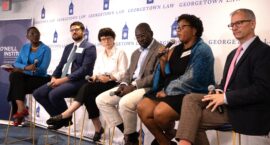
A panel at the 14th annual Supreme Court Review at Georgetown Law School discussed the high Court’s monumental decisions from the last several months, which will have ripple effects for years and decades to come. 

2023’s Top 10 Most Memorable Moments From ‘On The Issues with Michele Goodwin’

2020's 10 Most Memorable Moments from the Ms. Podcast, "On the Issues With Michele Goodwin"

2023 marked three years of On the Issues With Michele Goodwin, a fiercely feminist podcast about the most compelling issues of our time. This year, Goodwin brought us lawmakers, scholars and founders of movements and organizations that have defined how we think about fields like reproductive justice, care work and gun violence.

We selected some of the most powerful words heard on the podcast this year to propel us into 2024.

Welcome to the New Jane Crow

The Supreme Court of Texas notched itself into a troubling tapestry of U.S. legal history when it overturned a district court ruling that allowed Kate Cox, a 31-year-old Texas woman, to end her nonviable pregnancy. The state is committed to forcing Cox to remain pregnant, against her will and medical recommendations.

Women in Texas are living in a new Jane Crow.