Trump Considers Blocking Abortion Access for Unaccompanied Immigrant Minors in Federal Custody (Again)

A looming policy change threatens to undo existing protections and leave pregnant immigrant teens in federal custody without meaningful access to abortion care.

We won’t know what direction the rule will take until the proposed rule is released, but if the Trump administration’s antiabortion policies—such as the reinstatement of the Veterans Administration’s ban on abortion and abortion counseling, the defunding of Planned Parenthood and the reinstatement of an expanded global gag rule—are any indication, the rights of this marginalized population are at great risk.

The Next Phase of the Abortion Wars: Targeting Pills, Helpers and Patients

The first year of Trump’s second term marked major blows for reproductive healthcare. Medicaid funding cuts forced about 50 Planned Parenthood clinics to close throughout the U.S. and blocked 1.1 million Planned Parenthood patients on Medicaid from using their insurance to pay for reproductive healthcare. Twenty-three independent abortion clinics throughout the country also shut down in 2025.

Now, at the start of 2026, there are only nine states where it is possible to get a legal abortion with no restrictions.

Four years after the Supreme Court’s Dobbs decision overturned Roe, here are some of the key ways states are pushing harder than ever to end any access to abortion.

Independent Clinics Still Provide Most U.S. Abortions

2025 was a year marked by attacks on reproductive freedom, including a staggering wave of forced Planned Parenthood closures. About 50 of Planned Parenthood’s 600 locations have shut down as of December, largely due to last year’s combined loss of Title X funds and Medicaid reimbursements.

In the midst of these closures, independent abortion clinics continue to play a crucial role in the abortion access landscape. Even before last year’s Planned Parenthood cuts, independent clinics provided most U.S. abortions, offering care to women in big cities and rural healthcare deserts alike. In 2025, independent clinics provided 58 percent of U.S. abortions, compared to 38 percent through Planned Parenthood (and 3 and 1 percent through hospitals and doctors’ offices, respectively), according to the annual Communities Need Clinics report from Abortion Care Network (ACN), released in December.

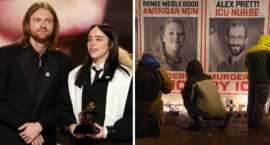
Resistance, From the Red Carpet to the Courts: Grammy Winners Denounce ICE, Immigrant Families Challenge Trump’s Visa Ban

In every issue of Ms., we track research on our progress in the fight for equality, catalogue can’t-miss quotes from feminist voices and keep tabs on the feminist movement’s many milestones. We’re Keeping Score online, too—in this biweekly roundup.

This week:
—For the first time, more Americans support than oppose abolishing ICE.
—Senate Democrats refused to pass a DHS bill that would fund ICE for this fiscal year. Instead they passed a two-week continuing resolution to give them time to negotiate reforms designed to prevent further brutality from ICE and CBP agents. 
—Artists use Grammy acceptance speeches to denounce Trump and ICE: “Our voices matter,” urged Billie Eilish. “We are humans and we are Americans,” said Bad Bunny.
—Organizations raise alarms about Grok AI spreading nonconsensual intimate images on Twitter.
—Virtual reality may be a tool to change opinions about catcalling.
—Access to IVF has led to more unmarried women in their 40s choosing to have babies.

… and more.

One Year In: 53 Ways the Second Trump Administration Is Harming Women and Families

A sweeping, year-one rundown of how Trump’s second-term power grabs and policy rollbacks are eroding women’s rights, healthcare and economic security, including—from dismantling the Women’s Bureau at the Department of Labor and shuttering reproductive health clinics, to passing historic cuts to the Medicaid program and sowing mistrust in abortion pill safety.

Keeping Score: Renee Good Fatally Shot by ICE; Women Work Longer and Are Paid Less Worldwide; N.Y. Fights Back Against Federal Childcare Freeze

In every issue of Ms., we track research on our progress in the fight for equality, catalogue can’t-miss quotes from feminist voices and keep tabs on the feminist movement’s many milestones. We’re Keeping Score online, too—in this biweekly roundup.

This week:
—”We had whistles. They had guns,” said Becca Good, wife of Renee Good, who was killed in Minneapolis by ICE agent Jonathan Ross.
—In central Texas, five months after the Sandy Creek flooding, “many are still homeless, and only 36 percent of FEMA claims in our area have been approved,” said survivor Brandy Gerstner. “FEMA must be independent, fully funded and strengthened—because when it fails to function, real families pay the price.”
—Anti-Muslim and anti-South Asian hate increased around the election of NYC Mayor Zohran Mamdani.
—The Department of Veterans Affairs announced new abortion bans.
—Meta has removed the social media accounts of dozens of reproductive health and LGBTQ groups.
—Women worldwide earn just a third of what men do when unpaid domestic labor is taken into account.

… and more.

There Is Nothing Patriotic About Denying Veterans Abortion Care

Claiming that abortion care is not an essential medical service, in August the Trump administration proposed a new rule to “reinstate the full exclusion on abortions and abortion counseling from the medical benefits package” for veterans and their dependents.” The proposed rule change drew fierce public opposition from a wide range of groups during the requisite 30-day comment period.

Then, under the cover of the holidays, the full exclusion on abortion and abortion counseling for veterans and their dependents took effect, by way of a legal directive issued in a Dec. 18 DOJ memo.

“You can’t thank a veteran for putting her body on the line for her country, then turn around and take away her right to control it. There is nothing patriotic about denying our nation’s heroes the care they deserve and the ability to determine their own futures.”

A Very Bad Year for Women’s Health

When I started writing for The Contrarian, a funny-not-funny inside joke was whether there would be enough fodder for a weekly democracy column that overtly centers gender. I think you already know the punchline. Suffice it to say, I did not miss a single Wednesday in all of 2025.

For my final entry of the year, we thought it worthwhile to offer a snapshot—a year’s worth of reporting on the depth of damage this administration has wreaked on women’s health, with real-time Contrarian reporting noted.

She Was an Antiabortion Poster Child. Now She’s a Reproductive Freedom Activist.

At the age of 15, Charlotte Isenberg took to social media to process complicated feelings about a miscarriage after alleged sexual abuse. That was what first brought her to the attention of antiabortion groups.

“Almost immediately, anti-abortion actors threaded a narrative for me between my grief, my miscarriage and anti-abortion sentiment. I clung to it with desperation,” Isenberg wrote.

Feeling isolated from peers due to both her traumatic experiences and the COVID-19 pandemic, Isenberg found a sense of belonging in these online spaces.

But in May 2024, at age 20, Isenberg says her birth control failed, and she became pregnant for the second time. The timing was devastating: She was unemployed, without stable housing or transportation, and preparing to relocate for college—the first in her family to access higher education. 

When she couldn’t find adequate support for her unplanned pregnancy, Isenberg scheduled an appointment at her local Planned Parenthood for an abortion consultation, unsure of what she would ultimately decide. Another prominent antiabortion activist, one of Isenberg’s best friends in the movement, found out about her appointment; she and other members of the group intervened aggressively.

Despite this pressure, Isenberg was able to make the decision that was best for her and her body. Since her own abortion, she’s become a reproductive freedom activist, educating others about extremist antiabortion tactics and promoting systemic protections for people navigating reproductive healthcare. 

Keeping Score: 137 Women Are Killed by Partners or Family Per Day; Bipartisan Push for Epstein Files; Trans Day of Remembrance and Native Women’s Equal Pay Day

In every issue of Ms., we track research on our progress in the fight for equality, catalogue can’t-miss quotes from feminist voices and keep tabs on the feminist movement’s many milestones. We’re Keeping Score online, too—in this biweekly roundup.

This week:
—137 women and girls are killed by intimate partners or family members every day.
—Congress votes overhwlemingly to force the Justice Department to release their Epstein files.
—Donald Trump snaps at women journalists: “Quiet, piggy” and “you are an obnoxious—a terrible, actually a terrible reporter.”
—Violence against trans women remains high.
—DACA recipients are being targeted and detained under the Trump administration.
—Higher-income college students often receive more financial support than they need, while low-income students struggle.
—Tierra Walker died from preeclampsia in Texas after being repeatedly denied an abortion.
—Viola Ford Fletcher died at age 111. She was the oldest living survivor of the 1921 Tulsa Race Massacre. 
—North Dakota’s total abortion ban was reinstated after the state’s Supreme Court reversed a temporary injunction from a lower court. There are now 13 states with total bans.

… and more.