I propose “misogynam” (mih-SAH-jih-NAHM)—the intertwined violence of anti-Semitism and misogyny directed at Jewish women.

Ever since I’ve been writing about slut-shaming, I’ve been called a slut and a whore.
In the 1990s, the age of doorstopper phone books (the kind with white pages and yellow pages), I received alarming letters delivered to my mailbox. In the early 2000s, the letters morphed into emails. And when I began posting on Instagram, the insults followed me there, too.
Over three decades, the insults were consistent: I was called various synonyms for prostitute and vagina, and an ugly pedophile for good measure. The hatred was misogyny—targeted, specific and designed to put me back in my place.
Then Hamas brutally attacked Israel on Oct. 7, 2023, and Israel retaliated in a devastating war in Gaza. The insults changed. I am no longer a regular slut and a whore; I am a “Jewish whore,” a “chosenite supporting the porn industry,” and a “whore” whom everyone could agree was bad apart from “tribes who hate Jesus.”
I had never posted anything about Israel or the fact that I was Jewish—I hadn’t even worn my chai symbol or Jewish star necklace on social media—yet the comments found me anyway, intent on outing me as if to clear up any possible misunderstanding of who I really am. And who am I, really, to the people denigrating me publicly? I experience being called a “Jewish whore” in public as a far more sinister act than when I receive hateful emails targeting me solely for being a woman and feminist because “Jewish whore” is not simply a modular combination of anti-Semitism plus misogyny. It is a container of a more complex tangle of hatreds.
The new Louis Theroux documentary on Netflix about influencers of the “manosphere” makes this explicit. Theroux interviews Amrou Fudl, also known as Myron Gaines, who asked on his podcast Fresh and Fit: “Who pushed feminism? The fucking Jews. Who pushed homosexuality? The Jews.”
On the alt-right, anti-Semitism and misogyny are not merely coexistent; they are structurally dependent on each other.
We need precise language to make sense of this phenomenon.
I propose misogynam (mih-SAH-jih-NAHM)—misogyny that targets a Jewish person, or member of am Yisrael, the people of Israel. This portmanteau follows the model of communication scholar Moya Bailey, who brilliantly coined misogynoir—combining misogyny with noir, the French word for black—to name the specific anti-Black stereotypes and oppression that Black women uniquely face. Bailey developed her framework within the broader intellectual tradition of intersectionality established by legal scholar Kimberlé Crenshaw, which holds that overlapping systems of discrimination produce forms of harm that are irreducible to their parts.
To some, I am a member of a group that is responsible for societal deterioration. To others, I’m a repository of anger about Israel’s actions in Gaza. Whatever the impetus, when anti-Semitism—which historian Susannah Heschel describes as always present as “a reservoir of possibility waiting to be activated”—fuses with misogyny, the result is a combustible force.
Scholars have demonstrated the long, sordid history of anti-Semitism, including the ways in which Jewish people have been accused of reversing the natural order of gender roles, with Jewish men mocked as feminized and Jewish women vilified as sexually promiscuous and aggressive. From antiquity through the Middle Ages, from the pogroms of the Pale of Settlement and the Jewish communities of North Africa to the Holocaust in Nazi Germany, Jewish women have been raped systematically: not only as an act of individual brutality, but as a tool to humiliate the Jewish community at large in a particularly sadistic and public manner.
I witnessed misogynam in a different form when I was growing up in suburban New York with the “Jewish American Princess,” or “JAP,” stereotype. This slur depicted a materialistic, shallow, entitled woman who is sexually frigid yet also sexually tempting, a tease. In the 1980s, a popular T-shirt said, “Slap a JAP.”
I’ve also experienced it internally. In some religiously observant Jewish communities, male rabbis dictate how women should dress so as not to tempt men, and it can be acceptable to yell “whore” at a woman who exposes her collarbone.
When shopping in Borough Park, Brooklyn, my neckline wasn’t deemed high enough, and a man crossing my path on the sidewalk hissed the Yiddish word nafke, or prostitute. This internal patriarchal control is not the same as anti-Semitism from outside—its sources and logic are distinct—but I don’t think the boundary is airtight. When a community has absorbed centuries of messaging that Jewish women’s bodies are dangerous, transgressive, and in need of policing, that messaging doesn’t simply stop at the door.
… If it’s acceptable to dismiss the sexual victimization of one group of women for political reasons, the door opens to dismiss violence against any woman for any reason.
On the alt-right, anti-Semitism and misogyny are not merely coexistent; they are structurally dependent on each other. White and male supremacists who believe that white male power is being “replaced” have constructed an ideology in which feminism and LGBTQ+ advocacy are framed as instruments of a Jewish plot to destroy Western civilization. In this worldview, Jewish women and feminists are twin threats: the orchestrators and foot soldiers of civilizational ruin.
Nick Fuentes—the Holocaust denier, white nationalist and key figure in the “America First” movement that helped radicalize a generation of young men online—exemplifies this fusion. After the 2024 election, he sardonically said, “Your body, my choice” to mock women’s reproductive rights. The move was not incidental to his anti-Semitism; it was an expression of it. In Fuentes’ ideology, feminism is not an autonomous women’s movement but a Jewish instrument of civilizational destruction. To mock feminist language is, in his framing, to indict Jewish power.
The denial of sexual violence in some corners of the political left is the mirror image of this problem, and just as corrosive. Some extremists on the left minimize or flatly deny the acts of sexual violence committed by Hamas on Oct. 7 against Jewish women.
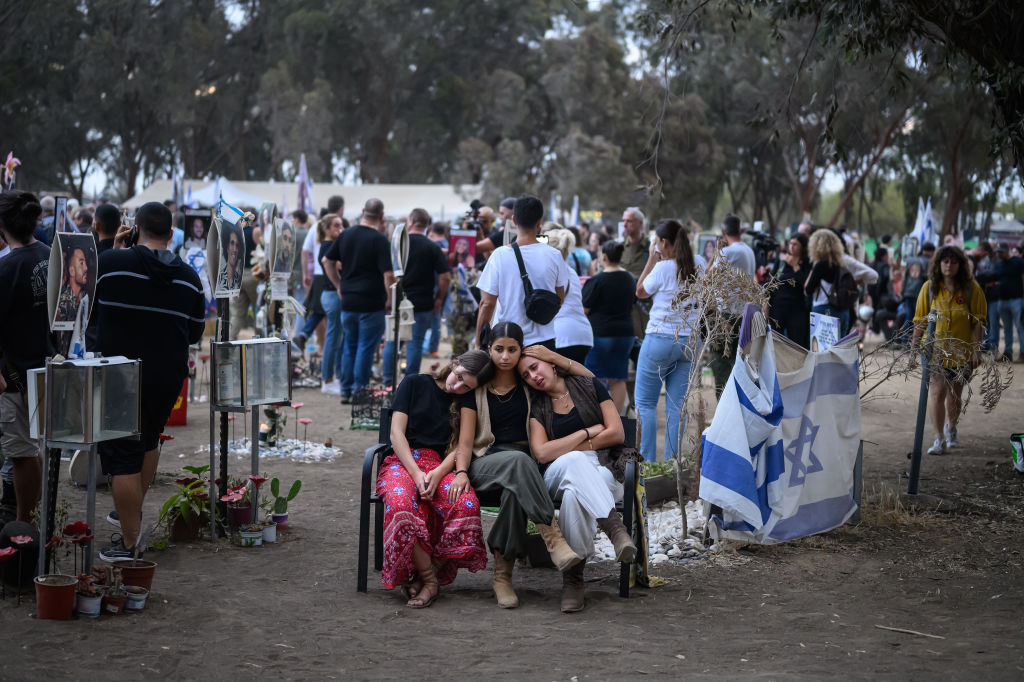
This is not a politically neutral editorial dispute. When solidarity politics require the suppression or denial of sexual violence against women because of the group they belong to, the result is a betrayal of feminist principles from within. The logic, once legitimized, does not stay contained: If it’s acceptable to dismiss the sexual victimization of one group of women for political reasons, the door opens to dismiss violence against any woman for any reason.
I’m weary of opportunistic efforts that purport to challenge anti-Semitism. It seems that every month, a new nonprofit sprouts to take it on. The Trump administration has been deploying anti-anti-Semitism as a weapon against political adversaries in a mind-scrambling way that increases dangers to Jewish people—as we see from the demand that the University of Pennsylvania create and share a list of Jews on campus.
This is why we need a term that is analytically precise rather than politically convenient. Misogynam is not a tool of any movement, right or left. It names something real: the specific and recurring ways that hatred of Jews and hatred of women fuse into a force greater and more dangerous than either alone. Naming that force clearly—what it looks like on the far right and on the left; its contours in the JAP joke and attacks from the manosphere; and its imprint in the medieval pogrom and Oct. 7 massacre—is the first step toward understanding it well enough to fight it.
All of us, not only Jewish women, are harmed when we cannot see it for what it is.