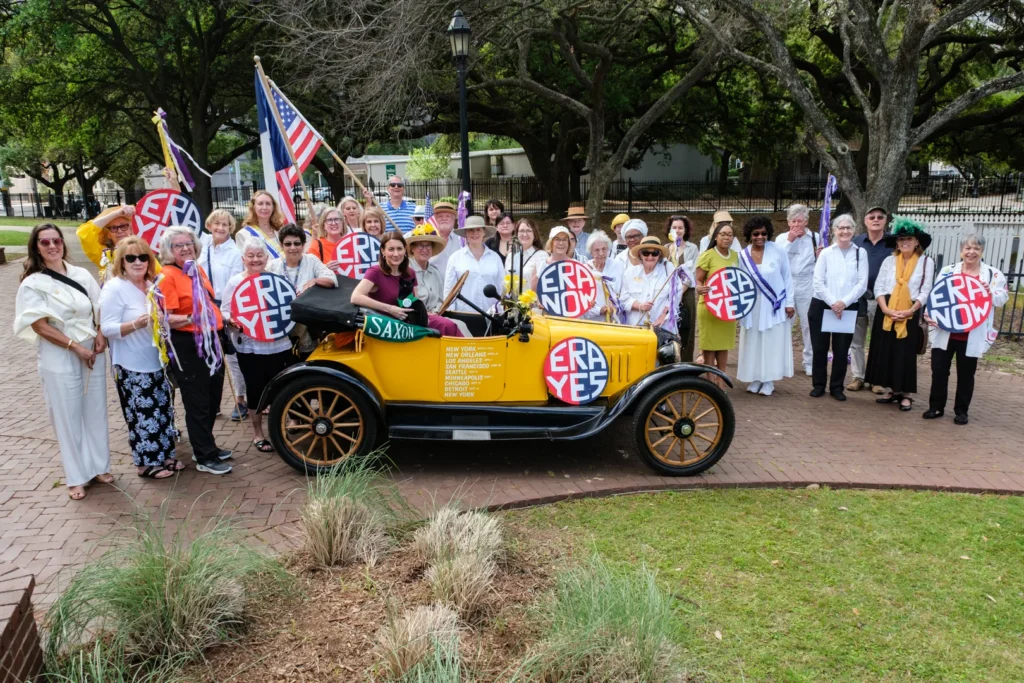
The Driving the Vote for Equality Tour is a cross-country campaign retracing the 1916 suffrage road trip, when activists drove across the United States to demand voting rights for women—this time calling on Congress to recognize the Equal Rights Amendment as the 28th Amendment. Traveling in a restored 1914 Saxon car known as the Golden Flyer II, organizers are connecting past and present while gathering support nationwide.
The following is excerpted from the tour’s daily diary, highlighting recent stops in Houston, Seguin and Georgetown, Texas.
March 22: Houston, Texas
The Spirit of 1916, the Spirit of Houston, and the Fight That Never Stopped

In May 1916, Alice Burke and Nell Richardson arrived in Houston a day ahead of schedule—rested, ready and apparently unstoppable. They held a major street meeting, speaking from their Golden Flyer roadster for nearly an hour, then led a parade of about 20 automobiles, decorated in suffrage colors, through the streets of Houston. Burke declared that the suffragists would concentrate their work on both Republicans and Democrats, and laid out their plans to proceed westward to the Pacific coast, returning east via the Northern route.
One hundred and ten years later, the Golden Flyer II came back to Houston. Same city. Same mission.
At the Houston stop of the Driving the Vote for Equality Tour, U.S. Rep Sylvia Garcia (D-Texas) took the podium at Sam Houston Park, making the case for why the Equal Rights Amendment is more important today than at any time in our past. She shared her personal story about attending the landmark 1977 National Women’s Conference in Houston as a young law student, where she first met Gloria Steinem and helped shape a national agenda for women’s rights—including support for the ERA.
Now an attorney and one of the lead co-sponsors of the ERA Joint Resolution, Garcia pointed out that rights are being taken away and argued that the Constitution must guarantee full protections of equality to stop the backward movement.
The 1977 National Women’s Conference marked a defining moment in modern American democracy—the first women’s rights conclave since the Seneca Falls Convention in 1848. More than 2,000 delegates from all 50 states and U.S. territories gathered to debate and adopt a comprehensive National Plan of Action on women’s rights. Delegates developed a platform addressing economic equality, reproductive freedom including access to abortion, education, domestic violence, disability rights, health care, childcare, sexual preference, political power and the ratification of the Equal Rights Amendment—issues we are still fighting for today. The Spirit of Houston demonstrated the power of civic participation at scale, showing that grassroots organizing could shape a national agenda and influence policy at every level.
More than 50 years later, the Golden Flyer II is back in Houston to finish the job.
March 23: Seguin, Texas
Democracy Built Locally, Equality Built Together
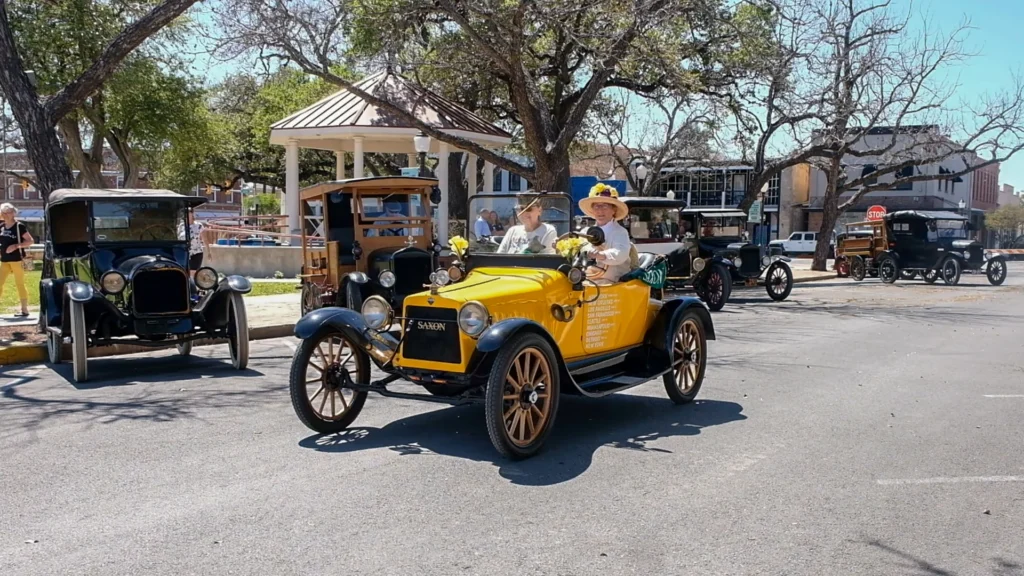
In 1838, the town of Seguin, Texas, was founded at the crossroads of cultures: Tejano leaders, immigrant settlers and frontier communities all shaping what would become one of the oldest cities in the state.
Nearly two centuries later, Seguin still tells a powerful American story: one of promise, perseverance and unfinished work. Today, that unfinished work is equality under the law.
As the Driving the Vote for Equality Tour travels through Texas, we stop in communities like Seguin not by accident, but by design. Places like this remind us that democracy has always been built locally—on town squares, in public parks and through conversations among neighbors. And they remind us that while our nation has expanded rights over time, it has never fully delivered on its promise of equality for all.
The Equal Rights Amendment was designed to do something simple and profound: guarantee that rights under the law shall not be denied or abridged on account of sex. More than a century after it was introduced, that guarantee is still not explicitly written into the Constitution. It matters in paychecks and pensions, in courtrooms and classrooms, in questions of safety, autonomy, and opportunity. While laws have evolved, they remain vulnerable—subject to shifting political winds and uneven protections across states. Constitutional equality provides a permanent foundation.
Seguin offered a fitting place to reflect on that need. On a beautiful, breezy Sunday at Pecantown Books & Brew, a steady stream of people signed petitions, heard about the 1916 suffrage tour and learned what they could do to help move the ERA forward. Parents with infants and toddlers, teenagers, and seniors alike gathered to meet author Jeryl Schriever, hear the story of the Golden Flyer, and engage in conversations about equality—often starting with curiosity about the car and leaving with a deeper understanding of the cause.
Equality has always been driven by ordinary people willing to take extraordinary action — and in Seguin, that action was everywhere.
March 24: Georgetown, Texas
From Jessie Daniel Ames to the Courthouse Steps, the Fight Has Always Been Local
Georgetown, Texas, holds an important place in the history of women’s suffrage and the broader fight for women’s rights, showing how local organizing helped drive statewide and national change. Although women in Texas were denied voting rights throughout the 19th century, momentum grew in the early 1900s as advocates organized across the state. Georgetown became a key center of activity during this critical period.
At the heart of this effort was Jessie Daniel Ames, who founded the Georgetown Equal Suffrage League in 1916 — the same year Burke and Richardson drove across Texas. Through newspaper columns, public meetings and direct outreach, Ames educated the community and helped build support for women’s voting rights. The movement reached a turning point in 1918, when Texas women won the right to vote in primary elections. With only 17 days to register, Georgetown activists mobilized quickly and effectively, registering thousands of women across Williamson County.
These efforts helped pave the way for Texas to become the first Southern state to ratify the 19th Amendment in 1919. Georgetown’s impact extended beyond suffrage: Ames later became the first president of the Texas League of Women Voters and a prominent advocate for broader human rights, including anti-lynching efforts and social reform. The town’s history stands as a powerful example of how local action can help secure lasting national change.
That legacy was clearly reflected during our visit. At Southwestern University, students gathered around the Golden Flyer II—signing petitions, taking photos and engaging in conversations about the Equal Rights Amendment. A panel at the Smith Library Center brought together leaders across generations to connect the suffrage movement to today’s ongoing fight for constitutional equality, underscoring that while the 19th Amendment secured voting rights, the broader promise of equality remains unfinished.
From campus conversations to courthouse steps, Georgetown’s participation in the Driving the Vote for Equality Tour underscored a central message: just as suffragists refused to accept delay in 1916, today’s advocates are pressing forward to ensure equality is fully recognized under the Constitution.
Read earlier installments of the Driving the Vote for Equality daily diary to follow the tour from the beginning.