In This Edition:

Milestones: Coretta Scott King leads the March for Welfare Mothers and is joined by Ethel Kennedy; Diane Humetewa became the first Native American woman to be a federal judge (2014); Susan B. Anthony and Elizabeth Cady Stanton established the National Woman Suffrage Association (1869); and the Grimke sisters spoke out about women’s rights in Philadelphia (1838).

Birthdays: Laphonza Butler, former U.S. senator & CEO of EMILY’s List; Harriet Quimby, the first American woman airplane pilot; Karen Skelton; Petula Dvorak, journalist; Donna Hall, former CEO of Women Donors Network; Kaeli Bombardier Shaw; Nada Sellers; Rose Kapolczynski, campaign strategist; Madeleine Albright, first woman to serve as secretary of state; Jessica Grounds, CEO of Corporate Directors Forum; and Ellen Wilson, former first lady (1860).
What’s Wrong With This Picture?
I often speak about the lack of women on boards and in negotiation rooms, but very rarely does a moment occur where the lack of women is so clearly depicted as it has been this week. The photographs clearly make the case in an undeniable way.
As President Trump and President Xi Jinping sat down at Beijing’s Great Hall of the People for what may be one of the most consequential diplomatic meetings of our time—two leaders of the world’s two largest economies, negotiating trade, security, artificial intelligence and the future of global world order—the image that circulated around the world told a story that no press release could spin away. Not a single woman was seated at the table. Not on the American side. Not on the Chinese side. The Guardian called it out perfectly in their article today, writing, “‘Backward’ photo panned for display of patriarchy, signaling that ‘women’s voices don’t matter in shaping global order.’” I could not agree more.
I have spent years making this argument with data, research and the slow accumulation of evidence. And then a photograph like this comes along and does it all in an instant. Harvard economist Gita Gopinath captured my frustration with the lack of representation perfectly when she posted: “A painting of the end of meritocracy: A meeting of the two largest economies and not one woman at the table.” Her post has drawn in over 31,000 likes and 5.4 million views, which tells me I am not alone in my reaction.

What struck me most, however, was her follow-up: that we have “gravitated back to this idea that what matters is your network and not your capabilities—and that matters [in terms of] whether or not you get a seat at the table.” That is precisely the topic I discussed with women experts at the Reykjavik Global Forum last November, and precisely what RepresentWomen exists to change. It is inexplicable, as Gita put it, “how you end up with a single gender table, given the many talented women around the world.”

The contrast with the recent past is jarring. Obama-era U.S.-China summits included women at the table as principals—Susan Rice as national security advisor, Hillary Clinton as secretary of state and China’s Vice Premier Liu Yandong. As Halima Kazem of Stanford noted this week, what we saw in Beijing was not a logical oversight. It was “a choice about what kind of authority to project: masculine, militarized and exclusionary… When both superpowers perform power this way, they’re jointly defining what ‘serious’ diplomacy looks like and who gets excluded from it.”
I keep returning to that word: choice. The White House released a list of 17 of America’s most influential business executives accompanying the president to Beijing, and only two were women. And those two women in the official government delegation held communications roles, protocol positions or were family members. That was not an accident. That is a set of choices, made one by one, that add up to a picture.
And that picture has consequences. McKinsey published its fourth edition of Diversity Matters in 2023, which drew on research from more than 1,200 companies across 23 countries and six global regions on the holistic impact of diversity in the workforce. What it found was that the business case for gender diversity on executive teams has more than doubled over the past decade, underscoring an even greater need for women’s representation on executive teams.
When I first read the 2015 report from McKinsey, it reported that companies in the top quartile for gender diversity on executive teams were 15 percent more likely to financially outperform those in the bottom quartile—a figure that had grown to 39 percent by 2023. The women I interviewed in Iceland on the main stage of the global forum echoed what these statistics illustrated, rooted in their own lived experiences.

And while we do not directly work on increasing women’s leadership in boardrooms, the argument applies with equal force to rooms where diplomacy happens, where wars are prevented or started, where policies are passed, and where the rules of global order are written. When you exclude women from those rooms and places of power, you do not just lose half the talent pool. You lose a quality of judgment, a breadth of experience and a set of priorities that the evidence consistently shows leads to better outcomes.
What we saw in Beijing this week was a choice of patriarchal power at the exact moment the world needs something different. What our world needs is what Former New Zealand Prime Minister Jacinda Ardern calls a “different kind of power,” grounded in empathy and a genuine willingness to collaborate across differences. Those are not soft virtues; they are precisely the qualities that diplomacy between two rival superpowers demands.
When the stakes are this high, the absence of women at the table is not just a failure of representation; it’s a failure of imagination of what leadership can and must look like. We deserve better and the world deserves better. It’s on all of us to demand that women be present in the halls of power—so that the next time a photograph of a key negotiation table circles the globe, it finally looks like the country, and the world, it is meant to represent.
A Picture Worth 1,000 Words: No Women at the U.S.-China Table

As I laid out in my introduction this week, the U.S. and China held high-stakes negotiations on trade and foreign policy at a summit of the nations’ leaders that will shape the global economy for years to come. An image from the White House depicting these meetings went viral on social media and exemplifies the phrase “a picture is worth a thousand words.”
Seated around a long formal table in Beijing, flanked by American and Chinese flags, are the delegations of the world’s two largest economies. There are dozens of men on both sides, with not one woman present. The hyper-masculine dynamics are hard to miss. And this statement cannot be chalked up to gender bias; here is what the research tells us about that room.
A study published in the Journal of Economic Behavior and Organization found that male-male negotiating pairs capture significantly less value than any other pairing, because men systematically overuse aggressive strategies against other male counterparts, creating mismatches that collapse rather than build toward agreement. It is not that men are bad negotiators. It is that men negotiating against men, in high-stakes, zero-sum frameworks, tend to bring out the worst in each other. The aggression escalates. The impasses multiply. The deals collapse.
Meanwhile, research from Laura Kray at UC Berkeley and Jessica Kennedy at Vanderbilt found that women bring greater cooperativeness, stronger ethics and a measurable advantage in generating goodwill through problem-solving—traits the researchers noted are “often overlooked or severely undervalued.” A Columbia Business School study found that women reach impasse roughly half as often as men in comparable negotiations—9 percent versus 19 percent. Less bluster. More deals.
And yet, in 2023, women represented just 9.6 percent of negotiators and 13.7 percent of mediators across more than 50 peace processes analyzed by the United Nations Secretary-General. Between 1992 and 2019, women made up a mere 6 percent of mediators in major peace processes worldwide. The U.N. has called this “a stark reality.” We might call it something sharper: a catastrophic, decades-long strategic error with grave consequences.
And these consequences are not abstract. Peace agreements with meaningful women’s participation are 35 percent more likely to last at least 15 years. Agreements without it are more fragile, more likely to collapse, and more likely to return the parties to conflict. The ceasefire we are watching unspool in real time looks a great deal like what the data predicts when women aren’t in the room.
A Study in Contrasts: Women’s Representation in China Versus Mexico

The photograph from Beijing this week is striking on its own, but it becomes even more intrusive when you place it alongside a simple data point: China ranks 90th globally for women’s representation. Ninety. There are no women on China’s 24-member Politburo—the body that holds real policymaking power—and that absence is not accidental. It is the predictable result of a system that has never been designed to include women at the highest levels.
Now, consider Mexico, which ranks sixth worldwide for women’s representation. This ranking derives directly from Mexico’s structural decisions: gender quotas combined with proportional representation, working in concert, mandating that women appear on ballots and that those ballots translate into seats. The result is one of the most representative legislatures in the world, and it happened by design, not by accident.

This is the argument I have been making for years: Representation does not happen on its own. It is the product of the rules, systems and deliberate choices about who gets to be represented and hold political power. China made one set of choices. Mexico made another. The rankings tell you everything about what those choices produce. See RepresentWomen’s extensive international research for more details.
Mexico Keeps Besting the U.S. on Women’s Political Representation
SUGGESTED GETTY
As the U.S. debates whether a woman can win the presidency in 2028, Mexico offers a useful reality check on what structural reform actually produces. According to Mexico Daily News, in 2009, 93.7 percent of Mexico’s governors were men, as were 72.4 percent of federal deputies and 80.5 percent of senators. A 2019 constitutional reform dubbed paridad en todo (“parity in everything”) mandated gender parity across elected and appointed offices at every level of government.
President Claudia Sheinbaum has assembled a cabinet that is 50 percent women. At the state level, 44 percent of Mexico’s federal entities are led by women, compared to 28 percent in the U.S. In the legislature, Mexico has achieved a majority-female lower house, with 50.6 percent of federal deputies women and exactly 50 percent of senators, something the U.S. has never approached. In the U.S. House, 28.5 percent of representatives are women, and in the Senate, 26 percent.
The gap between the two countries is not an accident or an issue of candidate quality. It is the direct result of structural choices. Specifically, a constitutional mandate for parity is enforced across parties and levels of government. The data reiterate the notion that representation at scale requires rules beyond good intentions.
Supreme Court’s Assault on Voting Rights Accelerates: Sherriilyn Ifill Explains

Last month, the Supreme Court in the Callais case reversed its historic rulings on legislation to uphold the Voting Rights Act by creating opportunities for racial minorities to elect candidates of their choice. In follow-up rulings, it has green-lighted requests from Alabama and Louisiana to cancel primaries where early voting had already begun, allowing the legislature to draw maps that replace black-majority districts with Republican-majority districts. The ruling also led directly to new congressional districts in Tennessee, helped shape Florida’s new map, and may spur new maps this year in states like South Carolina.
See this analysis by Kyle Kondick inLarry Sabato’s Crystal Ball on the overall impact of “re-gerrymandering” in the current cycle that includes this summary;
“Although several states are still in flux, we may be nearing the end of 2026’s redistricting saga. As tempting as it may be to do so, it won’t be possible to do a precise accounting of redistricting’s effects until after the November election. Assuming Republicans successfully add an extra seat apiece in Alabama, Louisiana and South Carolina, and that all of the current redraws remain in place, our best guess is a Republican gain in the high single digits from redistricting, with the potential for that to grow or shrink based on the actual results in several key races.”
Sherrilyn Iffill, the iconic law professor and former leader of the NAACP LDF, recently appeared on Jon Stewart’s Comedy Central program and, in the words of law professor Rick Hasen. Is the “best introduction for a layperson to the radical Supreme Court Callais decision”. Watch here.
2028 Presidential Nomination Poll: Women Lead Among Democrats

Every time a woman loses a major race, the murmurs start. Maybe the country isn’t ready. Maybe the party should play it safe. I heard it after Hillary Clinton’s loss in 2016. I heard it again after Kamala Harris’ loss in 2024. I even wrote about it directly in The Fulcrum last November—pushing back on the idea that women candidates are the liability, when the evidence consistently points elsewhere.
Which is why an AtlasIntel poll released on May 7 on the 2028 Democratic presidential primary caught my eye. While women are not a factor on the Republican side, the three women candidates included in the survey earned more than 40 percent of preferences among Democrats, with Alexandria Ocasio-Cortez leading with 26 percent and Kamala Harris at 13 percent. Meanwhile, the men in the race, including Pete Buttigieg at 22 percent and Gavin Newsom at 21 percent, split the remaining majority three, four, five ways.
I know early polling is erratic, and I’m not making predictions. But I want to say this plainly: Democratic voters are not afraid of women candidates. What has held women back is not voter appetite—it is the infrastructure, the narrative and the structural conditions that either support a candidacy or quietly undermine it before it ever gets off the ground. The data has always shown this, and the poll shows it again. As we look ahead to another presidential primary season, I question concerns that a woman can’t win in 2028, and Democratic voters seem to agree.
Kamala Harris’ Bold Thinking on Democracy Reform Includes Multimember Districts

This week, former Vice President Kamala Harris, in a national online forum organized by Win with Black Women, summarized a set of bold reforms that I have long supported as timely to put on the table, including reforming the Electoral College with a national popular vote, Supreme Court reform, adding states and multimember districts that are necessary for proportional representation and ranked-choice voting.
Watch here and read this excerpt of a story in Yahoo News:
“On Wednesday evening, Harris delivered remarks during an emergency virtual meeting hosted by Win with Black Women, a pro-democracy grassroots movement of Black women leaders and organizers. The cohort discussed the impact of the Supreme Court’s April 29 ruling in Louisiana v. Callais, which raised the bar for Black voters seeking to prove racial discrimination in redistricting. As a result, Republican-led states rushed to redraw congressional maps ahead of November’s midterm elections, targeting traditionally majority-Black districts that were once protected by Section 2 of the 1965 Voting Rights Act.… [Harris] laid out her political positions on what Democrats must do to fight back, including making serious reforms to the Supreme Court and even abolishing the Electoral College. She called for “expanding the playbook.”

Denise Powell Earns Primary Nod in Hotly Contested Nebraska Congressional Primary

With relatively few congressional races considered to be competitive in this November’s general election, primary elections are often decisive for creating opportunities for women. Denise Powell, a long-time leader in efforts to elect women in Nebraska, won the nod with a narrow plurality in the Democratic primary in the second congressional district to seek to win one of the few Democratic-leaning districts now represented by a Republican.
Powell benefited from millions of “dark money” spent against her leading opponent, but in the disturbing world of modern politics, she had no control over it. Transparent backers, including EMILY’s List, and Here is coverage from National Public Radio.
“The race for the state’s second congressional district is closely watched because the ultimate winner could help decide which party controls the narrowly divided U.S. House after this year’s midterm elections. The Democratic primary attracted more than $5.6 million in outside ad spending, according to a review of Federal Election Commission filings by Nebraska Public Media.
The second district, which includes the Omaha area, is known as the “blue dot” because it was the lone Nebraska district to vote for Kamala Harris in 2024 and Joe Biden in 2020. It is currently represented by Republican Don Bacon, who is retiring. Democrats see the seat as a prime pickup opportunity.”
Transparent backers of Powell included EMILY’S List, Elect Democratic Women and the Congressional Hispanic Caucus BOLD PAC. Here’s more from a BOLD PAC release:
“Denise Powell is exactly the kind of leader we need in Congress to help counter Donald Trump’s dangerous agenda and deliver for Nebraska families,” said Congresswoman Lois Frankel, chair of Elect Democratic Women. “A mom, small business owner, and longtime advocate for public education and affordable health care, Denise has spent her career uplifting her community, and Elect Democratic Women is proud to continue supporting her campaign.
“Flipping this seat is crucial for Democrats to regain the U.S. House majority in 2026, and Denise Powell is our strongest candidate. Denise understands how the Republicans’ reckless agenda harms Nebraskans and is ready to fight for real solutions,” said Jessica Mackler, president of EMILYs List. “EMILYs List is excited to be launching a joint paid media program to reach Nebraska voters about what is at stake in this race. We’re ready to help Denise win and make a real difference for the people of Nebraska.”
Vermont State Senate Majority Leader Reflects on Mother’s Day

A big thanks to Vote Mama’s Liuba Grechen Shirley for publishing a wonderful essay by Vermont state senate majority leader Kesha Ram Hinsdale that speaks for itself in this excerpt.
We talk a lot in this country about supporting families, but too often we mean it in the abstract. If we are serious about it, we need to make real economic changes—affordable housing that allows for multigenerational living, childcare that doesn’t consume a paycheck, workplace policies that recognize caregiving as essential, not peripheral.
But there’s something deeper, too. A shift in how we define leadership and success. In my twenties, I was in a hurry. I wanted to be someone. I worried about whether I would be remembered, and for what. That urgency is familiar to many young leaders, especially women, who feel they have to prove themselves quickly and completely.
Motherhood changed that. Now, I’m less focused on being someone and more focused on doing something. I think less about how I’ll be remembered in the headlines and more about how I’ll be remembered by my children. I think about what they see when they watch me lead—how I treat people, how I handle pressure, how I balance conviction with compassion.
It’s a quieter ambition, but a more enduring one. We need to stop asking mothers how they “do it all,” as if the goal is to carry an impossible load alone. We need to stop measuring success by how well women contort themselves to meet expectations that were never designed with them in mind.
Instead, we should be asking: What would it look like if we built a world where mothers didn’t have to do it alone?
Because when we do that—when we build systems, communities, and cultures that actually support caregiving—we don’t just make life better for mothers. We make leadership stronger, more grounded, and more reflective of the world it serves.
My story isn’t exceptional. It’s a testament to what’s possible when care is shared. This Mother’s Day, I’m thinking about the women who made space for me—my mother, first and foremost, but also the educators, caregivers, and community members who stepped in when she couldn’t.
And I’m thinking about what we owe the next generation of mothers. Not admiration for doing the impossible. But a commitment to finally make it possible.
Women Leading Detroit’s Biggest Foundations: ”We’re Not Stopping”

At a moment when federal funding for education, nonprofits and community development is under pressure, four of Detroit’s most influential women in philanthropy gathered at the Michigan Chronicle‘s Pancakes and Politics forum with a clear message that their investment in Detroit is not contingent on what Washington does.
The panel included Latrice McClendon, Detroit director for the Knight Foundation, Angelique Power of The Skillman Foundation, Kylee Mitchell Wells of Southeast Michigan Ballmer Group and Wendy Lewis Jackson of The Kresge Foundation. They covered education, neighborhoods, youth voice and nonprofit resilience. The Michigan Chronicle notes, however, the importance of philanthropy was especially resounding:
“Mitchell Wells said philanthropy must also be introduced as a career path early, especially for students who may not know the sector exists.
“There’s more that we need to do throughout the school year,” Mitchell Wells said. “I want to be in the schools talking to students about philanthropy. It’s important that we get out early to talk to kids about these careers, some that need a four-year degree and some that don’t, that have large salaries.”
McClendon ended with a clear statement of commitment.
“Philanthropy can’t solve problems, but we can determine who we will invest in,” McClendon said. “Regardless of what’s happening at the federal level, we will continue to fund, and we are very unapologetic about funding Detroit. We all know what Detroit looks like and we are going to continue to fund Detroit.”
The conversation made plain that Detroit’s future will require more than isolated investment. It will require equitable school funding, resident-led neighborhood development, youth voice, nonprofit strength, public-private alignment, and a shared belief that Detroit’s people are not problems to manage, but leaders to invest in.”
The panel is a reminder that women’s leadership shows up not only on ballots but in the rooms where long-term investment decisions get made. The women running Detroit’s major philanthropic institutions are making those decisions with explicit defiance of federal-level rollbacks.
P.S. —
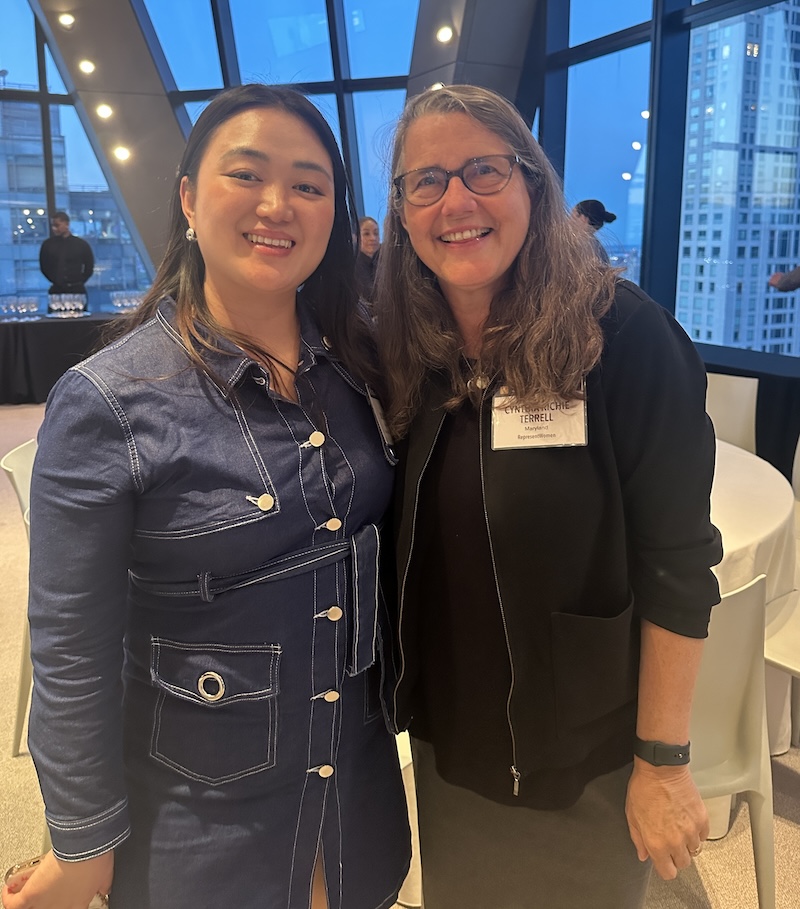
It was such a pleasure to meet NYC Councilperson Julie Won at the Leadership Now Project gathering of democracy reformers at the Hearst Tower in NYC this week!
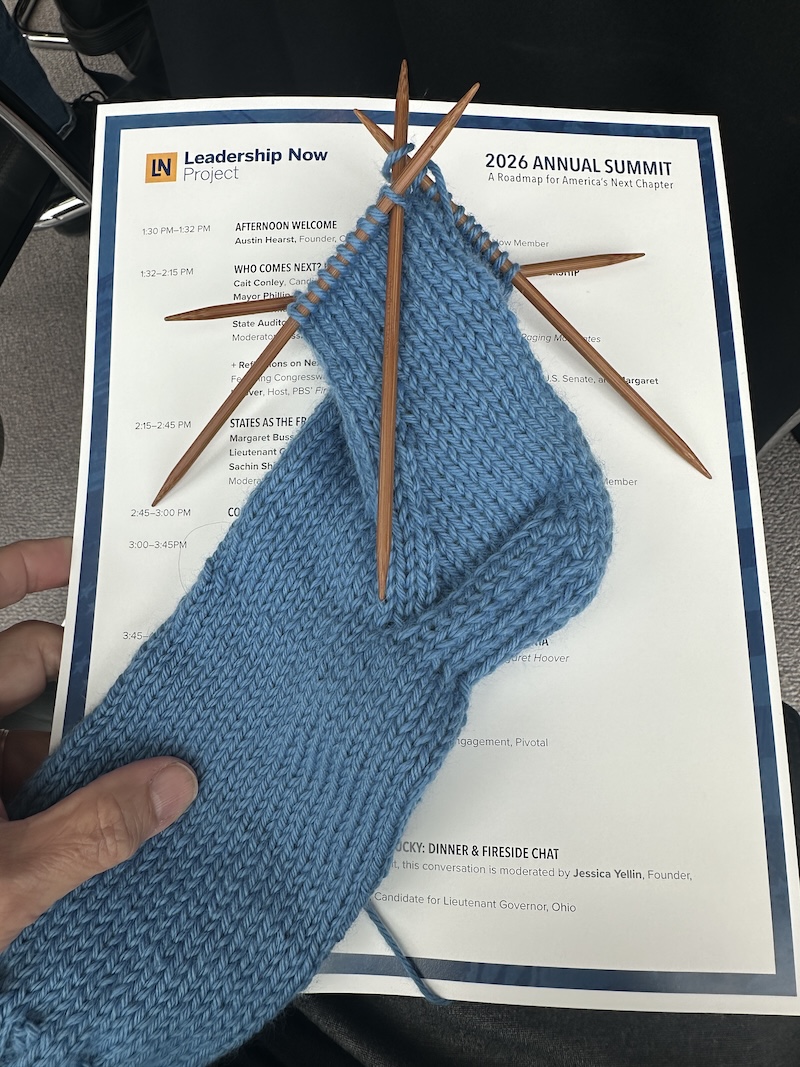
It was also great to get some knitting in during the Leadership Now gathering—many thanks to Danialla Ballou-Aares for another terrific summit!