Beyond American Exceptionalism: What the Success of the Green Wave Can Teach U.S. Abortion Activists

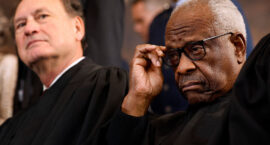
While the idea of the U.S. as a bastion of moral superiority has always been a myth—evident, for example, in efforts to shield Jim Crow laws from scrutiny in the founding of the United Nations—the overturning of Roe v. Wade is one of the latest reminders of this fallacy, particularly as it pertains to global health and women’s rights. It is also a cautionary tale for the rest of the world about the fragility of reproductive rights.

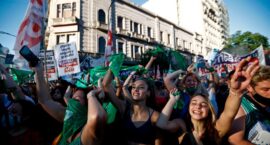
As states across the U.S. have banned abortion post-Dobbs, advocates and experts here have been forced to look outside of our borders for assistance, recognizing that other nations have recently mobilized to legalize abortion and have much to teach us, particularly those that have done so by enshrining abortion as a human right.

No Women Were Present at the U.S.-China Negotiations. This Is By Design.

Weekend Reading on Women’s Representation is a compilation of stories about women’s representation in politics, on boards, in sports and entertainment, in judicial offices and in the private sector in the U.S. and around the world—with a little gardening and goodwill mixed in for refreshment!

This week:
—Mexico continues to bet the U.S. on women’s political representation.
—A brief explanation on the Supreme Court’s attack on voting rights.
—In a 2028 presidential nomination poll, women lead among Democrats.
—Denise Powell earns a primary nod in a hotly contested Nebraska congressional race.

… and more.

Ms. Global: Energy Crisis in Cuba, Feminist Activist Assassinated in Iraq, Gay Asylum-Seeker Deported and More

The U.S. ranks as the 19th most dangerous country for women, 11th in maternal mortality, 30th in closing the gender pay gap, 75th in women’s political representation, and painfully lacks paid family leave and equal access to healthcare. But Ms. has always understood: Feminist movements around the world hold answers to some of the U.S.’s most intractable problems. Ms. Global is taking note of feminists worldwide.

This month:
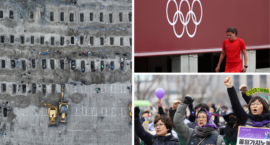
—Seoul holds the 41st Women’s Strike in South Korea for International Women’s Day.
—Hospital patients suffer during Cuba’s three major blackouts.
—The U.S. is at fault for the missile strike that hit the Shajareh Tayyebeh Girls’ School in Minab, Iran, on Feb. 28, killing 175 people.
—Yanar Mohammed, a leading Iraqi feminist and human rights defender, was killed in an armed attack in Baghdad.
—IOC restricts transgender participation in Olympics.
—Amid widespread displacement, poverty and institutional collapse during the ongoing war in Gaza, families are increasingly turning to child marriage for their daughters.

… and more.

The Trump Administration Wants the Supreme Court to Permanently Close the Border to Asylum Seekers

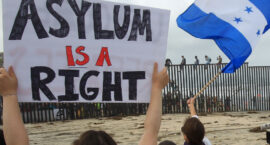
On Tuesday, March 24, the government will ask the Supreme Court to declare that asylum law does not apply at the border. The case—Noem v. Al Otro Lado—was brought by asylum seekers to challenge Trump’s turnback policy.

If the Supreme Court succumbs to Trump’s twisted logic, he will likely consider it carte blanche to keep the border closed permanently to asylum seekers and other people in need of protection. In other words, only people who already have permission to enter the United States could ask for protection.

As the Trump administration has shuttered virtually all other avenues to obtain protection in the United States, this effectively would violate non-refoulement and expose people seeking asylum at the southern border to danger and death.

The Noem v. Al Otro Lado case is both an effort to preserve the right to asylum and a step towards holding the administration accountable for ignoring the human cost of its border policies.

How U.S. Tried but Failed to Wipe Out 70 Years of Global Consent on Women’s Rights

The United States set a new precedent at the United Nations annual women’s rights meeting by requesting a recorded vote on the draft conclusions. The U.S. action culminated after weekslong negotiations on this year’s theme, “Ensuring and Strengthening Access to Justice for All Women and Girls.”

The move—which failed drastically—reflects the continuing assault of the Trump administration on gender equality worldwide, yet resistance from across the world couldn’t be more profound.

‘This Is Our Country Too!’: The Enduring Legacy of Spanish-Speaking Women in Early America

Centuries before the American Revolution, Spanish-speaking women crossed oceans and deserts to build communities whose legacies still shape the United States.

As anti-Latino sentiment coincides with the 250th anniversary of the United States, we must remember that long before the American Revolution, Spanish-speaking women inhabited territory that would become the United States. 

Like their English Protestant counterparts in New England, Spanish-speaking women were founding mothers of our nation. Their legacies live on through their descendants and the many other Latinas who immigrated to the U.S. over the past 250 years. Faced with the widespread detention of Spanish-speaking women, it is crucial to remember that it has long been their country too.  

(This essay is part of the FEMINIST 250: Founding Feminists series, marking the 250th anniversary of America by reclaiming the revolution through the women and gender-expansive people whose ideas, labor and resistance shaped U.S. democracy.)

Sundance 2026: Based on a True Story, ‘The Huntress’ Film Mythologizes a Vigilante Born of Juárez’s Violence

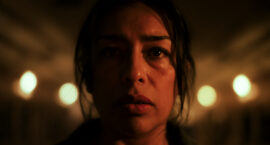
A gripping portrait of a Juárez factory worker who becomes an avenger after systemic violence against women goes unpunished, The Huntress (or La Cazadora) explores how myth, motherhood and desperation collide in a city where justice is scarce.

(This is one in a series of film reviews from the 2026 Sundance Film Festival, focused on films by women, trans or nonbinary directors that tell compelling stories about the lives of women and girls.)

Through Art and Storytelling, Artist Harmonia Rosales’ First Book Brings African-Centered Myths to Life

When Harmonia Rosales first unveiled The Creation of God in 2017—a reimagining of Michelangelo’s The Creation of Adam with a Black woman as the divine—she didn’t just challenge art history; she remade it in her image. With her brush, Rosales flipped the script on Western depictions of power, beauty and divinity, centering Black womanhood and African spiritual traditions long erased from the canon.

Her new book, Chronicles of Ori, continues that reclamation through story. A lushly illustrated volume rooted in Yoruba mythology, the work brings to life the Orishas, divine figures of West African cosmology, and weaves them together with familiar names like Eve—both biblical and mitochondrial—into a mythology that claims space for the African diaspora beyond enslavement.

“I felt that we needed a mythology,” Rosales told Ms. “We needed something to connect to besides enslavement, because that’s what seems to be in the Western canon.”

With Chronicles of Ori, she offers that connection: a world where African gods are unmasked, women embody creation itself, and the sacred is painted in brown skin. Through her art and her words, Rosales restores what history fragmented—melding spirituality, storytelling and imagination into what she calls a new kind of mythology, one that reclaims both memory and power.

Yearning to Breathe Free [Part 1 of 3]

In the matter of K-E-S-G-, a Salvadoran woman stalked and threatened by gang members was denied asylum by the U.S. Board of Immigration Appeals on July 18, even though her persecution stemmed from her gender in a country that treats women as property. Advocates warn that this ruling could make it much harder for women fleeing violence to prove gender-based claims and may embolden immigration judges to discount their stories.

“This isn’t the first time the Trump administration has singled out women seeking asylum, and we know where this path leads,” said Neela Chakravartula of the Center for Gender & Refugee Studies. “More judges denying protection to women who qualify for it. More refugees being deported to danger.”

The decision highlights the ongoing struggle to recognize gender as a protected basis for asylum. Afghan and Salvadoran women, among others, may now face even steeper barriers to protection—a chilling effect that experts say could deter survivors from seeking safety in the U.S.

This Hispanic Heritage Month, We Honor Immigrant Families by Fighting for Healthcare Justice

My family immigrated from Mexico to California when I was 3 years old. My brother wasn’t walking and was showing signs of physical delays. Unable to find answers back home, my parents sacrificed everything—our home, their small business, a familiar life—in search of a diagnosis, treatment and hope. This Latine Heritage Month, I’m reminded of the strength of the women in my family in the face of migration and uncertainty, and the extraordinary community in the U.S. that welcomed us. 

Immigrants have long been unable to healthcare because of coverage gaps or restrictions. Immigrant and migrant women have had especially difficult times getting access to abortions.

Healthcare access, including the full spectrum of reproductive care, can make or break lives. Nobody should be denied healthcare, no one should have to choose between paying for healthcare and rent, and no one should fear deportation for going to the doctor.

All of us should have access to care. Period.

(This essay is part of a collection presented by Ms. and the Groundswell Fund highlighting the work of Groundswell partners advancing inclusive democracy.)