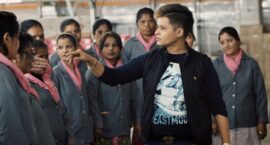
‘Pink Belt’ Documentary Follows Aparna Rajawat’s Mission to Train Women and Girls in Self-Defense Across India

Even as a child, Aparna Rajawat could see how boys in India were more respected, safer and freer than girls.

Wanting a way to defend herself, Rajawat cut her hair short and disguised herself as a boy, attending karate lessons behind her father’s back with the help of her mother and sister. By the time he discovered her secret, she was so good her coach was able to convince her father to let her continue. She went on to become a national champion and compete internationally, all while she was a teenager.

But that’s only the beginning of Rajawat’s story—a story in which her own achievements are only a backdrop to a life-long quest to inspire other Indian women and girls to achieve their dreams and protect themselves in a country where, despite its many advancements, incidents of sexual assault are still rampant and survivors struggle to get justice.

Enter Pink Belt Mission, Rajawat’s nonprofit, through which she works as a motivational speaker as well as training thousands of girls and women in self-defense.

It’s also the subject of a new documentary directed by John McCrite. A remarkable film, Pink Belt starts with Aparna Rajawat’s story, but goes much further, illuminating a path for anyone who cares about human rights to take that first step towards making a difference in their own communities and beyond.

Sundance 2026: ‘Run Amok’ Uses a High School Musical to Confront the Afterlife of School Violence and the Messy Work of Grief

Run Amok is a drama from Sundance’s U.S. competition, a debut feature written and directed by NB Mager, that notably and earnestly oscillates between quirky moments of comedy and profound reflections on how to navigate grief.

Run Amok never settles into a genre; it’s part coming-of-age, part drama, part satire, part socio-political indictment of U.S. gun culture, and part backstage high school musical.

(This is one in a series of film reviews from the 2026 Sundance Film Festival, focused on films by women, trans or nonbinary directors that tell compelling stories about the lives of women and girls.)

Sundance 2026: In Documentary ‘One in a Million,’ a Syrian Girl’s Life in Exile Reveals the Long Road After War

Winner of Sundance’s Audience Award in the World Cinema Documentary category, as well as the Directing Award for filmmakers Itab Azzam and Jack MacInnes, One in a Million lives up to its title. It homes in with a laser focus on the experiences of Israa, a Syrian girl whose family undertakes the perilous migration to Germany after the start of the Syrian civil war.

When the filmmakers first meet Israa in 2015, she is an inquisitive 11-year-old selling cigarettes on the street in Turkey while her family waits for the chance to cross the Mediterranean. The journey that follows—overcrowded rafts, long treks across multiple borders and nights spent sleeping on the street—contains harrowing moments, but it ultimately occupies only a sliver of the film’s larger story.

Once the family arrives in Germany, where the filmmakers check in with them over the next nine years, One in a Million reveals a far more complicated and intimate portrait of migration and acculturation.

As Israa grows from child to teenager to young adult, she navigates questions of identity, freedom and belonging, while her mother Nisreen becomes increasingly confident and independent in a country that offers opportunities she was denied in Syria. The result is a quietly riveting portrait of family life in transition, showing how the experience of displacement continues to reshape relationships, expectations and the possibilities of who each person might become.

(This is one in a series of film reviews from the 2026 Sundance Film Festival, focused on films by women, trans or nonbinary directors that tell compelling stories about the lives of women and girls.)

Sundance 2026: ‘Big Girls Don’t Cry’ Is an Empathetic, Slice-of-Life Portrait of One Teenage Girl’s Summer

For adults who’ve conveniently blocked out memories of their own teenage angst, director Paloma Schneideman’s Big Girls Don’t Cry may bring all those feelings roaring back—but it’ll also urge you to have a little empathy for the younger version of yourself.

A New Zealand entry in Sundance’s World Cinema Dramatic competition, the film is a sensitive, insightful portrayal of how teenagers struggle to sort out their own mixed motivations while shuttling constantly between big adult feelings and childlike urges.

(This is one in a series of film reviews from the 2026 Sundance Film Festival, focused on films by women, trans or nonbinary directors that tell compelling stories about the lives of women and girls.)

In Documentary ‘To Hold a Mountain,’ Motherhood Becomes a Form of Resistance, and Love of Land Becomes Political

In the remote mountains of Montenegro, a small community of herders tend their sheep and cattle, making cheese, harvesting wool, and maintaining traditions that have persisted for generations. But they also must passionately defend their rural life against the incursions of NATO, which wants to use their land as a military training ground because of its isolation and rugged terrain. A documentary premiering at Sundance, To Hold a Mountain follows the leader of the protest movement, a staunchly loving and protective woman named Gara, and her young charge, Nada.

The documentary film won this year’s World Cinema Grand Jury Prize for documentary film at Sundance. By remaining focused with meditative intensity on the quiet day-to-day of its subjects, the film presents an argument both deeply affecting and more effective than if its message were emblazoned across every frame. As the festival jury aptly put it, To Hold a Mountain, directed by Bijana Tutorov and Petar Glomazić, represents “the truest example of the power of cinema to make the personal political.”

(This is one in a series of film reviews from the 2026 Sundance Film Festival, focused on films by women, trans or nonbinary directors that tell compelling stories about the lives of women and girls.)

Sundance 2026: ‘Extra Geography’ Puts a Quirky, Tender Spin on a Familiar Boarding-School Tale

Extra Geography, the United Kingdom’s entry in the World Cinema Dramatic Competition at Sundance this year, is a funny, sweet and quirky coming-of-age story about two best friends in an all-girls English boarding school. Directed by Molly Manners and written by Miriam Battye, the film offers a wholly unique angle on a well-worn subgenre, reimagining the contours of youthful exuberance and teen ambition, as well as the conflicting feelings and confusing choices we make when we’re learning what it means to grow up.   

(This is one in a series of film reviews from the 2026 Sundance Film Festival, focused on films by women, trans or nonbinary directors that tell compelling stories about the lives of women and girls.)

Sundance 2026: Olive Nwosu’s Haunting Lagos-Set Drama ‘LADY’ Asks What Happens When You Can No Longer Tune Out the World

LADY is a film about perspective—about choosing what we see and how we see it, as well as what we decide is important. It’s also a film that consciously balances discomfort with bravery, weaving a tale about a woman on the cusp of a sea change, uncertain whether or not she’s willing to be taken up by its current. 

Winner of the 2026 Sundance World Cinema Dramatic Special Jury Award for Acting Ensemble, LADY is, according to the jury, “a film full of depth and texture and with a rhythm all its own, with an electric ensemble cast that brings life and humor and insight to a story about day-to-day challenges and finding safety in unexpected friendships.”

(This is one in a series of film reviews from the 2026 Sundance Film Festival, focused on films by women, trans or nonbinary directors that tell compelling stories about the lives of women and girls.)

Sundance 2026: ‘Barbara Forever’ Chronicles the Life and Work of Experimental Lesbian Filmmaker Barbara Hammer

Prolific lesbian feminist filmmaker Barbara Hammer’s refusal to be written out of history paid off, and Barbara Forever is full of evidence of the impact Hammer, both herself and her work, made on those around her. Beyond just telling the story of the life of a trailblazing lesbian filmmaker, the documentary is an intimate portrait of a fascinating and indomitable woman who treated life as the ultimate adventure.

Barbara Forever received Sundance’s Jonathan Oppenheim Editing Award for U.S. Documentary (the film’s editor is Matt Hixon), with its whirling, dynamic and comprehensive array of film and archival footage from an artist who voraciously documented her own life and the lives of others.

(This is one in a series of film reviews from the 2026 Sundance Film Festival, focused on films by women, trans or nonbinary directors that tell compelling stories about the lives of women and girls.)

Sundance 2026: The Tea Is Profitable. The Land Is Contested. Documentary ‘Kikuyu Land’ Tells the Story.

The Kikuyu are a tribal people located in the Kenyan highlands—a gorgeous region now dominated by enormous tea plantations, many owned by multinational corporations. 

As the documentary Kikuyu Land spells out, the farms are owned by wealthy Kenyans and multinational corporations who seem quite capable of hiding their exact provenance. One such corporation: consumer goods behemoth Unilever.

As news of journalists being abducted and people being killed over land disputes filters into the film, Nairobi-based journalist Bea Wangondu tries to track down a representative of Unilever willing to address the allegations against the plantations, going so far as traveling to its headquarters in London. When those efforts fail, she seeks answers in archival records. But, as she digs into her own family and its claims to Kikuyu land, she discovers an upsetting history of complicity and betrayal.

The documentary is a gripping investigation with stakes that are both intimately personal and startlingly global, contrasts the arresting beauty of its geographical setting with the dark underbelly of its secrets.

(This is one in a series of film reviews from the 2026 Sundance Film Festival, focused on films by women, trans or nonbinary directors that tell compelling stories about the lives of women and girls.)

Sundance 2026: The Masculinist and Eugenicist Origins of AI Are Writ Large in Documentary ‘Ghost in the Machine’

A fast-paced Sundance documentary, Ghost in the Machine traces how modern AI’s obsession with “intelligence” and innovation is rooted in the eugenicist, sexist and racial hierarchies that have long shaped Silicon Valley and its technologies.

(This is one in a series of film reviews from the 2026 Sundance Film Festival, focused on films by women, trans or nonbinary directors that tell compelling stories about the lives of women and girls.)