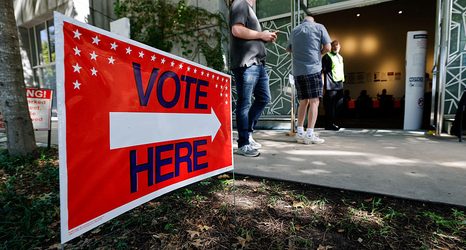
With 64 seats at stake in state supreme court races this year, voters will help decide who rules on abortion access, voting rights and the fairness of congressional maps.
There are 31 state supreme court elections across the country in 2026 with 64 seats at play. The justices who will fill those seats will issue rulings that could shape issues from abortion access to voting rights.
Former U.S. Attorney General Eric Holder Jr. (appointed by President Barack Obama in 2009) says no one can afford to sit on the sidelines in this election cycle.
“State supreme court rulings have protected abortion rights. By contrast, state supreme court rulings have outlawed IVF [in vitro fertilization]. There are state supreme courts that protected voting rights and struck down gerrymanders. And there are state supreme courts that allowed really reckless politicians to make it harder for American citizens to vote. So state supreme courts are extremely important guardians of democracy and people’s liberty.”
As chair of the National Democratic Redistricting Committee, considered the centralized hub in the fight for fair legislative maps, Holder is paying particular attention to the race in North Carolina between state Supreme Court Justice Anita Earls and former state Rep. Sarah Stevens, who held various GOP leadership roles in the legislature. Earls, first elected to the bench in 2018, is one of two Democratic justices on the high court and the court’s only Black justice. The outcome of this year’s race could have significant consequences for how the court decides issues like partisan gerrymandering—the drawing of legislative districts to favor one political party over another.

Holder says the state Supreme Court’s current 5-2 Republican majority could shift over the next few years, which he believes will directly impact people’s right to vote.
“And with the United States Supreme Court weakening [and] gutting the Voting Rights Act of 1965,” he adds, “it will be the state courts again, using the state constitutions, where we’ll try to protect the interests of African Americans and other minorities.”
Unlike federal judges and U.S. Supreme Court justices, those serving on state supreme courts do not have lifetime terms, with the exception of Rhode Island. They come to the bench in six different ways, depending on the state’s individual selection process:
- appointment by the sitting governor
- election by voters in partisan contests, where political party labels are shown on the ballot
- election by voters in nonpartisan contests
- merit selection, in which an independent nominating committee screens candidates and sends the governor a short list
- legislative election, in which the state legislature votes to elect the judge (only Virginia and South Carolina use this method)
- a hybrid system (used by four states)
The length of a justice’s term depends on each state’s constitution and legislative statutes.
In recent years partisan elections have become political flashpoints.
In 2025, for example, incumbent North Carolina Supreme Court Justice Allison Riggs, the other Democrat on the court, defended her election bid against Court of Appeals Judge Jefferson Griffin. After Riggs won her seat by 734 votes, Griffin waged a six-month legal challenge to throw out more than 60,000 votes that he claimed were cast by ineligible voters. He later conceded, but only after two recounts confirmed the results and a federal court ordered the state to certify the election.
The influence of big money has also drawn attention in high-profile elections, including the 2025 Wisconsin Supreme Court race. Liberal candidate Susan Crawford defeated conservative Brad Schimel for a 10-year seat vacated by retiring liberal jurist Ann Walsh Bradley in what was the most expensive judicial election in U.S. history. Campaign spending from both conservative and liberal groups topped $100 million, with organizations linked to billionaire Elon Musk contributing, by some accounts, more than $25 million to elect Schimel. Although Wisconsin elects its Supreme Court justices in statewide nonpartisan contests, Crawford’s victory maintains a 4-3 liberal majority on the court.
Also in 2025, a dark-money campaign tied to billionaire Jeff Yass targeted three Democratic justices of the Pennsylvania Supreme Court in their retention elections. Justices Christine Donohue, Kevin Dougherty and David Wecht had in 2018 thrown out a congressional map for unconstitutionally favoring Republicans. Despite misleading attack ads targeting them, all three won their retention votes.
Back in 2022, North Carolina’s Supreme Court included four Democrats and three Republicans. That court ruled that extreme partisan gerrymandering violated the state constitution. It ordered that the districts be redrawn, and the resulting map led to seven Democrats and seven Republicans being sent to Congress from North Carolina that year.
In January 2023, the court flipped to Republican control. The new court reheard the case, and its five Republican justices ruled that the legislature can draw districts however it chooses.
After the 2024 election, North Carolina sent 10 Republicans and four Democrats to Congress. Election research and advocacy groups contend that had the court remained controlled by Democrats, it is likely that North Carolina’s congressional delegation would not have changed.
Shedding light on state supreme courts and the everyday consequences of their rulings is part of the mission of Alliance for Justice, a nonprofit advocacy organization that tracks federal and state courts’ activity and judicial nominations. According to AFJ president Rachel Rossi, state supreme courts matter because they have become the last line of defense for the protection of rights that federal courts are stripping away.
“In Montana in 2024, the state Supreme Court struck down two laws that would have limited Native American voters’ access to the ballot. That court also protected the use of student IDs and the state’s ability to send ballots to individuals under 18 who would have turned 18 on Election Day. So, you know, critical democracy and voting rights rulings,” Rossi tells Ms. She notes, “In 2025, the Montana state Supreme Court struck down a 20-week abortion ban and restrictions on medical abortion.”
According to State Court Report, a project of the Brennan Center for Justice at NYU School of Law, states to watch for political flashpoints in 2026 include Wisconsin, North Carolina, Washington, Montana and Michigan.
This article originally ran in the Fall 2026 print issue as “Races That Could Shape Our Rights.” Become a Ms. member and get magazines delivered right to your mailbox.