

A Feminist Historian’s Year-End Reading and Viewing Guide

As the year winds down, I find myself returning—as I always do—to the stories, performances and ideas that have shaped my teaching and thinking. Feminism’s past is never really past; it’s a living archive we carry with us, full of unresolved questions, missteps, breakthroughs and beautiful, complicated people. This year’s reading and viewing list reflects that sensibility.

Liberation forces its contemporary narrator—and its audience—to reckon with the impossible expectations we’ve placed on small groups of women in church basements.

Molly Jong-Fast’s memoir presses on the tender, maddening ties between feminist foremothers and the daughters who grew up in their shadow.

Sarah Weinman’s study of spousal rape laws exposes just how recently the law stopped treating wives’ bodies as open territory—while showing how fiercely survivors and advocates have had to push for change that should never have been controversial.

Sex, Power and Impunity: Epstein’s Legacy in Historical Perspective

The scandal that has preoccupied much of mainstream U.S. politics has, been, at one level, delightful: We have seen extremist Republicans—Reps. Marjorie Taylor Greene, Lauren Boebert, Thomas Massie and Nancy Mace—break with their party and its president in an effort to force into light the U.S. Department of Justice files on convicted sex trafficker and pedophile Jeffrey Epstein. 

The story is almost irresistible for critics of the current national administration, feminists among them: Will we finally get to items from Epstein like the CD labeled “girl pics nude book 4”? What might these materials reveal? And whose misbehavior might they reveal?  

Fire the starting gun on analyses from every liberal, left, critical corner. Claims abound of shifting coalitions, changing tides, pages turned, a president’s authority shredded. 

But there are still as many questions stirring in the Epstein pot as there are answers. Why did these particular Republicans break from the pack? Is this a contemporary Republican version of feminism? 

And beneath them all: What good does it actually do us—or Epstein’s particular victims, or the scads of other victims of sexual coercion, trafficking and other mistreatment—to raise the heat so high on this particular scandal?

‘Feminism, Fascism and the Future’: Sociologist Laurie Essig on Dissolving Democracies in Russia and the U.S.

Sociologist and author Laurie Essig has decades of experience studying and visiting Russia (and before that, the Soviet Union). Her first book, Queer in Russia, chronicles and analyzes the time between the dissolution of the USSR and the solidification of Putin’s non- (or anti-)democratic rule in Russia.

As Trump’s second term intensifies anti-gender rhetoric, sociologist Laurie Essig draws chilling parallels between rising U.S. authoritarianism and decades of state-sponsored repression in Putin’s Russia.

“One of the things we can learn from Russia is just how important resistance is. There were moments when things could have gone differently. They didn’t, but I don’t think that was pre-ordained. …

“Every strongman, every dictator we look at, had anxiety about masculinity.”

On America’s 250th Anniversary, Let’s Remember Women’s Stories: The Ms. Q&A with Jill Hasday

The United States’ 250th anniversary in 2026 presents an opportunity to include women in the stories America tells about itself, according to Jill Hasday, author of the important new book, We the Men: How Forgetting Women’s Struggles for Equality Perpetuates Inequality.

We the Men tells the stories “of so many women who deserve to be remembered,” said Hasday. It also explores the ways in which forgetting women’s ongoing struggles for equality has perpetuated injustice and promote complacency. Remembering women’s stories more often and more accurately can help the nation advance toward sex equality.

Trump’s Detention of Pro-Palestinian Protester Marks Dark Turning Point in U.S. Jewish History

Days before Purim, the Jewish “festival of the lots,” the Trump administration arrested Mahmoud Khalil, a U.S. green card holder whose spouse is a U.S. citizen, because of his role in anti-Israel or pro-Palestinian protest activity at Columbia University.

This is a terrible breach of civil libertarian principles and university cultures of critique and dissent. Immigration and naturalization are being pulled back, it seems, into an early-20th-century mode in which ambiguous standards of what constitutes acceptable or unacceptable political speech become grounds for admission or deportation from the U.S.

Conservative Supreme Court to Rule on Right to Be Trans, Medical Care, Parents’ Rights, Constitutional Sex Discrimination—and the Right to Be Different

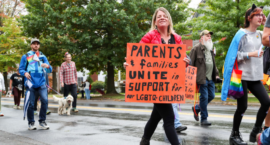
“I’m here to stand up for my kid,” Brian Williams told me outside the Supreme Court on Dec. 4. Williams and his wife Samantha have been fighting for their daughter—known as L.W. in the legal papers the ACLU filed to challenge Tennessee’s ban on gender-affirming medical care for minors—for years.

Though difficult to sit through, the two-plus hours of argument in United States v. Skrmetti—a challenge by trans youth, their families, the ACLU, Lambda Legal and the Biden administration to Tennessee’s ban on gender-affirming care for minors—was a nearly perfect distillation of this moment in our gender politics.

Stop Trashing Trans People. Get Smarter About Gender.

Throwing trans and nonbinary people under the bus is a terrible compromise to the very authoritarian ambitions that liberals say they’re stepping up to fight. We need more love and support for people who are stigmatized and under assault, not less. And we desperately need more understanding of sex, gender and sexuality.

Let’s equip ourselves with the intellectual tools that will help us understand how would-be tyrants use gender to divide us.