The United States Is No Country for Mothers. (Not Yet.)

For 250 years, America has asked mothers to carry the weight of families, communities and the economy while offering little in return. We celebrate motherhood rhetorically, but our policies tell a different story: unaffordable childcare, inadequate paid leave and a culture that blames women for structural failures. In this essay, I argue that these conditions are not accidental—they are the result of political choices that have excluded mothers from full participation in economic and civic life.

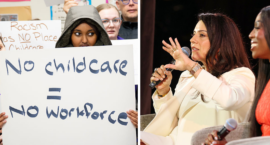
If we are serious about building a stronger democracy for the next 250 years, we must start with childcare. Universal, affordable childcare is not a fringe idea; it is the foundation that makes equal pay, workforce participation, political engagement and family well-being possible. States like New Mexico and New York are already demonstrating what can happen when leaders treat care as public infrastructure rather than a private burden.

The good news is that mothers are increasingly refusing to be divided by the same culture wars that have stalled progress for generations. Across political lines, families want the same basic thing: the ability to work, raise children and participate fully in their communities without being pushed to the breaking point. The future of American democracy depends on whether we finally build a country that works for mothers.

(This is part of a new miniseries FEMINIST 250: Democracy’s Feminist Future, a special Ms. series examining the next chapter of American democracy through a feminist lens. As the nation approaches its 250th anniversary, the series explores how women and marginalized communities have shaped democratic progress, what lessons history offers for the challenges ahead, and how a more inclusive, representative and equitable democracy can be built for the next 250 years.)


Childcare Won’t Be Fixed Until Moms and Dads Join Forces

The Trump administration would have you believe they’ll try anything to have more babies. Their proposed list of incentives include medals for mothers who have more than six children, classes to educate women about their menstrual cycles and special seats reserved in the Fulbright program for applicants with children. Anything, that is, except the glaringly obvious solutions: affordable, accessible childcare and paid parental leave.

If we want to secure policies that will benefit all parents, then we need to come together, breaking down the silos between those advocating for men and those advocating for women. After all, we want the same things: affordable childcare, paid leave and a living wage for all families.

The False Promise of Split-Shift Parenting

In a country where roughly two out of every five parents struggle to afford care for their kids, many couples have resorted to parenting in shifts: One parent looks after the kid(s) while the other works, and then they swap.

I asked my social media followers: What is split-shift parenting like in 2023? One word popped up over and over again: exhausting. And when the whole family is stretched thin, we know exactly who picks up the slack: moms.

Moms deserve more options. Better options. Sustainable options—and they need them urgently. 

Without the Public Infrastructure Needed to Support Families, Moms Will Continue to Feel Like Failures

Let’s call it what it is: Moms are in a mental health crisis. Even before COVID, one study found that more than 90 percent of moms reported feeling lonely after having kids, over one-third said they cried regularly, and more than half suffered from anxiety.

After the pandemic hit, fully half of American moms with young kids reported feeling “serious loneliness”; the same number noted a marked mental health decline since the pandemic’s onset.