Keeping Score: Voters Disapprove of Kristi Noem and ICE; Winter Olympics Nears Gender Parity; Challenges to State Abortion Bans Continue

In every issue of Ms., we track research on our progress in the fight for equality, catalogue can’t-miss quotes from feminist voices and keep tabs on the feminist movement’s many milestones. We’re Keeping Score online, too—in this biweekly roundup.

This week:
—“Kristi Noem sees immigrants like me as subhuman,” says Santiago Mayer, executive director of Voters of Tomorrow.
—A majority of U.S. voters think DHS Secretary Kristi Noem should be removed, and disagree with how ICE is operating.
—Women are 47 percent of athletes at the Winter Olympics in Milan.
—California Gov. Gavin Newsom fired back at threats from Louisiana over abortion protections.
—President Trump appointed no women of color to federal judgeships in his first year in office.
—A new Kansas law introduces a “bounty hunter” aspect to transphobic bathroom bills.
—Some ICE detention facilities and prisons refuse to provide appropriate menstrual products.
—A Kentucky couple was arrested over a year after seeking care for a miscarriage.
—A wave of “common sense” candidates, more than half women, recently won competitive school board races in swing states. Sixty-two percent of “extremist” candidates lost their elections, showing that culture war tactics like book bans may no longer resonate with local voters.

… and more.

A White House Invite, a Punchline—and a Choice for the Men of Team USA

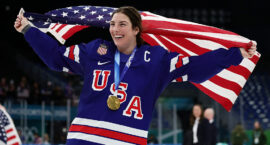
Both the U.S. women’s and men’s ice hockey teams won gold at the 2026 Milan-Cortina Winter Olympics. Yet, within hours of defeating Canada, only the U.S. men’s hockey team received a congratulatory call from President Donald Trump and an invitation to the White House.

What should have been a routine celebration of athletic excellence instead became a revealing cultural moment. 

After extending the invitation, the president joked, “I must tell you, we’re going to have to bring the women’s team,” adding that he would “probably be impeached” if they were not invited. Laughter followed.

Some have dismissed the comment as harmless—just a joke, just locker room talk, boys being boys. But humor has long been one of the ways inequalities sustains itself. Framed as harmless, softened by laughter and repeated often enough, it teaches audiences what is acceptable and what feels risky to challenge.

When women’s inclusion becomes a punchline, the triumph no longer belongs equally to everyone it represents.

The Intensity and Perfectionism That Drive Olympic Athletes Also Put Them at High Risk for Eating Disorders

Olympians—athletes at the top of their sport and in prime health—are idolized and often viewed as superhuman. These athletes spend their lives focusing on building physical strength through rigorous training and diets that are honed to provide the nutrients necessary to excel at their sport.

However, athletes are at considerable risk for eating disorders and having an unhealthy relationship with food and their bodies.

Lindsey Vonn Redefines The Limits of Possibility 

Last Sunday, I woke before dawn to watch 41-year-old ski legend Lindsey Vonn race Olympic downhill at the Milano Cortina Games—the oldest woman ever to start the event and the first to do so with a knee replacement. Nearly seven years after retiring, she returned to the Olympic start gate with a torn ACL and decades of accumulated injuries, propelled by the same resolve that once made her the most decorated female alpine skier in history.

As I watched her charge down the course, cheered on by teammates, family and a global audience, I found myself asking the same question reverberating across sports media: Could she once again defy the limits imposed on her body, her age and her ambition?

When Vonn crashed seconds into the run, the reaction revealed just how persistent those limits still are. While elite skiers—men and women alike—routinely crash when pushing for hundredths of a second, her fall was framed by some as proof that a 41-year-old injured woman had overreached, rather than as the calculated risk that defines downhill racing. What moved me most wasn’t just the loss of a potential medal but the familiar scrutiny that followed: critiques of her age, her body and her decision to try at all. Her return alone had already stretched what we imagine is possible for women in sport. The fall, though painful to witness, underscored something more enduring—her insistence on defining her own limits in a world still unsettled when women refuse to accept theirs.

Ms. Global: Iranian Women’s Resistance, Gaza’s Reproductive Care Crisis and More

The U.S. ranks as the 19th most dangerous country for women, 11th in maternal mortality, 30th in closing the gender pay gap, 75th in women’s political representation, and painfully lacks paid family leave and equal access to health care. But Ms. has always understood: Feminist movements around the world hold answers to some of the U.S.’s most intractable problems. Ms. Global is taking note of feminists worldwide.

This week: stories from Iran, Gaza, the International Olympic Committee, and more.

Olympians on Olympians: Women Athletes Honor the Trailblazers Who Made Today’s Games Possible

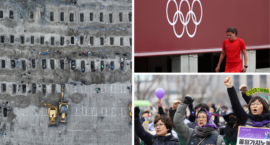
Organizers of the 2026 Milano-Cortina Winter Olympics are touting “the most gender-balanced Olympic Winter Games in history,” reflecting years of pressure from athletes who have questioned why women and men do not always have the same number of events or chances to participate.

These gains did not happen on their own—they are the result of sustained advocacy by women athletes who have pushed the International Olympic Committee to expand women’s participation, add events, and commit to gender equity in both athlete quotas and medal opportunities. Even as parity edges closer, competitors and supporters continue to call out the remaining gaps—keeping the pressure on Olympic leadership to deliver full equality across all sports.

Women’s and Girls’ Wrestling Is Ready for Its Modern Era

Women’s and girls’ wrestling has grown considerably in the U.S. since the late ’80s. After the sport’s debut at the 2004 Olympics in Athens, more and more girls began joining high school wrestling teams as more high schools began making teams for girls.

Although the sport carries a long history, women’s wrestling is now more popular than it’s ever been. The sport seeks to create community after being ignored for many years, and will be featured at the 2028 Olympic Games in Los Angeles. It will be in that moment in Los Angeles, under the Olympic flame, that women’s and girls’ wrestling will close the chapter of its trailblazing journey and launch into a modern era.

Calling Foul: Breaking Down WNBA Pay and Why It Matters

There’s a long history of women in sport fighting for equal pay, and what’s happening with the WNBA today is less of a mirror of the current gender pay gap and more of a throwback to a time when women’s efforts were even more deeply devalued. The WNBA is a visible legacy of Title IX, and an indication of how far there is left to go. 

These are women at a pinnacle of professional achievement, who are still beholden to structural barriers. This is not a sports issue. It is a feminist issue.

Ms. Global: Starvation’s Effects on Women in Gaza, Gisele Pelicot Awarded France’s Legion of Honor, Taliban Enforces Dress Laws for Women, and More

The U.S. ranks as the 19th most dangerous country for women, 11th in maternal mortality, 30th in closing the gender pay gap, 75th in women’s political representation, and painfully lacks paid family leave and equal access to health care. But Ms. has always understood: Feminist movements around the world hold answers to some of the U.S.’s most intractable problems. Ms. Global is taking note of feminists worldwide.

This week: News from Gaza, Thailand, Canada, and more.