10 Must-Read Stories on Women in Politics This Week: Title IX Anniversary, AI’s Anti-Women Bias and Ranked-Choice Voting Victories

Weekend Reading on Women’s Representation is a weekly compilation of stories about women’s representation in politics, on boards, in sports and entertainment, in judicial offices and in the private sector in the U.S. and around the world—with a little gardening and goodwill mixed in for refreshment! Published every Friday.

—This week marked the 54th anniversary of Title IX.
—As the Taliban approaches the five-year mark of its return to power this August, a rare protest in western Afghanistan last week laid bare both the brutality of its rule and the resilience of those living under it.
—A woman will replace Eric Swalwell in California … but for not two more months.
—A study of 133 AI systems found that 44 percent demonstrated gender bias, and more than a quarter showed both gender and racial bias.

… and more.

Peace Without Women? Ongoing Peace Talks and War Negotiations Keep Leaving Women Behind

As negotiations over conflicts across the Middle East continue, one pattern remains stubbornly familiar: women are largely absent from the room. From Gaza to Iran, women are bearing the costs of conflict, repression, displacement and economic collapse even as negotiations over security, governance, reconstruction and political transition move forward without their meaningful participation.

This exclusion has consequences far beyond representation. Decisions about who governs, who receives aid, who returns home and who is protected shape whether societies emerge from conflict more secure or more fragile. When women are kept outside these processes, transitions risk reinforcing the inequalities and grievances that helped drive conflict in the first place.

Trump’s Executive Order to Restrict Vote by Mail Is a Five-Alarm Fire

Republican voters regularly use mail-in voting. Nearly one in five registered Republicans vote by mail. One in four Democrats does too.

Data on who votes by mail suggests that many Americans trust and rely on it.

Trump himself uses mail voting. He has defended casting his own ballots by mail, saying he did it “because I’m president” and “I had a lot of different things” to do.

Trump has repeatedly tried to restrict Americans’ ability to vote by mail. His latest effort, following several failed attempts, began with an executive order he signed on March 31: “Ensuring Citizenship Verification and Integrity in Federal Elections.” The order seeks to shift authority over federal elections from the states—which the Constitution grants primary responsibility for administering elections—to the federal government.

There are, of course, lawsuits challenging this executive order. The challenges to this executive order may well determine how and when you vote this November. So I asked my Brennan Center colleague Wendy Weiser, one of the lawyers in the League of Women Voters case, to share her perspective.

This Week in Women’s Representation: LA’s Next Mayor Will Be a Woman; Ranked-Choice Voting in Maine May Help Elect Back-to-Back Woman Governors 

Weekend Reading on Women’s Representation is a compilation of stories about women’s representation in politics, on boards, in sports and entertainment, in judicial offices and in the private sector in the U.S. and around the world—with a little gardening and goodwill mixed in for refreshment!

—Los Angeles is sure to keep a woman as mayor, after City Council member Nithya Raman secured a spot in a runoff, currently holding 29 percent of the vote compared to Karen Bass’ 34 percent.
—June 11 marked the birthday of former U.S. Rep. Jeannette Rankin, the first woman elected to federal office in the U.S.
—On June 16, Washington, D.C., will hold its first primary elections with ranked-choice voting.
Liberation playwright Bess Wohl is the first American woman to win the Tony for Best Play since 1989.

… and more.

Buckle Up, the Primaries Are Coming: From New Mexico to California, Women’s Representation Is on the Ballot

Weekend Reading on Women’s Representation is a compilation of stories about women’s representation in politics, on boards, in sports and entertainment, in judicial offices and in the private sector in the U.S. and around the world—with a little gardening and goodwill mixed in for refreshment!

This week:

—June primary contests will take place in 18 states.
—Concerning trends are taking place for women’s representation in New Jersey.
—The American Women’s History Museum on the National Mall is at risk.
—All 15 men in Donald Trump’s original Cabinet remain, but four of its seven original women are now left.

… and more.

Election Conspiracies Are Moving From Rhetoric to Government Action

Attacks on the legitimacy of U.S. elections are no longer confined to conspiracy theories circulating online—they are increasingly shaping government action at the local level.

In Riverside County, Calif., Sheriff Chad Bianco seized roughly 650,000 ballots from a 2025 special election based on fraud allegations that election officials say stem from misleading interpretations of preliminary voting data. Courts have since intervened, with the California Supreme Court ordering the investigation paused while litigation continues.

I spoke with Jill Garvey, co-director of States at the Core, about what these escalating “election integrity” efforts mean for democracy and public trust.

Garvey says many of the activists driving these claims understand election systems far better than they let on—and are intentionally using confusion around technical election data to sow distrust in the voting process.

Even when election officials fully explain the data and publicly refute the allegations, she said, demands for investigations continue, helping fuel a broader narrative that elections cannot be trusted.

Garvey sees these efforts as part of a larger strategy testing how far local officials can go in challenging election systems and democratic norms.

But she also points to growing community-level organizing and civic engagement in response. The groups advancing these claims, she noted, are relatively small compared to the hundreds of thousands of voters affected by their actions—a reminder that local communities still have significant power to push back against efforts to undermine confidence in elections.

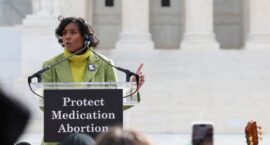
Women’s Health Is a Democracy Issue—and a Midterm One

It is critically important to keep reproductive health and the chaos at the Food and Drug Administration (FDA) front and center in the headlines. Why? Two words: midterm elections.

Last week, within 48 hours of each other the Supreme Court issued an emergency stay pausing the Fifth Circuit’s attempt to let Louisiana negate the FDA rule that allows telehealth provision and mail delivery of mifepristone, and FDA commissioner Marty Makary announced his immediate resignation after rumors that President Trump was planning to fire him.

Though Makary’s antipathy toward deregulation of flavored vapes appears to have triggered his fall from grace, and the rest of the chaos is perhaps business as usual, the Trump administration’s tip-toe approach to mifepristone is the real story.

The Justice Department’s litigation approach seemingly has been to wait until October when the FDA’s so-called “safety review” is due—ordered despite the mountain of evidence proving mifepristone’s safety and efficacy. But reports indicate that study has not even begun and is mired in data delays caused by the Department of Health and Human Services.

Foot-dragging? Finger-pointing? Old-fashioned incompetence? Who can tell anymore. But it surely hews to Republicans’ favor to keep the entire endeavor out of public sight, given that the vast majority (68 percent) of adults in this country oppose banning mifepristone.

The Frisco Test: What Happened in One Texas Suburb Signals a National Shift

Earlier this month, an Indian slate ran for Frisco City Council and school board: Sreekanth Reddy, Vijay Karthik and others. Every one of them lost.

As it turns out, in America, you can be the most educated demographic in America and still watch a sitting member of Congress call your religious traditions “Third World.” You can have a $151,200 median household income and still feel unsafe wearing your cultural clothing in public. You can have a vice president whose wife is Indian American and watch the president repost a podcaster who calls your country of origin a hellhole.

The achievement is real. The immunity it was supposed to purchase is gone.

Political scientists describe three options for a dissatisfied constituency: Exit, voice or loyalty. Indian Americans are exercising none of them cleanly. They are not leaving—37 percent have never considered it. They are not organizing. Their attachment to either party is measurably eroding.

What they are doing is waiting: making individual calculations, reading the room, finding both parties wanting. When a diaspora adapts individually rather than responds collectively, both parties get to pretend the problem does not exist.

Five million people with nowhere to go is not a problem for Indian Americans. It is an opportunity for whoever figures out how to meet them where they are. So far, at the national level, nobody has shown up.

States Already Enacting Harmful SAVE Act Policies, Requiring Proof of Citizenship to Vote

Congressional Republicans are once again prioritizing the SAVE Act, legislation that would force Americans to show documents like a passport or birth certificate to register to vote. The House has already passed yet another version of the bill, but so far it has stalled in the Senate.

If the SAVE Act becomes law, it would block millions of eligible American citizens from voting.

As the Senate considers the SAVE Act, state legislatures are advancing similar “show-your-papers” policies. Florida, South Dakota and Utah have enacted similar laws in recent weeks. Other states that already have similar laws have experienced the difficulties of implementing them.

Including Arizona, which has had a proof-of-citizenship requirement for over 20 years, five states will have a show-your-papers requirement for all voters for the 2026 midterms: Arizona, New Hampshire, South Dakota, Utah and Wyoming. A sixth state, Louisiana, has one on the books that it has not yet implemented.

That’s a lot of strain on the election system to solve a problem that doesn’t exist. The U.S. Senate would be wise not to inflict those obstacles on every election official nationwide.

A Government for Big Tobacco and Bigger Families

The Department of Health and Human Services (HHS) made multiple headlines last week—starting with the apparent implosion of Dr. Marty Makary’s tenure as Food and Drug Administration commissioner. But beneath the chaos lies something more troubling: a federal health apparatus increasingly shaped by antiabortion pressure campaigns, pronatalist messaging and culture-war governance masquerading as public policy.

From the Supreme Court fight over mifepristone access to the Trump administration’s bizarre new moms.gov initiative—complete with links to antiabortion crisis pregnancy centers and rhetoric about Americans being “under-babied”—the week offered a revealing snapshot of where U.S. health policy is headed. Meanwhile, flavored vape approvals for Big Tobacco sailed through the FDA, even as reproductive healthcare access remains under constant attack.

Chaos may be Trump’s currency, but the throughline here is ideology: rewarding conservative allies, policing reproductive autonomy and repackaging motherhood as a nationalist project while offering little meaningful material support to actual families.