The Ranked Ballot Is the Pro-Women, Pro-Voter, Pro-Democracy Reform America Needs

For 250 years, the story of American democracy has been a story of expanding who holds power and who gets to decide who yields it.

The 15th Amendment, the 17th, the Voting Rights Act, the 19th Amendment and the 26th—each was a structural intervention, a deliberate redesign of the rules to bring more people into the democratic process. And at each iteration, a bet was made on the same proposition: Democracy works better when more people have real power within it.

We are overdue for the next chapter.

Women make up 51 percent of the American population and hold fewer than 29 percent of seats in Congress. That gap is not a product of insufficient ambition, inadequate candidates or a thin pipeline of viable women. It is the product of an electoral system that was designed before women could vote, and has never been fundamentally redesigned since.

Ranked-choice voting changes that. The ranked ballot is the single most powerful, best-documented structural reform available for advancing women’s political participation, and it serves every voter, at every level of government, on every ballot.

In a ranked-choice voting election, voters rank candidates in order of preference—first choice, second and third—and if no candidate wins a majority outright, the candidates with the fewest votes are eliminated and their votes are redistributed until someone reaches a winning threshold.

Under this system, voters can express a genuine preference without fear of wasting their vote on a candidate who can’t win, and qualified women candidates can run without fearing splitting the vote.

(This is part of a new series FEMINIST 250: Democracy’s Feminist Future, a special Ms. series examining the next chapter of U.S. democracy through a feminist lens. As the nation approaches its 250th anniversary, the series explores how women and marginalized communities have shaped democratic progress, what lessons history offers for the challenges ahead, and how a more inclusive, representative and equitable democracy can be built for the next 250 years.)

Democratizing America’s Lawmaking Institutions: Why Feminists Should Stop Waiting for Congress and the Court

A feminist pro-democracy agenda must include new lawmaking institutions that can ensure our democracy is more inclusive, more democratic, more representative, and more responsive to the needs of all the people who call America home.

The past decade has brought two major failures of existing institutions to establish the basic requirements of non-patriarchal democracy: Congress’ failure to add the Equal Rights Amendment (ERA) to the U.S. Constitution and the Supreme Court’s failure to guard women’s constitutional right to control their reproductive lives. After calling out these outrages and trying to reverse them for years, it’s time for feminists to confront the deeper causes of these failures: the dysfunctional lawmaking institutions that were created by the Constitution over 200 years ago to govern the nation.

(This is part of a new miniseries FEMINIST 250: Democracy’s Feminist Future, a special Ms. series examining the next chapter of American democracy through a feminist lens. As the nation approaches its 250th anniversary, the series explores how women and marginalized communities have shaped democratic progress, what lessons history offers for the challenges ahead, and how a more inclusive, representative and equitable democracy can be built for the next 250 years.)

No Equality Without Paid Leave

The U.S. remains one of the only wealthy nations without a national paid leave program.

That failure has profound consequences for women’s economic security, caregiving responsibilities and ability to participate fully in public life: Every day, workers are forced to choose between caring for a new baby, recovering from illness or supporting a loved one and keeping a paycheck. Those impossible choices fall disproportionately on women, reinforcing gender inequities at work, at home and in civic life.

Paid leave is not simply a workplace benefit; it is a cornerstone of a more equitable democracy. When women are pushed out of the workforce, lose income or shoulder the overwhelming burden of unpaid care, they have less time, fewer resources and fewer opportunities to participate in their communities and shape public life.

Change is possible. States across the country have already demonstrated paid family and medical leave works, and overwhelming majorities of voters support it. If we are serious about creating a more inclusive future, guaranteeing paid leave for all workers must be part of the agenda. Women cannot be equal citizens without it.

(This is part of a new miniseries FEMINIST 250: Democracy’s Feminist Future, a special Ms. series examining the next chapter of American democracy through a feminist lens. As the nation approaches its 250th anniversary, the series explores how women and marginalized communities have shaped democratic progress, what lessons history offers for the challenges ahead, and how a more inclusive, representative and equitable democracy can be built for the next 250 years.)

A Case for Court Reform

For generations, Americans have expanded the meaning of “We, the People”—not because our institutions did it on their own, but because ordinary people demanded it.

From U.S. Rep. Barbara Jordan’s powerful reminder that the Constitution did not originally include everyone, to the hard-fought victories that secured civil rights, voting rights and reproductive freedom, our democracy has always depended on people pushing institutions to live up to their promises.

Today, the Supreme Court stands at the center of that struggle.

While courts remain an essential safeguard against abuses of power, public confidence in the Court has eroded amid ethics concerns, increasing politicization and decisions that have narrowed rights and weakened democratic protections.

If the Court is to serve as a guardian of liberty for future generations, it must be willing to change—through reforms that promote accountability, transparency and greater public trust.

As the nation marks its 250th anniversary, we should remember that our institutions are not fixed. The Constitution was designed to evolve, and the Court has changed before in response to the demands of the American people. Whether through term limits, stronger ethics rules or other structural reforms, the question is not whether the Court can change, but whether we will insist that it does.

A democracy that truly serves all of us depends on nothing less.

(This is part of a new series FEMINIST 250: Democracy’s Feminist Future, a special Ms. series examining the next chapter of U.S. democracy through a feminist lens. As the nation approaches its 250th anniversary, the series explores how women and marginalized communities have shaped democratic progress, what lessons history offers for the challenges ahead, and how a more inclusive, representative and equitable democracy can be built for the next 250 years.)

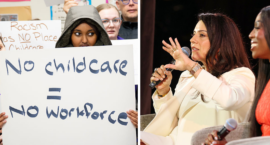
The United States Is No Country for Mothers. (Not Yet.)

For 250 years, America has asked mothers to carry the weight of families, communities and the economy while offering little in return. We celebrate motherhood rhetorically, but our policies tell a different story: unaffordable childcare, inadequate paid leave and a culture that blames women for structural failures. In this essay, I argue that these conditions are not accidental—they are the result of political choices that have excluded mothers from full participation in economic and civic life.

If we are serious about building a stronger democracy for the next 250 years, we must start with childcare. Universal, affordable childcare is not a fringe idea; it is the foundation that makes equal pay, workforce participation, political engagement and family well-being possible. States like New Mexico and New York are already demonstrating what can happen when leaders treat care as public infrastructure rather than a private burden.

The good news is that mothers are increasingly refusing to be divided by the same culture wars that have stalled progress for generations. Across political lines, families want the same basic thing: the ability to work, raise children and participate fully in their communities without being pushed to the breaking point. The future of American democracy depends on whether we finally build a country that works for mothers.

(This is part of a new miniseries FEMINIST 250: Democracy’s Feminist Future, a special Ms. series examining the next chapter of American democracy through a feminist lens. As the nation approaches its 250th anniversary, the series explores how women and marginalized communities have shaped democratic progress, what lessons history offers for the challenges ahead, and how a more inclusive, representative and equitable democracy can be built for the next 250 years.)

For the People: The Case for a Cabinet-Level Department of Democracy

For 250 years, women and marginalized communities have fought to expand democracy, yet the institutions of government still were not designed with their full participation in mind. That is why I propose a Department of Democracy: an independent, permanent institution dedicated to protecting voting rights, safeguarding civic participation and holding government accountable to the people it serves.

Just as the federal government maintains departments devoted to national defense and economic stability, it should establish a Department of Democracy with the authority to enforce voting rights protections, monitor threats to democratic participation and ensure every citizen has meaningful access to the ballot box. The goal is not to navigate a flawed system, but to redesign and strengthen democracy so it reflects the people who have always sustained it.

Through a Department of Democracy, we can build a durable safeguard against democratic erosion and create a government that is more representative, responsive and accountable for the next 250 years.

(This is part of a new miniseries FEMINIST 250: Democracy’s Feminist Future, a special Ms. series examining the next chapter of American democracy through a feminist lens. As the nation approaches its 250th anniversary, the series explores how women and marginalized communities have shaped democratic progress, what lessons history offers for the challenges ahead, and how a more inclusive, representative and equitable democracy can be built for the next 250 years.)