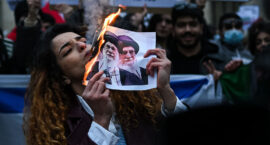
Ms. Global: Iranian Women’s Resistance, Gaza’s Reproductive Care Crisis and More

The U.S. ranks as the 19th most dangerous country for women, 11th in maternal mortality, 30th in closing the gender pay gap, 75th in women’s political representation, and painfully lacks paid family leave and equal access to health care. But Ms. has always understood: Feminist movements around the world hold answers to some of the U.S.’s most intractable problems. Ms. Global is taking note of feminists worldwide.

This week: stories from Iran, Gaza, the International Olympic Committee, and more.

Sundance 2026: A Film About Revolution and Hope, ‘The Friend’s House Is Here’ Shows How Art and Friendship Sustain Resistance

Even when it’s created at great personal risk, nothing can negate the power of art. So, too, the importance of friendship, which impacts our choices, shapes our ideas about the past, present and future, and changes lives.

These are central themes of The Friend’s House Is Here, a U.S.-Iranian co-production that won the U.S. Dramatic Special Jury Award for Ensemble Cast at Sundance this year. In their presentation of the award, the jury praised the film’s ensemble cast “for delivering performances that each of us could find ourselves in, revealing a story that is frighteningly universal. The ensemble injects the world with gravity, love, and humor, and shows us the way community and connection are often our key to survival.”

In a case of life imitating art, the film circulates through its own act of defiance: It had to be smuggled out of Tehran for it to be shown at Sundance.

(This is one in a series of film reviews from the 2026 Sundance Film Festival, focused on films by women, trans or nonbinary directors that tell compelling stories about the lives of women and girls.)

What Iran’s Crackdown Looks Like From Inside: A Q&A With Nasrin Sotoudeh and Reza Khandan

As mass protests and a deadly crackdown grip Iran, human rights lawyer Nasrin Sotoudeh speaks from Tehran while her husband, activist Reza Khandan, calls in from Evin Prison—offering a rare, firsthand account of repression, resistance and the stakes for democracy inside the country.

“My message has always been to use all non-violent means to persuade governments to uphold democracy and human rights. Small actions can have big impacts.”

“… You can’t bomb a country into democracy.”

Iranian Feminists Urge World to ‘Join Hands With Us’

A powerful call from a collective of Iranian feminists in the diaspora:

“‎‎We, a group of Iranian feminists, at a time when the Islamic Republic has cut off the internet and all channels of communication with the outside world while carrying out a brutal massacre of protesters, extend our hands to feminists around the world. We call on the global civil society and feminists to stand with the people of Iran and to use all available independent national and international mechanisms to stop the regime’s machinery of killing and repression.”

Reza Khandan’s Crime: Supporting Women’s Rights in Iran

It has been a year since 60-year-old Iranian human rights activist Reza Khandan was arrested in what was clearly another official attack on his family. Political prisoners in authoritarian regimes are meant to disappear into hopeless silence, but Reza has become a force to be reckoned with.

“The crime for which Reza Khandan is in prison is the crime of love,” writes Ariel Dorfman, author and friend of Khandan and his wife, activist Nasrin Sotoudeh. “Not just love of his country and its culture. Not just love of humanity and our rights to be human. Not just love for the future. But also, the real reason why he is being punished: Reza loves the extraordinary Nasrin with whom he shares a life, a land, and a cause. How those who persecute Reza must fear his loyalty and steadfastness. He will prevail.”

“I will continue until I achieve legal rights, restore my family’s dignity, and change the conditions of the prison administration,” Khandan wrote. “May the shadow of terror and tyranny be removed from our beloved country one day. And finally, I would like to add: ‘I object to the compulsory hijab!’” 

Caregiving Is Extremely Difficult in America. It Doesn’t Have to Be This Way.

For many Asian and immigrant families, caregiving is a way of life, with generations living and caring for one another under the same roof as part of daily life. My Iranian grandparents lived in a multi-unit dwelling in Tehran, where they cared for each other through illness and aging, cooking and sharing meals with their children and grandchildren in what seemed to me a seamless synchronicity. When my Pakistani grandmother emigrated from Karachi to the U.K. in the 1970s, she moved in with my uncle’s family, sharing a bedroom with her youngest grandson until she died. Now, that grandson lives in the same house with his own children and aging parents. 

However, here in the U.S., caregiving takes on a very different form, even for families raised on the belief that caring for another is simply what we do.

The U.S. Draft Explained: Who Registers, Who’s At Risk, and What It Means for Women

Last month, Donald Trump and Benjamin Netanyahu collaborated in an attack on Iran’s nuclear facilities, thrusting America into the middle of a centuries-long conflict. Almost immediately, my TikTok feed filled with posts and videos expressing fear of a U.S. military draft. One user asked, “Trump dodged the draft—why can’t we?” Another wondered, “Why are we getting into business that is not ours?” With tensions rising and misinformation about a draft spreading on social media, young people—and especially women—are left speculating: Who will be called to serve, and who will be left behind?

While recent statements from both U.S. and Iranian officials suggest a preference for negotiations over direct military conflict, it begs the question: What happens if the U.S. formally declares war—on Iran or another nation? If a draft is implemented, who will be forced to serve? And what happens to those who don’t?

Why Trump’s Manhood Is Threatened by a Free Press

President Donald Trump doesn’t hate the media because it lies. He hates it because it tells the truth, and the truth frightens him. Despite nonstop lying, he’s managed to stay ahead of reality. But even with MAGA, his grip is slipping.

When Trump sneers, “The press is the enemy of the people,” he’s not showing strength; he’s revealing weakness. A truly strong man doesn’t need to crush dissent. That’s what weak men do.

With War Escalating, Iranian Political Prisoners Demand Their Release—Before it’s too Late

As Israel’s military campaign escalates and air raid sirens sound over Tehran, prisoners like by Reza Khandan, husband of renowned human rights attorney Nasrin Sotoudeh, are sounding an alarm of their own. Citing existing Iranian legal codes, they make an urgent, clear-eyed case for the immediate release of non-violent inmates—many of whom are political prisoners or behind bars for peaceful dissent. With bombs falling nearby, and prison facilities ill-equipped to safeguard detainees, their letter warns that inaction could turn incarceration into a death sentence.