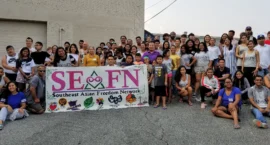
Fifty Years After War, Southeast Asian Communities Face a New Kind of Violence. Gender and Queer Justice Must Be at the Heart of This Moment.

Drawing on histories of war, displacement and resistance, Southeast Asian organizers expose how patriarchy fuels violence, erasure and division—and why intersectional justice must lead the way forward.

“Patriarchal power is regrouping, seeking to reassert its grip. If we do not recognize and resist this realignment, we risk losing hard-won resources, protections and, most importantly, people. 

“As a community, Southeast Asians’ trauma is compounded by war and displacement. Nearly 16,000 Southeast Asian refugees face deportation; many live in poverty and fear, underserved by traditional systems and are often overlooked in broader Asian American narratives. As the United States expands its deportation machine, refugees from the U.S.-backed wars in Laos, Cambodia and Vietnam are being re-criminalized and forcibly removed. These deportations fracture families, destabilize communities, and retraumatize those already targeted by the carceral state. Gender-based violence and anti-queer violence only intensify those challenges.”

(This essay is part of a collection presented by Ms. and the Groundswell Fund highlighting the work of Groundswell partners advancing inclusive democracy.)

With New DOJ Ruling, Women Fleeing Gender-Related Persecution Will Have an Even Harder Time Winning Asylum

In Matter of K-E-S-G-, an asylum case decided by the Board of Immigration Appeals on July 18, Department of Justice officials declared that an abused Salvadoran woman could not obtain asylum based only on the argument that her persecution was based on her gender, in a country that views women as property. The decision is the latest in a 30-year battle over the legitimacy of gender-based asylum claims and closely tracks the first of the Trump administration’s efforts to roll back decisions and policies that recognized the unique role that gender plays in many asylum cases, particularly those involving domestic abuse, sexual violence or trafficking.  

It was already difficult to obtain asylum in the United States. You must demonstrate that you have been or will be persecuted, based on a protected category, and that your own government will not or cannot help you. You must show that your persecutor intended to harm you based on the protected category. You must show that you can’t simply move to another part of your country, and you must provide evidence that your life is in danger if you return home.

“What I desire most is for all women who are fleeing abuse in their country to have their asylum cases heard and to be safe here. The situation right now is dire. The struggle continues. But they have to keep fighting.”

The Ugliest of Bills: How Republicans’ Reconciliation Bill Endangers All Children

One of the many dangers of the budget reconciliation package currently before the Senate is its audacity. It is so large, so ugly and so expensive—nothing beautiful to see here—that it can be hard to know how to fight back. 

So much is at risk that, even assuming some of the most talked-about measures, such as Medicaid cuts, are removed or modified in the Senate, it is likely that passage of This Ugliest of Bills (THUG Bill) would still fundamentally harm millions of people.  

Children—citizen and non-citizen—are going to be especially hard hit if this ugliest of bills passes.

How Trump’s America Is Normalizing Violence Against Women

Under Trump’s America, violence against women isn’t just ignored—it’s become a deliberate political strategy. Powerful men accused of abuse are actively protected and celebrated by the Trump administration, while survivors and those who stand up for them are punished and silenced. (Just look at the attacks and public shaming Christine Blasey Ford had to endure after courageously coming forward with her sexual assault allegations against Brett Kavanaugh.) From legal interventions and judicial appointments to funding cuts, Trump has systematically dismantled protections for women and emboldened those who harm them.

Don’t Let Donald Trump and Elon Musk Talk Us Out of Democracy

Trump and Musk are testing the limits, trying to sell America on being an authoritarian state—but they can’t do it unless we allow them to do so.

When Justice Department lawyers go to court, trying to defend many of Trump and Musk’s actions, DOJ has regularly lost—and often face tense moments in court before being dealt those losses.

On Monday, for example, Judge John Bates, a George W. Bush appointee, heard arguments over a group of doctors’ lawsuit challenging the removal of webpages and datasets by the Centers for Disease Control and Prevention (CDC), Food and Drug Administration (FDA), and Department for Health and Human Services (HHS) as part of the government-wide censorship purge put into effect following Trump’s Jan. 20 executive order defining “sex” to exclude transgender people.

Conservative Supreme Court to Rule on Right to Be Trans, Medical Care, Parents’ Rights, Constitutional Sex Discrimination—and the Right to Be Different

“I’m here to stand up for my kid,” Brian Williams told me outside the Supreme Court on Dec. 4. Williams and his wife Samantha have been fighting for their daughter—known as L.W. in the legal papers the ACLU filed to challenge Tennessee’s ban on gender-affirming medical care for minors—for years.

Though difficult to sit through, the two-plus hours of argument in United States v. Skrmetti—a challenge by trans youth, their families, the ACLU, Lambda Legal and the Biden administration to Tennessee’s ban on gender-affirming care for minors—was a nearly perfect distillation of this moment in our gender politics.

‘Take Beauty From Ashes’: Advocating for Felony Murder Law Reform

In 2017, Briana Martinson, then 20, and Megan Cater, 19, went to the apartment of a man whom they believed had stolen medication from Martinson, with the intent to steal it back. By the time they arrived at the apartment, Martinson and Cater were joined by several other individuals, two of whom were older men that the women did not know. According to Martinson, one of the men threatened them with a gun before entering, at which point she realized, “Okay, there’s no turning back.”

In the end, they were each sentenced to 13 and a half years in prison for aiding and abetting second-degree unintentional felony murder.

Was this a case of wrongful conviction? It’s complicated.

How the Supreme Court Endorsed the Authoritarian Behavior of State Legislatures

In 2019, the Supreme Court ruled along political lines that it could not review disputes over partisan gerrymandering. The conservatives in Rucho v. Common Cause insisted that the question of how state legislatures draw their maps is a “political” question and thus “nonjusticiable” by the Court.

The truth is more that the Court silenced the Constitution and set our democracy on a destructive course. As Justice Kagan wrote in the liberals’ dissent, the Court had “encouraged a politics of polarization and dysfunction.” The resulting “unchecked” gerrymanders, she warned, “may irreparably damage our system of government.”

Most Girls in the Juvenile System Experience Abuse Prior to Incarceration. Their Stories of Abuse Don’t End There.

Over 80 percent of girls in the juvenile justice system in multiple U.S. states are sexually or physically abused prior to incarceration. But their stories of abuse do not end there. Many young women continue to experience sexual and physical abuse by juvenile justice employees after being placed in juvenile detention.