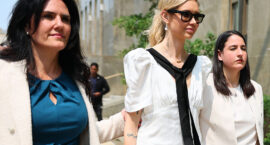
Finding the Power in Single Black Motherhood

We can say, “We knew this would happen,” and tell Black single mothers, “I told you so,” all day long, but then what? There’s something hollow in the phrase—especially when it follows public documentation of abuse.

If we are people who truly believe that Halle Bailey, Keke Palmer and Skai Jackson deserved better, then we should be extending that same belief to the women we actually know.

(This essay is part of a collection presented by Ms. and the Groundswell Fund highlighting the work of Groundswell partners advancing inclusive democracy.)

Inside Liberty University’s Secret Maternity Home

Imagine you’re a pregnant teenager in 1972. Abortion isn’t an option, and you’re not ready to get married… so you might turn to a maternity home for unwed mothers. You’ll live there until the baby is born, then give it up for adoption to redeem yourself from the so-called sin of premarital sex.

On June 23, podcast studio Wondery released the new series Liberty Lost, which investigates the well-kept secret of Liberty University’s Godparent Home, which opened in the 1980s and is still operating today. In the podcast, reproductive rights journalist T. J. Raphael explores the history of the maternity home on the campus of Liberty University, a private evangelical college in Lynchburg, Va. There, staff members coerce young girls into surrendering their babies for adoption by affluent Christian parents in exchange for a full-ride scholarship at Liberty. 

“Maternity homes are on the rise,” Raphael told me. “There might be one near where you live, and maternity homes play a larger role within the wider antiabortion movement.”

The Seven Warning Signs of Testosterone Poisoning (October 1975)

From the October 1975 issue of Ms.:

“Until now it has been thought that the level of testosterone in men is normal simply because they have it. But if you consider how abnormal their behavior is, then you are led to the hypothesis that almost all men are suffering from testosterone poisoning. …

“The pathological violence of most men hardly needs to be mentioned. They are responsible for more wars than any other leading sex.

“Testosterone poisoning is particularly cruel because its sufferers usually don’t know they have it. In fact, when they are most under its sway they believe that they are at their healthiest and most attractive. They even give each other medals for exhibiting the most advanced symptoms of the illness.

“But there is hope.”

(The Summer 2025 issue of Ms. is a modern reimagining of the October 1975 issue. Join the Ms. community today and you’ll get issues delivered straight to your mailbox.)

The Problem With Sabrina Carpenter’s Album Cover Is Not Sex—It’s Violence 

The real discomfort with Carpenter’s controversial cover isn’t about sexual provocation. It’s about normalizing images of violence against women.

Policing women’s sexual choices should never be the goal of this discourse. Our personal sex lives are rich with context, and I hope that most people who enthusiastically interact with violent sexual acts, such as choking or hair-pulling, have felt comfortable enough with their partner to talk them through and have a truly consensual experience.

But we can monitor the way we speak about sex—especially expressions that lack that personal context, like album covers—and our tendencies as feminists to defend them in any light, no matter how troubling, for fear of restricting women as opposed to liberating them. 

We do not need to be OK with violence. Each of us has the personal autonomy to consider it, be conscious of it, oppose it, or even play with it. But when we look at an image of a woman having her hair pulled like the leash of a dog, it is only human—and important—that we feel uncomfortable.

Harvey Weinstein’s Half-Baked Verdict Reinforces a Continued Tradition of Suspicion Towards Victims of Sexual Assault

While dressed in modern garb, today’s distrust of accusers who delay reporting is hardly new. For most of our history, a “prompt outcry” rule was baked into our law, as explained in my book on accuser credibility. The rule rested on an abiding suspicion of accusers, equating delayed reporting with falsehood and allowing only rape allegations reported soon after the incident to proceed. 

Case Not Dismissed: Domestic Violence Is Indeed a Big Deal For Survivors

“It’s just domestic violence.”

“They did not have a good relationship.”

 If I had a dime for every utterance of those repulsive, dismissive sentiments from TV pundits and legal experts about the details in the Sean “Diddy” Combs trial in New York, I would donate it to the Department of Justice’s Office on Violence Against Women, to reinvigorate paused funding.

That is because the cultural affinity for survivor diminishment as demonstrated in this case is aligned to the White House administration’s latest reduction of monetary, social, healthcare, housing and legal support for those experiencing domestic violence.

The Trump Administration Is Making the Country Less Safe for Domestic Violence Victims

Over the last four decades, the United States has built a web of federal policies and funding to address domestic and intimate partner violence, a pervasive health and safety crisis. 

In just 130 days, the Trump administration has put that safety net in jeopardy.

Funding pauses, cuts, firings and information purges have destabilized the infrastructure that helps victims of abuse. At the same time, federal teams dedicated to preventing sexual violence are being decimated. Departments in charge of administering grants that fund shelters for those fleeing assault have been deemed “duplicative, DEI or simply unnecessary.”

“I am horrified,” said Rep. Gwen Moore (D-Wis.), who has detailed her experience as a victim of domestic violence.  “Maybe it’s not intentional, but it’s very dangerous as a survivor of domestic violence—a survivor in the days where there was no crisis line to call … no information to be able to stand up for yourself. There was no shelter to go to.”

The Feminist Leadership Syllabus: Where History, Politics and Pedagogy Meet

When women assume a position of power, does she represent feminist leadership? Can she govern according to feminist principles? What is the difference between women’s leadership and feminist leadership?

This public syllabus on feminist leadership, assembled by Ms. contributing editor Janell Hobson and students in her graduate research seminar at the University at Albany, is an attempt to respond to these questions by exploring different examples of feminist leaders and feminist movements—both globally and historically.

We hope this syllabus can educate us on the kind of feminist leadership that will move us forward toward an inclusive democracy.

(This is Part 2 of a two-part series on women leaders and feminist leadership. Part 1—out last week—breaks down Angela Bassett’s role as U.S. president in the latest and final installment of Mission: Impossible, and how her representation on screen blurs the line between the impossible fictions and possible realities of women’s power in American politics.)

This Public School Program Is Grooming Kids to Hate Through Bible Study

When you think about Bible study, images might pop into your head of kids learning principles like forgiveness or loving thy neighbor, and that’s just what LifeWise Academy advertises on its website: “a supportive and inclusive atmosphere where everyone feels valued.” But for many parents and LGBTQ kids in at least 591 American public schools with LifeWise programs, that’s far from the truth.

LifeWise Academy is a conservative Christian organization that takes public school students off school property to “integrate a Bible class into their weekly class schedule.” For an hour a week, students from kindergarten through 12th grade learn about religious concepts rooted—in part—in homophobia and transphobia. LifeWise’s growth in the U.S. reflects a trend of politicians and lawmakers attempting to incorporate Christianity in public schools and minimize LGBTQ representation.