Trump’s Anti-Diversity Crusade Claims Two Campus Magazines

I recently discovered two glossy magazines published by and for young people: Alice, which focuses on fashion, beauty, personal health, wellness and lifestyle; and Nineteen Fifty-Six, which brings a Black cultural lens to coverage of news, style and the arts.

Both are student-run publications housed at the University of Alabama. And on any other day, they would make one think the future of journalism look very bright indeed. Except that the sole reason I found these magazines at all is because they are now officially suspended. Last week, campus officials announced their permanent shuttering. Yet another casualty of the Trump administration’s attacks on free speech and public higher education—all in the name of stamping out supposed diversity, equity and inclusion.

The Ms. Q&A With Democracy Defenders Norm Eisen, Skye Perryman and Jennifer Rubin

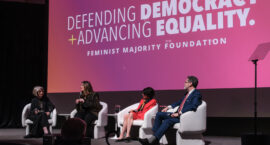
In the middle of an accelerating democratic crisis, and a year defined by sweeping attacks on women’s rights, the Feminist Majority Foundation, publisher of Ms. magazine, gathered in Los Angeles to honor some of the most formidable leaders on the front lines of resistance. At the Nov. 18 Global Women’s Rights Awards, journalists, lawyers, artists, organizers, litigators, community activists and movement strategists came together to celebrate what I call the “essential trifecta” for defeating authoritarianism: the law, the press and culture.

We recognized The Contrarian’s Jennifer Rubin and Norm Eisen for building an independent media platform willing to call out authoritarianism plainly; Democracy Forward president and CEO Skye Perryman for her organization’s record-breaking wave of legal challenges against the Trump administration; and the creative team behind the Broadway hit Liberation—playwright Bess Wohl, director Whitney White, and former Ms. writer and editor Lisa Cronin Wohl—for reminding audiences that storytelling is itself a democratic act.

“The number one tool that autocratic actors use to try to consolidate power and take away power from the people, is to convince people that they have no power,” said Perryman. “Their toolbox is one of isolation. They want you to feel alone.”

“I grew up miles from here, family hamburger stand,” said Eisen, “and now to be here, to have this opportunity with my colleagues to fight for this democracy that took my country, and my parents. … When my mother was living, she loved to say the Nazis took us out of Czechoslovakia on cattle cars, and my son flew back on Air Force One. So, how can I not be hopeful?”


Are We Ever Off Work, or Just Out of Office? The OOO Messages Exposing America’s Care Crisis

A new public awareness campaign, “Out of Office for Care,” launched this week invites employees to set their “OOO” automated email replies to accurately reflect the array of care responsibilities that pull them away from work, and then share those messages publicly.

People across industries—artists, founders, caregivers, cultural influencers, nurses, educators, nonprofit leaders, small business owners and parents—can give the country an unfiltered look at why they step away from work, and what it costs to do so without paid leave.

OOO replies range from clever to catastrophic. Some name the person they are caring for; others reveal the exhaustion of trying to do it all. All together, they show a country exerting caring in every direction and a policy landscape that hasn’t caught up.

Among those making the rounds:
—”I’m OOO because inexplicably school ends at 3 and work ends at 5 at best. … I can’t keep up, I need sleep, I’m getting a cold, everything is expensive and unnecessarily hard, and the holidays are coming.”
—”I’m OOO because my parents are getting older and I can’t manage their RX and 500 unread emails at once. In-home care is $60K and I have limited PTO. WiIl get back to you ASAP!”
—“Hi, sorry to miss you! I’m OOO because I just gave birth, but like 1 in 4 women in the U.S. I’ll be back at work in a couple weeks.”

The Resistance Is Everywhere

These past 10 months have been tough. Every day a fresh outrage, more trampling of the Constitution and a new attack on common decency. Taking a page from Hollywood, Trump and his administration seem to have embraced a strategy of “everything, everywhere all at once.” 

But, unfortunately for them: The resistance has also been everywhere all at once, too.

There is no doubt that when historians look back on this sordid moment in history, they will conclude that it was women, and feminists, who led the way out of it.

Feminists vs. Authoritarians: Honoring Leaders Holding the Line

Greetings from Los Angeles—on the heels of a very special evening to celebrate the heart and soul of the democracy movement. On Tuesday night, Ms. paid tribute at the Global Women’s Rights Awards to bold leaders operating at the intersection of media, the law and storytelling—recognizing these as the essential trifecta for toppling authoritarianism. And, importantly, for fueling a feminist future.

Trump Administration Forced to Fund SNAP Benefits—But Only Enough to Cover Half of November

The Trump administration will release funds to pay for half of November’s SNAP benefits, following two federal court rulings the Department of Agriculture (USDA) to release the money. Patrick Penn, who oversees the SNAP program at the USDA, warned of disruptions and delays, suggesting many SNAP recipients will still be without benefits for some time.

Trump’s IVF Announcement Fails Families—But Duckworth’s Right to IVF Act Could Deliver

Last week’s White House announcement is the equivalent of “politely [asking] companies to add IVF coverage out of the goodness of their own hearts—with zero federal investment and no requirement for them to follow through,” says Sen. Elizabeth Warren (D-Mass.).

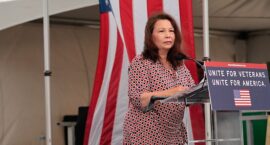
There is, in fact, an alternative to the Trump plan: The Right to IVF Act, introduced by Sen. Tammy Duckworth, would require employer-sponsored health plans and public health insurance, including Medicaid and military plans, to cover treatments. The bill also addresses discrimination and forbids the restriction of access to IVF based on marital status or sexual orientation.

Republicans have voted it down twice.

Meanwhile, at the FDA: Menopause Progress, Abortion Gaslighting

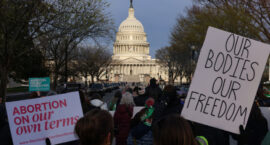
The FDA caused a stir last week when it approved a new, generic version of mifepristone—the abortion medication that has safely, effectively and privately ended pregnancies for 25 years. Many mainstream outlets made it sound like a dramatic policy reversal, but really it was a procedural box check. Meanwhile, the Trump administration is already laying the groundwork to undermine access, announcing a so-called “safety review” based on flawed data and false claims. As reproductive rights advocates like Mini Timmaraju have pointed out, this is gaslighting—pretending to be moderate while plotting restrictions. That’s why protecting mifepristone still matters now.

At least there was some progress this week in menopause care: The FDA signaled plans to remove the “black box” warning on certain hormone treatments that has long stoked fear and confusion. Experts say the label was based on outdated science and has caused real harm, leaving countless women to suffer unnecessarily. For once, the agency seems poised to get this one right.

Trump and RFK’s Pseudoscience Is Another Tool to Control Women

We have reached the point in American politics at which a sitting U.S. president sees fit to decree pregnant women must “tough it out.”

We all would be wise to strenuously push back on junk science—not just for our safety here and now, but in service of a future that doesn’t create new inroads for punishment of pregnancy.