Why Is the Vice President Sitting Like That?

That awkward posture isn’t accidental. When Vance spreads his legs and plops down for an interview, he is directly addressing young men. He wants to prove that he’s just one of the guys, while also issuing a dire warning. “The boys,” he asserts, are under attack.

Advancements in women’s rights have always been followed by countermovements, each one lamenting, “But what about the boys?”

In reality, the cure for loneliness can’t be found in calling your friends the f-word or finding a “trad wife” who will stay in her place. It requires genuine relationships. It’s about having your feelings valued but with the equal expectation of emotional reciprocity. Behold and be held. That’s the deal.

Guys: You all, like all people, deserve to be loved. The problem is, the messengers who claim to be your friends are lying. Those guys don’t love you. They love their power over you.
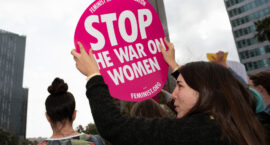

Historic Cuts to SNAP Deepen the War on Women

 Republicans in the House and Senate scrambled to pass legislation that will cut $184 billion from SNAP through 2034—by far the largest cut to SNAP in the program’s history—to finance tax cuts for the wealthy big businesses. They also hope to increase funding for pursuit of immigrants. 

This extremist budget will drive millions of people into poverty and hunger. It also represents a full-throated assault on women—particularly single mothers, for whom SNAP has been a lifeline.

Ms. Global: Climate Change Linked to Increases in Cancer for Women, U.K. Parliament Votes to Decriminalize Later Abortions, and More

The U.S. ranks as the 19th most dangerous country for women, 11th in maternal mortality, 30th in closing the gender pay gap, 75th in women’s political representation, and painfully lacks paid family leave and equal access to health care. But Ms. has always understood: Feminist movements around the world hold answers to some of the U.S.’s most intractable problems. Ms. Global is taking note of feminists worldwide.

This week: News from Nigeria, South Australia, Canada, and more.

Women, Christianity and the Politics of Submission in ‘The Handmaid’s Tale’ and ‘The Righteous Gemstones’

The popular and critically acclaimed series The Handmaid’s Tale and The Righteous Gemstones each recently wrapped a successful series run.

When placed in conversation, The Righteous Gemstones and The Handmaid’s Tale expose the dangerous consequences of women participating in the cultural backlash against feminism. The tradwife ideologies that Amber and Judy negotiate, and that Serena Joy embraces in theory, become a totalitarian nightmare for women in The Handmaid’s Tale.

Why Do MAGA Women Dress Like That?

No judgment, but the women featured in Evie Magazine, a “conservative Cosmo” for women 18-34, are more likely than not to show off their breasts. In a nod to the tradwife fashion trend, milkmaid dresses with low décolletage are featured on young, voluptuous white women. An article making the case against body positivity and fat acceptance, “The Return of Skinny,” is accompanied by a photo of a busty white woman on a beach wearing a thong bikini. A photo spread of Eva Vlaardingerbroek showcases the Dutch right-wing activist wearing a gold cross necklace—along with her breasts falling out of a low-cut gingham dress.

To people with conservative views, only some women—those who look and act like ‘real women’—get the privilege of being sexy.

‘Companion’ Unmasks the Horror Beneath the Tradwife Fantasy

Companion starts with a dreamy tradwife fantasy and ends in a blood-soaked feminist reckoning. Writer-director Drew Hancock’s film may nod to Scream, Ex Machina and Black Mirror, but it carves out its own smart, brutal allegory for waking up from the fantasy of obedience. Sophie Thatcher’s performance anchors the story as Iris evolves from Stepford-perfect to gloriously feral, reminding us that when women start asking questions, the whole system bleeds.

The Fantasy of Underconsumption: Truly Productive or a Tradwife Pipeline?

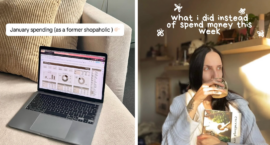
Since stumbling on “underconsumption-core,” I’ve been deep in a world of no-buy rules, budgeting spreadsheets, and influencers who turn frugality into an aesthetic. What started as a seemingly productive financial reset now feels more like a lifestyle that rewards domesticity and quiet femininity over real economic empowerment. The deeper I looked, the more it felt like a soft return to tradwife ideals.

It’s not that saving money is bad, but when frugality becomes a moral performance, especially for women, it’s worth asking who this trend really serves.

Women’s History Month Is a Time for Optimism

Dispatches from Week 2 of Women’s History Month:

It’s Week 2 of Women’s History Month, and just knowing the federal government might well ban those three words in sequence—along with “gender,” “female,” “feminism” and about 250 others—you can bet I’m feeling extra rebellious as I write this column.

I am back from celebrating International Women’s Day (March 8) at South by Southwest. Among the festival keynotes, Chelsea Clinton urged that optimism is fundamentally a moral and political choice. Remaining optimistic, she remarked, is like “saying we do not have to accept the status quo. … We do accept that we may not be able to do everything all at once, but we can always do something.”

Women’s History Month is a solemn reminder that our reaction—and our commitment to action—also requires that we hold tight to the optimism our foremothers possessed.

‘When Power Curdles Into Violence’: Escaping the Tradwife Lifestyle

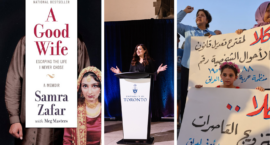
Brides shouldn’t be thinking about homework just before their wedding day. But when I entered into an arranged marriage with a 28-year-old stranger, I was still just a 17-year-old girl who loved her private British school and her books and cricket—and so I found myself thinking about a creative-writing assignment I had recently finished. I’d written a story about a young woman who wore jewelry in the shapes of snakes. I wrote that they suddenly came to life and they slithered up to her throat, strangling her. 

As someone who was forced into a life I never chose, I am appalled that women, who are more empowered than ever, are effectively choosing a life without choice—putting themselves in a prison of their own making.