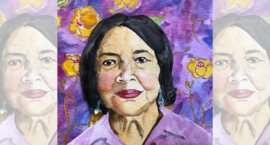
From Dolores Huerta to Cynthia Richie Terrell, Celebrating the Birthdays of the Women Keeping Movements Alive

Weekend Reading on Women’s Representation is a compilation of stories about women’s representation in politics, on boards, in sports and entertainment, in judicial offices and in the private sector in the U.S. and around the world—with a little gardening and goodwill mixed in for refreshment!

This week:
—Chris Taylor wins her race for Wisconsin Supreme Court.
—Emily Gregory flips a Florida House seat in Trump’s backyard.
—New data says that women could definitely win the 2028 presidential election.

… and more.

Trump Touts a ‘Roaring Economy.’ Families Say Otherwise.

In his State of the Union address, President Trump opened by boasting about a roaring economy, falling inflation and a richer and stronger nation. But those claims ring hollow for many Americans who feel economic security slipping further out of reach, a reality made worse by the policies he and his Republican Congress have championed.

In Tucson, Ariz., Angelica Garcia begins most mornings waiting for her Lyft app to ping. She’s a driver raising three children in a two-bedroom apartment that costs $1,400 a month. Her summer electric bills hover around $300. At the grocery store, it costs her over $100 just to cover basic essentials. Angelica and her children rely on Medicaid and SNAP. Medicaid covered her daughter’s broken arm and her son’s tonsil surgery. “It’s been a blessing. A godsend,” she says.

But her representative in Congress, Juan Ciscomani (R), voted to cut Medicaid and SNAP and to impose new work requirements.

Meanwhile, in Iowa, a retired woman named Jill is enrolled in a Marketplace healthcare plan that once cost her $75 a month thanks to enhanced Affordable Care Act subsidies. But when Republicans voted against extending those subsidies, her premium jumped to nearly $800 a month.

Her representative in Congress, Marianette Miller-Meeks (R), voted to let those subsidies expire.

In Eau Claire, Wis., Erin Klaus has spent 17 years building up and running her small business. Erin’s representative in Congress, Derrick Van Orden (R), voted to protect Trump’s tariffs—tariffs that made small businesses like hers pay upfront, even as multinational corporations are better positioned to shift supply chains or pass along costs.

As Wisconsin Democrats Push First-Ever Pregnancy Loss Protections, State Republicans Advance Embryo ‘Personhood’

In late 2025, Wisconsin Senate Republicans passed SB553, a bill that defines embryos, fertilized eggs and fetuses as “unborn children” and “human beings” from the moment of fertilization. The bill passed with the support of every Republican senator and opposition from all Democrats. SB 553 also attempts to redefine the word “abortion,” asserting that a termination performed to prevent the death of a pregnant woman is not an abortion if it is not “designed or intended to kill the unborn child.”

Doctors also warn that SB 553 quietly functions as a personhood law by stating that once an egg is a human being from the moment of fertilization. By granting fertilized eggs status as human beings, the bill is giving those eggs legal rights which are equal to those of their pregnant mothers. While Gov. Tony Evers has said he will veto the bill if it reaches his desk, Wisconsin state Sen. Kelda Roys says its passage reveals Republican lawmakers’ intent.

Roys recently introduced the Pregnancy Loss Protection Act, the first bill of its kind in Wisconsin. Its goal is to prevent overzealous prosecutors or law enforcement officers from targeting people who experience miscarriage or stillbirth, while also pushing back against a broader Republican effort to confer legal personhood on embryos from the moment of fertilization.

Her Pregnancy Wasn’t Viable. Wisconsin’s Laws Still Made Her Fight for an Abortion.

Abortion may be legal in Wisconsin, but the hurdles still involved forced mom Gracie Ladd, 33, to flee the state anyway.

“He recommended terminating the pregnancy because I was so low on amniotic fluid that Connor would most likely pass away before birth, which would put me at serious risk for infection. … I was aware Wisconsin had an abortion ban, but I was shocked to learn only two hospitals would do D&Es for someone 20 weeks pregnant.

“There was so much nonsense just for a woman to get essential care. …

“I received a huge amount of support from many people, even those I didn’t expect. That opened a door for me to use this experience to help other moms. … When Roe v. Wade fell, I wondered, ‘How do I help?’ But I felt insignificant, like my voice wouldn’t matter. But after this happened with Connor, it gave me a way to get involved and a reason to speak out about how abortion is healthcare.”