In a packed Capitol Hill room, survivors, family members of Virginia Giuffre and their allies demand accountability, systemic reform and an end to the silence that has long protected powerful perpetrators.
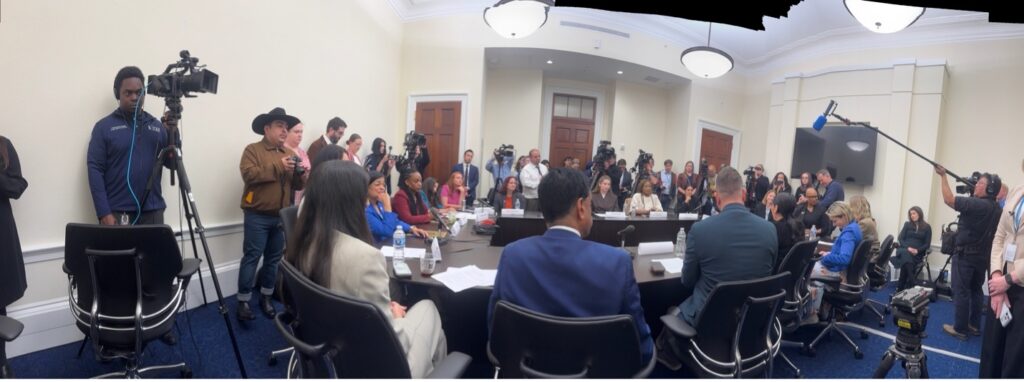
Last week, on a day when most of the political eyes in the world were fixed on a carefully staged moment at the U.S. Capitol involving the king of England, something else far more consequential was happening: In a small conference room in the Cannon House Office Building, made even smaller by the crush of TV cameras pressed into every corner, the air thick and claustrophobic, a group of extraordinary women gathered to speak.
The roundtable—convened by Rep. Ro Khanna (D-Calif.)—brought together survivors, family members of Virginia Giuffre and leading advocacy organizations to discuss the realities of trafficking and sexual assault and the systemic failures that allowed it to persist, and to call for the concrete actions from Congress to better protect survivors and prevent abuse. It was timed to coincide with the king’s visit, drawing attention to the fact that he did not meet with or hear directly from survivors, despite the well-documented involvement of his brother in Epstein’s network.
I was there to observe as part of a feature on accountability in cases of sexual abuse and trafficking that I’m reporting for the fall issue of Ms. magazine. I’ve already begun speaking with survivors for that work. It was an honor to witness this courageous moment firsthand.
Survivors of sexual abuse and assault spoke about what they had endured at the hands of powerful men, including Jeffrey Epstein and his associates. Despite everything that has come to light in recent months, their experiences are still far too often met with avoidance—or worse, with quiet, performative sympathy followed by dismissal and inaction.
One of the survivors told me quietly before it began that she had never spoken before so many cameras.
The survivors who spoke at the roundtable included Dani Bensky, Sharlene Rochard and Marijke Chartouni, as well as Sara Ziff of Model Alliance, herself a survivor of abuse within the modeling industry and a leading voice calling for accountability. They were joined by Giuffre’s brother Sky and sister-in-law Amanda Roberts of Speak Out, Act, Reclaim (SOAR), the organization founded by Virginia Giuffre, with which her family is now closely involved, speaking in honor of her years-long fight for accountability for Epstein and his associates.
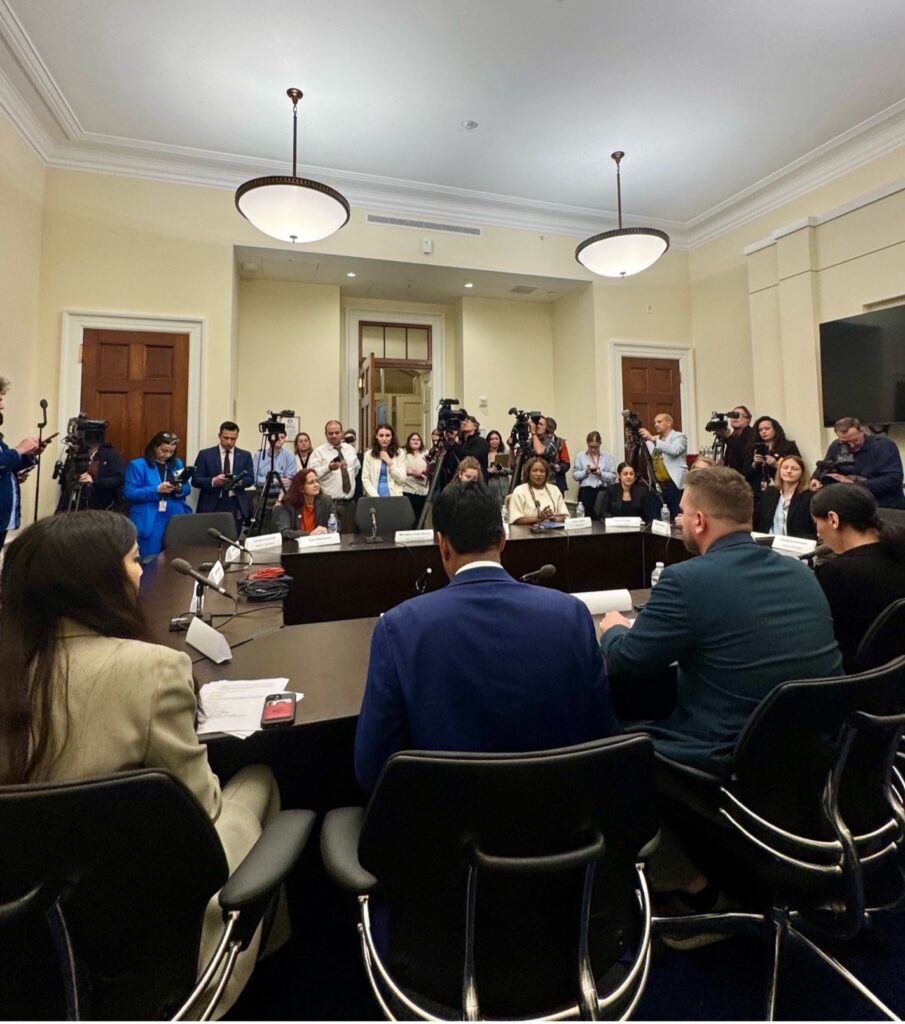
The presence of Model Alliance and SOAR, alongside organizations like World Without Exploitation, Polaris Project, Rights4Girls, UltraViolet, NOW and Women’s March, underscored the growing movement to confront not just individual harms caused by Epstein and his associates, but the institutions, systems and decades-long inaction or incomplete action by law enforcement that enabled it.
They spoke not only for themselves, but for what many believe to be thousands affected by Epstein’s network of abuse, as well as for the millions more across the United States and around the world who have experienced trafficking, sexual abuse and sexual violence.
With just a three- to five-minute window to speak, each survivor opened a small window into their world, into the harms they suffered and the systems that allowed it, and called not for sympathy, but for concrete action.
Some spoke with a palpable degree of nervousness, voices trembling, but eyes steeled and brave.
Some spoke through tears.
Some spoke more briefly than one might imagine possible, given the weight of the harms they were subjected to.
All the voices were powerful. They did not equivocate. They did not look away.
There was a palpable tension in the room as survivors tried to compress years of harm into just a few minutes. What was shared felt both immense and necessarily inadequate to capture the scale of the problem we are facing as a country.
In more than two decades of working with survivors, especially in high-profile, high-stakes cases, I know what it takes to walk into a room with the world watching. I know what it costs to speak. And I know what a day like this means. It is a true gift they have given all of us.
In addition to Rep. Khanna, who spoke about the importance of accountability moving forward, several other members of Congress showed up as well, including Reps. Summer Lee, Pramila Jayapal, Teresa Leger Fernández, Ayanna Pressley and Melanie Stansbury. Many spoke with passion about the urgency of addressing these matters, promising Virginia Giuffre’s family, Sky and Amanda Roberts and the other survivors that they would not give up until accountability is achieved.
Calls were made for enforcement of the Epstein Files Transparency Act and for the release of what advocates describe as millions of unreleased documents, with some estimates placing that figure at roughly 3 million. There were also calls for the passage of Virginia’s Law, which would expand statutes of limitations for civil claims in cases of sexual abuse and trafficking. Advocates say these reforms are critical given that existing limits often prevent survivors from pursuing justice years after the harm occurred.

The roundtable followed a series of public actions honoring Virginia Giuffre’s life and legacy, including a vigil on the National Mall organized by advocates, survivors and members of her family. The events, which also included projections in Washington, D.C., honoring survivors of Epstein’s network and all survivors of sexual violence, were framed as both remembrance and a renewed call for accountability.

At both the private roundtable and the public vigil, advocates, survivors and members of Congress acknowledged that the Epstein Files Transparency Act has not been fully followed. Survivors pointed to the continuing harms being caused by the mishandling of the files. Victims’ names and private information too often entered the public domain through the release, while a broader network of powerful individuals connected to Epstein has been shielded.
And yet, these efforts are stalled. In the Republican-controlled Congress, there has been no meaningful movement to advance further investigation or accountability related to Epstein. Todd Blanche, Trump’s senior Justice Department official, has stated that the files “should not be part of anything going forward.”

It remains to be seen what action, if any, Congress will ultimately take in response to the Epstein files, systemic failures or reforms needed to avoid the harms identified by this case. Other legislative measures are in development, but much depends on what comes next politically, culturally and how enforcement plays out in the courts.
The survivors and advocates assembled this week were undeterred. They understood that while spectacle and distraction unfolds elsewhere, the real work continues, steady and unrelenting.
And it mattered.
I left with something that felt unfamiliar these days: hope.
I’ll be writing more on this in the months ahead, focusing on accountability efforts and systems change. I won’t look away. I hope you won’t either.