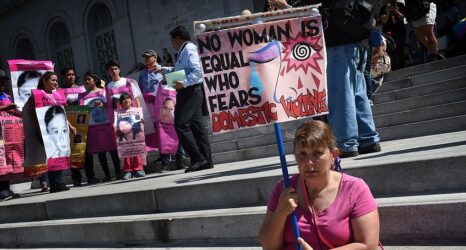
The 2000s proved that even in an era of political backlash, feminist organizing could expand public support, win critical victories and lay the groundwork for future change.

One of the most important lessons of the 2000s is that a movement does not have to hold political power to hold public support. Even as conservatives controlled much of the federal government and attacks on reproductive freedom intensified, feminist ideas continued to gain ground. The decade revealed the power—and the limitations—of being a majority movement in a political system that does not always reflect majority opinion.
This essay is part of Feminist Lessons, a series from Ms.’ FEMINIST 250 project exploring what each decade of modern feminist history can teach us about power, democracy, backlash and social change. Drawing on more than 50 years of reporting, organizing and activism, the series examines how feminists transformed American life—and what those victories and setbacks can teach us today.
The political pendulum swung right again at the turn of the new millennium: George W. Bush was president, and Republicans held the majority in both the House and Senate. Yet Ms., in its Spring 2003 story, confidently declared that “this land is our land.”
A new poll, conducted that year by the Peter Harris Research Group for Ms., found that 77 percent of women and nearly 70 percent of men, when read the dictionary definition, identified as feminists.
“From the redwood forests of California to the New York island to the Gulf Stream waters, a feminist tide is sweeping over America,” Lorraine Dusky wrote. “The spread of its gains and the flow of the current of opinion are steady, slow, sure, unmistakable. And because support reaches its crest among younger women, we believe the future course is also clear.”
One year earlier, as part of the magazine’s Spring 2002 30th anniversary issue, Ms. announced that the Feminist Majority Foundation had acquired and would now be publishing the magazine. After decades of reporting on the change feminists sought to realize across the globe, Ms. would now be joined with an organization that organized, mobilized and instigated transformation.
In 2000, the FDA had finally approved mifepristone for use in medication abortions, following a 12-year campaign by FMF, a story Ms. covered in its February/March 2001 issue. Throughout the decade ahead, Ms. and FMF would continue to wage battles—in its pages, on Capitol Hill and in the streets—to push back against what they called the “War on Women.”
On his first day in office, and on the 28th anniversary of Roe, Bush reinstated Reagan’s global gag rule; throughout his presidency, he additionally withheld UNFPA funds over abortion policies.
In 2003, Bush signed into law the first federal statute restricting abortion since Roe was decided, prohibiting later abortions.
In 2004, he additionally signed a bill that recognized fetuses as legal crime victims—the first federal law inching toward the anti-choice goal of fetal personhood.
In 2005, Ms. sounded the alarm about the danger Bush posed to the Supreme Court, where he filled two vacancies, warning that access to both abortion and contraception were at risk, especially when he nominated anti-abortion Supreme Court Justice Samuel Alito.
(On top of it all, Bush more than doubled funding for scientifically inaccurate abstinence-only sex education, which often contained false or misleading information about birth control, abortion, and STI and pregnancy prevention.)
Despite overwhelming public support for a woman’s right to choose, the majority in Congress and President Bush oppose women’s reproductive freedom. Hopeless? Not at all. We are taking to the capital.
Ms. editors, Fall 2003

After Bush signed his 2003 abortion ban into law, Martha Mendoza lost a pregnancy at 19 weeks. In the Spring 2004 issue of Ms., she details how antiabortion laws limited her access to critical care, chronicling instead the “horrifying” days she spent bleeding out and being turned away by doctors and hospitals. (She was refused an abortion until she went into active labor.)
At the time, nearly three-quarters of OB-GYN residencies eschewed abortion training: “After all,” Mendoza wrote, “why spend time training for a surgery that’s likely to be made illegal?”
Less than 7 percent of OB-GYNs performed the type of abortion Mendoza needed, even though tens of thousands of women each year would undergo abortions between 13 and 20 weeks, and thousands would miscarry, like her. In the second trimester.
“Thirty years after the landmark Roe v. Wade decision, reproductive freedom hangs by a thread in the U.S. Supreme Court,” Ms. declared in the Fall 2003 issue. “Despite overwhelming public support for a woman’s right to choose, the majority in Congress and President Bush oppose women’s reproductive freedom. Hopeless? Not at all. We are taking to the capital.”
On April 25, 2004, they made good on their promise. Over 1 million activists convened in Washington, D.C. for the pro-choice March for Women’s Lives. The action, organized by an abortion rights coalition that included the Feminist Majority Foundation, was in its time believed by some to be the largest march in the history of the country.
“A sea of ‘radical raspberry’ T-shirts and signs filled the Mall,” Ms. reported in a Spring 2004 recap. “We were women and men, younger and older, and our message was loud and clear: A woman’s right to choose must be protected.”
Alongside cheers for comprehensive reproductive healthcare and pro-choice candidates, the crowd chanted: “This is what democracy looks like!”
In August 2006, the FDA made emergency contraception available over the counter—a victory made possible when feminist lawmakers in Congress refused to advance Bush’s FDA commissioner until the agency made its decision.
In its Fall 2006 issue, Ms. channeled the clear power of the pro-choice majority by relaunching the historic “We Have Had Abortions” petition campaign that appeared in the 1972 Spring preview issue of Ms., railing against the gag rule and domestic policies that threatened reproductive freedom.
“Even then … it seemed absurd that the government could deny a woman sovereignty over her own body,” the Ms. team asserted. “It is even more absurd in 2006 to learn that an abortion ban has passed into law in South Dakota … [and] 17 other states now have trigger laws…that could automatically ban abortion if the Supreme Court were to reverse Roe.”
The spread only had enough space for 1,016 signatories, though by then more than 5,000 women had signed the petition online. Ms. delivered the names to the White House and the offices of Congressional and state lawmakers.
In another decade of setbacks, feminists once again found ways to triumph—increasing consciousness about gender equality, mobilizing successfully for women’s rights, and, at the end of the 2000s, transforming politics once again.
“One thing is certain,” Ellen Hawkes wrote about the gender gap in Ms.’ Fall 2004 issue, “If women, married and unmarried, come out in full force on Election Day, they will realize that their collective political strength means that one woman—one vote—actually wields enormous power.”
Although Bush won reelection in 2004, the gender gap in 2008 would end the decade in triumph as Barack Obama ascended to the presidency. Like Clinton, Obama gained a significant boost from women voters in the general election, who split 56-43 for him over John McCain. An FMF exit poll that year also found that 48 percent of voters identified as feminists.
Behind Obama at his first State of the Union would be Nancy Pelosi, who, in January 2007, became the first woman elected Speaker of the House. Pelosi, who has appeared on the cover of Ms. three times, made her debut in the Winter 2007 issue. (No other magazine put her on the cover, despite consistently giving the cover treatment to men who had held her new title.) In her interview, Pelosi declared that women’s issues “should be everybody’s issues.”
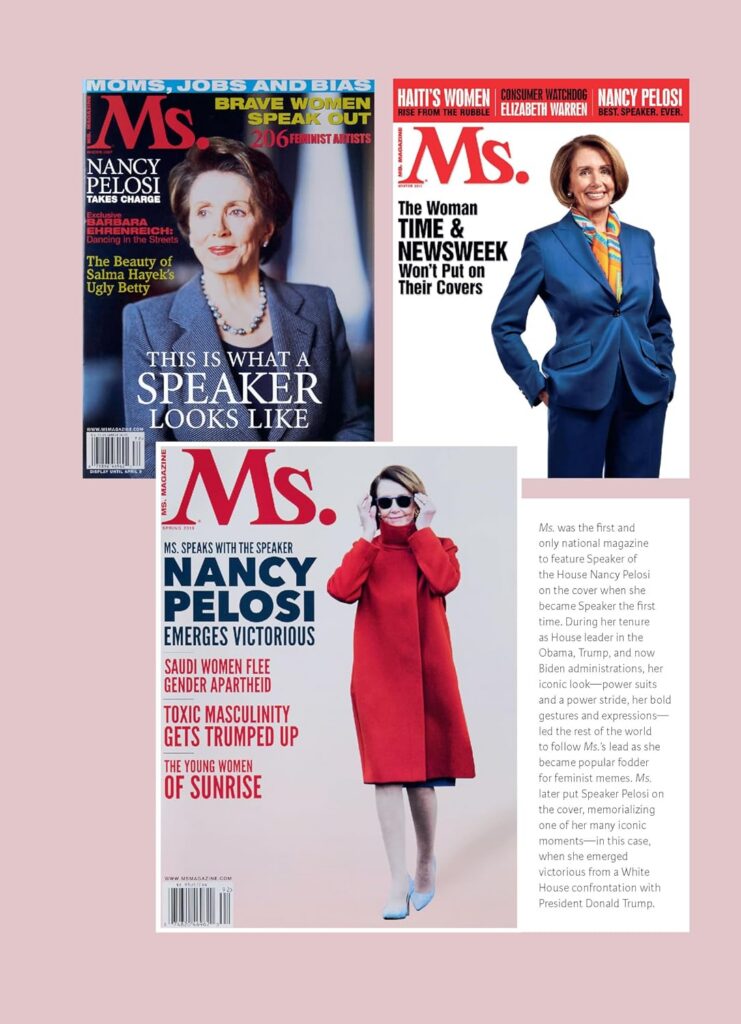
Two years later, Obama also appeared on the cover. The Winter 2009 issue of Ms., its Inaugural Special, he was depicted wearing a shirt emblazoned with the popular FMF slogan: “This is what a feminist looks like.”

Inside the 2009 special issue, FMF president and Ms. publisher Smeal shared that she was “working with members of the Obama-Biden transition team, urging more women appointments, making sure women were not forgotten in the economic recovery package, and focusing on the reversal of horrific Bush-era executive orders, regulations and legislative mandates that attacked women’s rights.”
In the next issue, Jodi Jacobson wrote that “the Obama administration has revived reproductive justice in just a few months,” extolling his administration for ending the global gag rule, expanding Medicaid funding and early childhood education, lowering birth control costs, and increasing Title X funding and restoring UNFPA funds—while slashing abstinence-only sex ed funding. He also signed the Lilly Ledbetter Fair Pay Act into law. A month after the issue hit newsstands, he nominated Sonia Sotomayor to the Supreme Court.
It was a familiar kind of whiplash—from regression back to progress almost overnight. But the next decade would show just how quickly political headwinds could switch, and just how much work lie ahead.
The lesson of the 2000s is that public opinion alone is not enough. Feminists entered the decade with growing public support and left it with an even larger constituency behind them. Yet the period also demonstrated how determined political actors can use institutions, courts and legislation to advance agendas that do not reflect majority views. The challenge for a majority movement, the decade revealed, is converting cultural influence into durable political power.
Feminist Lessons: Keep Reading the Series
At a moment when hard-won rights are being challenged, and fundamental questions about democracy, equality and freedom are once again at the center of American politics, there is much to learn from the recent past and modern women’s movement. Explore the rest of Feminist Lessons to see how feminists transformed American life in the 1970s, confronted organized backlash in the 1980s, emerged as a powerful political force in the 1990s, built a feminist majority in the 2000s, turned mass resistance into political power in the 2010s, and continue fighting for democracy in the 2020s. Together, these essays draw on more than 50 years of reporting, organizing and activism to recover the hard-won lessons of the modern women’s movement—and to illuminate the challenges and opportunities that lie ahead.