From the Affordable Care Act to #MeToo and the Women’s March, the 2010s proved that backlash can spark movements powerful enough to reshape politics, culture and the fight for equality.
One of the defining lessons of the 2010s is that backlash can become a catalyst for change. Faced with escalating attacks on reproductive freedom, economic equality and democratic participation, millions of feminists refused to retreat. Instead, they organized, mobilized and transformed resistance into one of the most powerful political forces of the decade.
This essay is part of Feminist Lessons, a series from Ms.’ FEMINIST 250 project exploring what each decade of modern feminist history can teach us about power, democracy, backlash and social change. Drawing on more than 50 years of reporting, organizing and activism, the series examines how feminists transformed American life—and what those victories and setbacks can teach us today.
During his first year in office, Obama created the White House Council on Women and Girls, signed the Lilly Ledbetter Fair Pay Act into law, and successfully appointed Sonia Sotomayor to the Supreme Court, making her the first Latina to assume the bench. As the decade turned, his administration continued to usher in historic gains for women, including the 2010 appointment of Elena Kagan to the Supreme Court.
That same year, the Affordable Care Act (ACA) passed—a watershed moment for the country’s broken healthcare system and a major victory in particular for women’s health.
The ACA ended many discriminatory sex-based insurance pricing and prohibited insurers from denying women coverage due to pre-existing conditions, which in the past had included being a domestic violence survivor or having had a c-section. The legislation also mandated that all coverage include maternity and newborn care and that preventive services like well-woman visits, breastfeeding supplies, contraception, vaccines, domestic violence screening, and more be available without cost sharing. By 2015, the law had saved women $1.4 billion on contraception alone.

For the next six years, Obama’s administration advanced policies in line with the feminist movement’s advocacy. He boosted women’s health research at the National Institutes of Health. He signed a VAWA reauthorization into law that expanded support for Indigenous, immigrant, and LGBTQ survivors. (His Department of Education also mandated through Title IX guidance that schools, colleges, and universities combat campus sexual assault, and his Department of Defense crafted a Sexual Assault Prevention and Response Strategic Plan to end military sexual trauma.) He established the National Action Plan on Women, Peace and Security, opened the office of Global Women’s Issues, and he hired the first Ambassador for Global Women’s Issues.
Feminists also won major victories at the Supreme Court during Obama’s tenure and throughout the 2010s, including the 2013 decision in United States v. Windsor that legalized gay marriage, the 2016 decision in Whole Woman’s Health v. Hellerstedt that ruled states could not place undue restrictions on abortion access, and the 2019 June Medical Services v. Gee that struck down a Louisiana TRAP Law.
But the movement did not rest on its laurels. Ms. went digital in 2010, launching its website to expand how feminists could learn and become involved with the feminist movement.

In 2011, the magazine launched a successful virtual campaign to change the FBI’s 82-year-old definition of rape—ensuring that nonconsensual oral and anal sex or digital assault, attacks with other objects, assaults where the victim was unable to consent, and all male and nonbinary victims could access justice.
In 2013, Ms. covered the women fast-food workers striking for a higher minimum wage and better working conditions in the movement that would become known as the Fight for 15; the story’s corresponding cover art, of Rosie the Riveter in a fast-food worker’s uniform, was printed and attached to picket signs used in protests nationwide.
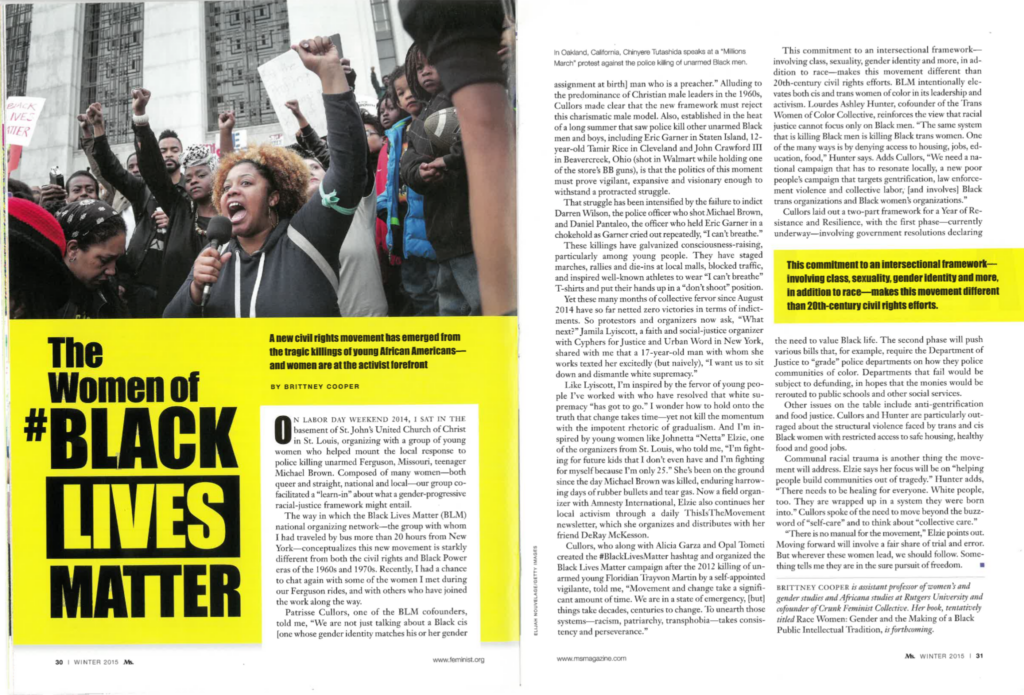
That same year, the women-led Black Lives Matter movement rose to national prominence, sparking reforms in policing.
And in 2014, Ms.’ coverage of the campus sexual assault epidemic inspired mainstream outlets to devote space to the issue.
Despite the momentum of the feminist movement, however, the War on Women persisted throughout the Obama era and the rest of the 2010s within Congress, in the courts, and at the state level. (By as early as 2012, the all-out assault warranted a special report in Ms.) The House Judiciary Committee convened an all-male hearing to speak out against the ACA’s birth control mandate, and a state judge ruled that pharmacists could not be forced to fill prescriptions for Plan B if it violated their religious beliefs. (In Congress, legislation to that same effect was introduced but did not pass.)
Lawmakers in dozens of states introduced and passed hundreds of bills that restricted or banned abortion and access to some forms of contraception, and slews of TRAP (targeted regulations of abortion provider) laws forced clinics to cooperate with erroneous requirements or shut their doors. Republicans in Congress attempted to water-down VAWA, and House lawmakers tried to cut all funding for Title X, which supports family planning services for low-income people.
In the meantime, state lawmakers slashed Medicaid and other funding for women’s healthcare and rolled back economic protections for women workers.
These two distinct visions for the future of the American dream went head-to-head in the 2016 election. Hillary Clinton, whose campaign, Kelly Dittmar noted in Ms., ”mainstreamed gender”—forcingall candidates to address paid leave, pay equity, and affordable child care—faced Donald Trump in the general election, who had bragged on tape about assaulting women and often resorted to sexist bullying (as well as blatant racism, xenophobia, and warmongering) as a campaign strategy.
“Put simply,” Smeal wrote in an election post-mortem in the Winter 2016 issue of Ms., “if only women had voted Hillary Clinton would have won by a landslide.” Instead, Trump was elected by a “razor-thin” margin, carried to victory by the votes of 63 percent of white men and 53 percent of white women. (Ninety-four percent of Black women, 68 percent of Latinas, 62 percent of single women, 51 percent of white college-educated women, and a plurality of married women went for Clinton.)
In his first term, Trump turned policymaking into a new bully pulpit, consecrating the War on Women into law at breakneck speed. He extended religious exemptions to the ACA’s contrception mandate and attyacked abortion coverage in ACA health care plans. He slashed funding for family planning services, reinstated the global gag rule and implemented a new domestic gag rule prohibiting Title X recipients from referring patients to or providing information about abortion services, which pushed dozens of grantees out of the network and left 1.6 million women without access to family planning services.
At Trump’s direction, the Equal Employment Opportunity Commission stopped collecting and analyzing pay data, halting a process meant to confront wage discrimination, and the Department of Education rescinded Obama’s guidance that mandated schools campus sexual assault under Title IX.
Worst of all, he ensured his anti-woman agenda would shape laws for generations by stacking the Supreme Court and lower courts with conservative judges aligned with the Heritage Foundation’s ideology of “originalism,” which seeks at its most extreme to deny women all legal rights.

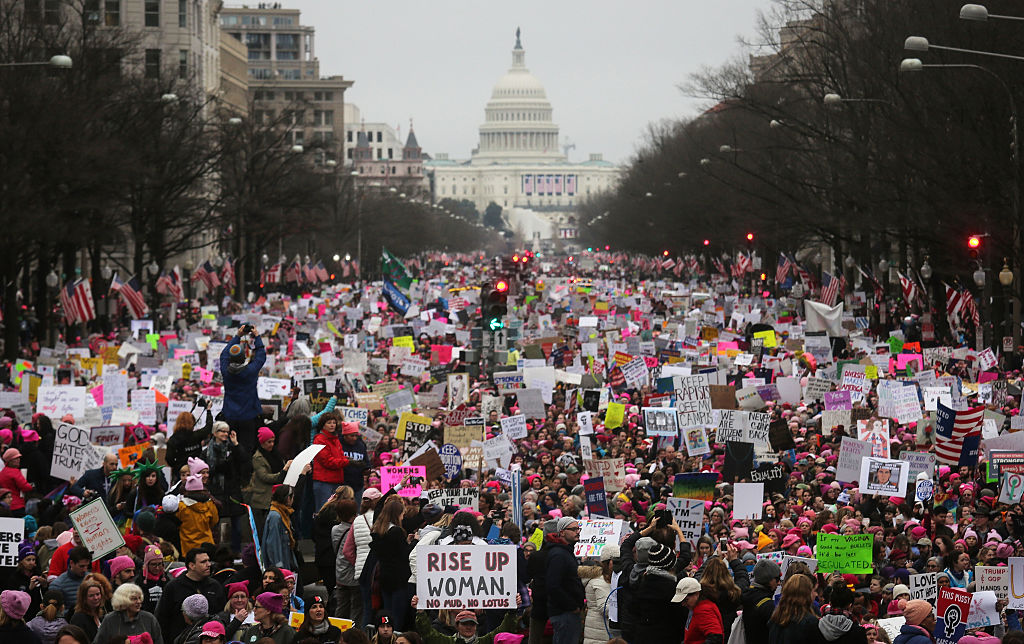
Feminists did not hesitate to fight back. Thirteen years after the March for Women’s Lives, an estimated 5.6 million activists nationwide participated in at least 999 Women’s Marches during Trump’s first day in office in 2017, setting a new record for the largest single-day protest at that point in U.S. history. (Protests also took place globally, on every continent—including Antarctica.)
And in the 2018 midterm elections, feminists flipped 40 House seats.
Ms., FMF and Lake Research Partners first noted the existence of “the feminist factor” in 2012, when Obama was carried to victory not only in part by the gender gap, but additionally by voters of all genders who shared his feminist beliefs. Of the 55 percent of women and 30 percent of men who reported in 2012 exit polling that they considered themselves feminists, 64 percent of the women and 54 percent of the men voted for Obama. So did 61 percent of voters who identified as pro-choice.
“While there were many reasons for President Obama’s decisive victory,” Smeal wrote in the Winter 2013 issue of Ms., “the feminist factor may be one of the most significant.”
In 2018, the gender gap and the feminist factor struck again. In an election with the highest turnout in over 50 years, women of color, young women and college-educated women elected a record number of women were elected to both chambers of Congress and to state legislatures, including a series of Black, Latina, Native American and young women candidates who made history as “firsts” in their office.
In a poll conducted by Lake Research Partners, Ms. found that 77 percent of women and 53 percent of men who voted for Democrats identified as feminists. A majority of Latinas, Black women, and white women voters identified themselves feminists, as did a majority of married women and unmarried women, and college-educated women and non-college-educated women.
Women also rose up against sexual harassment and gender-based violence as part of the viral #MeToo movement, initiating an unprecedented number of workplace reckonings—from Hollywood, Capitol Hill and Silicon Valley to newsrooms, farms and hotels—beginning in 2017. Predatory men and the careers they had built were toppled; unions and lawmakers advanced legal and workplace reforms; and survivors and advocates exposed and dismantled cultures of silence upheld by NDAs, forced arbitration agreements, statutes of limitations and hush-hush settlements.
In statehouses, the ERA even experienced a revival, as Nevada, in 2017, and Illinois, in 2018, voted to ratify the amendment—over 40 years after it was first sent to the states.
“The continued need for a federal ERA could not be clearer in light of widespread violence against women, attacks on voting rights…and rollbacks to reproductive rights,” Gaylynn Burroughs wrote in the Winter 2015 issue of Ms. “Women’s equality should not depend on shifting political winds, and everyone deserves to live a life free from the pernicious effects of sex discrimination.”
And on the field, the U.S. Women’s National Soccer Team broke barriers by speaking out publicly for equal pay and equal rights, pushing feminist causes further into the mainstream. They infamously turned down a chance to meet with Trump at the White House following a World Cup victory, but accepted invitations from women lawmakers across party lines to discuss the issue in both chambers of Congress.
In the face of Trump’s assault on women’s gains and the core tenets of our democracy, these moments reaffirmed the power of the feminist movement, and the ways it had reshaped women’s lives.
“They don’t want a feel-good narrative about how much progress has been made since 1972,” Dave Zirin wrote of the USWNT in the Fall 2019 issue of Ms. “They would rather drive a discussion that asks greater structural questions about institutionalized sexism.”

Feminists in the 2020s have continued that discussion—demanding a more equitable future despite the continuing reign of Trump-era patriarchs.
The lesson of the 2010s is that progress is not guaranteed—but neither is defeat. The decade showed that attempts to roll back rights can generate new movements, new leaders and new forms of political engagement. From the Women’s March and #MeToo to the ERA revival and record numbers of women running for office, feminists demonstrated that resistance is most powerful when it becomes a force for lasting political change.
Feminist Lessons: Keep Reading the Series
At a moment when hard-won rights are being challenged, and fundamental questions about democracy, equality and freedom are once again at the center of American politics, there is much to learn from the recent past and modern women’s movement. Explore the rest of Feminist Lessons to see how feminists transformed American life in the 1970s, confronted organized backlash in the 1980s, emerged as a powerful political force in the 1990s, built a feminist majority in the 2000s, turned mass resistance into political power in the 2010s, and continue fighting for democracy in the 2020s. Together, these essays draw on more than 50 years of reporting, organizing and activism to recover the hard-won lessons of the modern women’s movement—and to illuminate the challenges and opportunities that lie ahead.