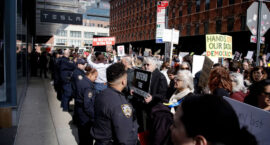
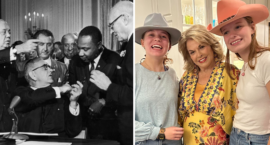
The Road to the ERA Runs Through Congress

In 1916, just as Americans were beginning to enjoy the new travel freedoms that came with motorized vehicles, a couple of frustrated leaders of the campaign to secure women’s rights to vote, Alice Snitjer Burke and Nell Richardson, secured one of the first gas-driven automobiles in the country. They named the car, a Saxon, Golden Flyer and set off across the country to get support for what would become the 19th Amendment, guaranteeing women the right to vote.

Yes, the original ‘road trip’ was an act of political audacity. Long before women even had the vote, these two women drove into towns across America, on their own, spoke in town squares, slept in boarding houses and not surprisingly, endured ridicule and resistance. They were history’s first “Thelma and Louise.” This road trip had a very different ending, of course, as it led to the passage of constitutional clarity on the question of voting rights, at least for white women, with the 19th Amendment. Getting that right guaranteed for all women, whatever race or circumstances, would still take other struggles. And the campaign for full equality for all women didn’t end with the Drive across America for voting rights.

The struggle for a constitutional guarantee of equality has led to another road trip across America: Driving the Vote for Women’s Equality Tour.

When Burke and Richardson set out in the Golden Flyer in 1916, they did not know the outcome. They only knew that democracy requires action. And the action now is to finish the work through the ERA joint resolution. The message to policymakers is direct and clear: Recognize the will of the states and acknowledge that the ratification threshold has been met. Finish the work.

Equal means equal. It did in 1916. It does now. And this time, we will not stop until the Constitution says so.
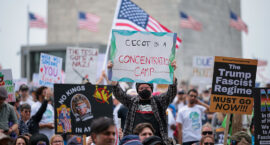
The Resistance Is Here

This week marks the 100th day of Donald Trump’s presidency, and a record number of Americans are unhappy with him and his administration.

During Trump’s first term, public demonstrations of disapproval were rapid and massively visible. This time around, it’s building in a different way.

Now is the time for all of us to practice democracy daily—by staying informed; talking with our friends, coworkers and family members; calling our representatives; and showing up at meetings, rallies and events.

It’s Time to Take Action—Even Though It Feels Dangerous

“Action is the antidote to despair.”

I find this statement by the legendary activist/songwriter, Joan Baez, to be particularly relevant and inspiring in this time when it’s so easy to fall into despair. When I am engaged in activism—the purposeful resistance to the many push backs on rights and freedoms—I push aside despair and reclaim the hope that comes with action.

And it’s time for action! Time to stop the handwringing and worse, the silence, about what is happening in the U.S. that is having an impact everywhere in the world.

Documentary Films ‘Seeds’ and ‘How to Build a Library’ Debut at Sundance—Just in Time for Black History Month

This year’s observance of Black History Month falls at a convulsive time for Americans. As the Trump administration works to eliminate all diversity, equity and inclusion programs in government and throughout American society, from companies to nonprofits, it’s more important than ever to celebrate and commemorate the achievements and the contributions of Black Americans.

With that in mind, two films that premiered at Sundance are worthy of your attention.

Seeds, the winner of the U.S. Grand Jury Prize for documentary, explores the lives, traditions and history of Black generational farmers in the American South.

How To Build A Library, a powerful new documentary from Kenya, tells the story of two remarkable women who decided to transform what used to be a whites-only library until 1958 into a vibrant cultural center in Nairobi.

Do You Remember the First Time You Voted?

The first year I could vote, the choices for president were Republican Sen. Barry Goldwater or the incumbent President Lyndon B. Johnson. LBJ won—the largest landslide in U.S. history. Voting for him as a first-time voter felt consequential.

This year, I’ll be voting with two very special first-time voters: my twin granddaughters, in the swing state of Georgia. Our daughters’ and granddaughters’ future is in danger.

Not One Woman on the List

Earlier this month, Azerbaijan President Ilham Aliyev announced the organizing committee for COP29, which will be held there in November. The list included 28 appointees, including Azeri government ministers of energy, health, finance and economy, among others. What the list did not include: women. Not one woman on the list.

The backlash was swift and thunderous. Global women leaders are speaking out: “Many of the key successes of the COP process, including the Paris Agreement, were delivered by women leaders, working closely with their male colleagues.”

Action Is the Antidote to Despair

As Joan Baez, one of my favorite songwriters/performers/activists from my political ‘coming of age’ era, once said, “Action is the antidote to despair.”

Tuesday, Nov. 7, is Election Day in the United States, and voting is one action we can all take as U.S. citizens—and a privilege for every person living in a democratic country—to fend off the despair so easily experienced given the wars, the violence, and the rollback on rights in so many places today.