A new book by gynecologic oncologist Dr. Kemi Doll helped me see my hysterectomy not just as an ending, but as part of a life-saving conversation women need to have.

Women’s health conversations tend to revolve around breast cancer—but uterine cancer routinely kills women in their 50s and 60s. Though it strikes three times more often than ovarian cancer and five times more often than cervical cancer, uterine cancer flies under the radar, and too many women learn nothing about it … until they are diagnosed with it. Worse, most don’t recognize the warnings our bodies send long before we’re in danger.
Conducting research, seeing patients and performing surgery keeps Dr. Kemi Doll busy, but she also wrote a book inviting us all to join her in the life-saving work of raising awareness.
Determined to prevent deaths from uterine cancer, Doll published A Terrible Strength: The Hidden Crisis of the Black Womb and Your Survival Guide to Healing in May. Both comprehensive and compassionate, the book focuses on individuals of African descent, arguing everyone will benefit if we improve the system for this specific group of patients.
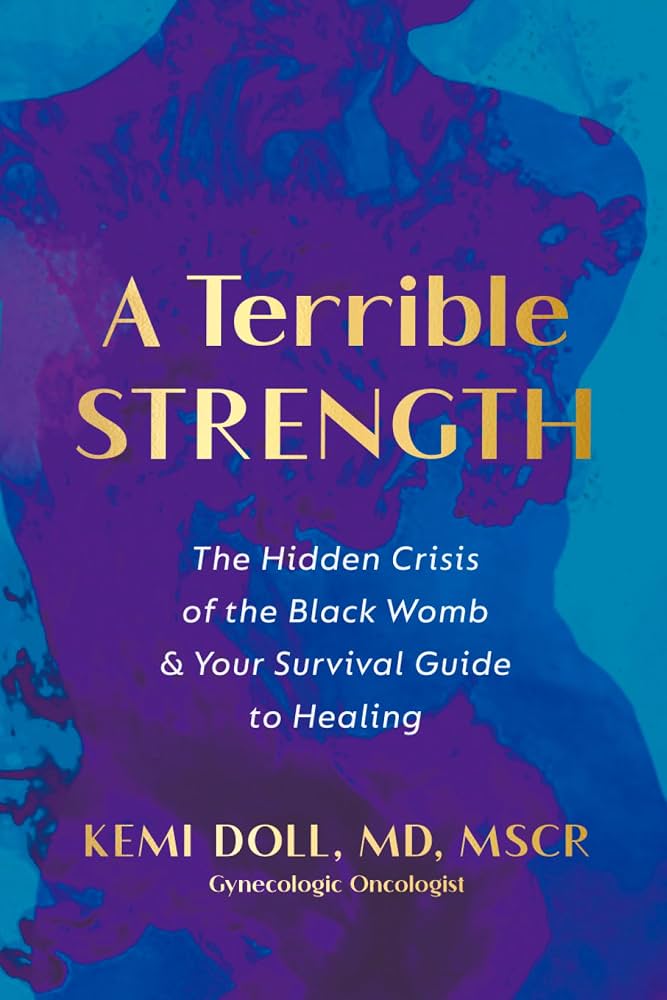
For the past 16 years, Doll’s clinical practice has served Black women—so her findings can seem prescient. When only Black women died from uterine cancer, many doctors and researchers ignored the disease, but it recently became fatal for white women—and Doll wants everyone to know the truth: Women save lives by sharing our gynecological histories.
Upon finishing A Terrible Strength, I took its message to heart: One need not have a womb to prioritize womb health. We can all join Kemi Doll’s Womb Sisterhood through the “deliberate telling and sharing” of “womb stories” with “our true friends.”
Fortunately, women have already started talking. Personal testimonies changed health outcomes in the 1970s and ’80s—and they’re doing the same now. Earlier generations suffered through perimenopause in silence, but today, women in their 20s, 30s and 40s hear about not only hot flashes but also itchy ears and frozen shoulders. And, as a woman in my early 50s, I’m not completely in the dark about hormone replacement therapy (HRT).
Nevertheless, deadly silence remains.
Because there’s so much we don’t know about the womb, A Terrible Strength equips readers to share accurate information along with their personal stories; only a fraction of the book focuses on cancer. Too much about women’s bodies remains a mystery because shame distorts conversations. The book therefore begins by educating readers about the basics of reproductive organs and systems.
After detailing how female anatomy functions, Doll holds up a mirror that many of us will see our jaws drop in. Readers encounter familiar stories about heavy periods—periods that were not considered heavy by the people experiencing them. In the process, Doll prepares readers for more substantive conversations with friends and family.
She also exposes assumptions that have shaped our behavior since we were teenagers. For example, “successful femininity is having a period that no one knows about.” While living by this philosophy, some women bleed their way into chronic anemia. Doll writes, “I know Black women who are shining stars in their careers while severely iron deficient. Can you imagine what they could do with normal, healthy iron levels?”
While revealing how common heavy bleeding is, especially among Black women, Doll demonstrates how tolerating heavy periods—seeing them as an inconvenience rather than a problem—puts us in danger.
She also empowers readers by explaining endometriosis—which is common but not well understood, even by those who suffer with it. A Terrible Strength also offers practical information about the treatments available as well as the benefits and drawbacks of each.
Readers of A Terrible Strength also gain clarity about fibroids—another malady plaguing women that is both incredibly common but poorly understood. Because fibroids disproportionately impact Black women, Doll emphasizes the Black Women’s Health Study (BWHS), which followed 60,000 individuals over 25 years.
Again and again, this book helps all women by focusing on Black women—the group hardest hit.
Any reader who shares the understanding available in these pages can change outcomes. After all, silence has done us all a disservice for too long.
Uterine cancer comes up only after significant ground has been covered. After all, paying attention when the previously discussed conditions emerge determines so much. And that’s why sharing our experiences at every stage of our lives can make a world of difference. As Doll reminds us, conversations about womb health often revolve around pregnancy, but most women “spend more than 90 percent of their lives not pregnant.”
I am childfree by choice, so pregnancy never fueled my concerns, but I became preoccupied with gynecology in 2017. Fibroids were wreaking havoc in my life, and I pursued a hysterectomy to end my suffering. As Doll puts it, this “definitive treatment” is “welcomed by some and mourned by others.” Though I very much welcomed a hysterectomy, I couldn’t secure one until May 2021, despite my best efforts.
I was indescribably relieved that I had been so persistent when, in June 2022, the Supreme Court overturned Roe v. Wade, and medical professionals became even more hesitant about reproductive health procedures.
From now on, I will participate in the “deliberate telling and sharing” of “womb stories.” Doing so is difficult but necessary. As Doll explains, sharing our experience requires us to “shift away from a strength that withstands suffering, silence and pain.” It requires, in her words, “a strength that embraces our vulnerability and can demand better care from the larger world.”
Kemi Doll refuses to equivocate: “Black women in their 50s, 60s and 70s … have accumulated power from lifetimes spent strategizing how to live in a country that hates them. Their gifts are finally in full bloom.”
And that’s exactly when decades of neglecting womb health will wreak havoc.
Let’s reverse this deadly trend by joining the Womb Sisterhood.
*
A note from Ms. editors: We want to hear from you for The Majority, a new campaign collecting stories about how reproductive freedom has enabled readers to build the lives they want and need.
Poll after poll shows a majority of Americans support reproductive healthcare access. Yet public debate overlooks the lives shaped by abortion access, contraception, IVF, miscarriage care, maternal healthcare or comprehensive sex education—countless women who chose to pursue an education, have children, not have children, protect their health and chart their own future. What’s your reproductive freedom story? Add your voice. Together, these stories will help show not only why reproductive freedom remains a majority value, but also what it makes possible.