The label “jiggle TV” obscured the surprising ways Charlie’s Angels shaped girls’ understanding of feminism, work and solidarity.

I don’t remember how old I was when I first heard the term “jiggle TV,” but I know it was many years (decades, probably) after I was a devoted, starry-eyed fangirl of the genre. And I do mean girl—Wonder Woman (1975-79) came into the world just a year after I did, Charlie’s Angels (1976-81) two years after, Three’s Company (1977-84) the year after that.
This timing meant that I watched them all—first in weekly nighttime installments, later in endlessly imbibable reruns—as I was learning to walk, talk, dress, eat, interact with other girls and other boys, and understand how the world saw me and where I fit into it.
The term “jiggle TV” was coined in the mid-1970s by NBC exec Paul Klein to describe and deride rival network ABC’s successful lineup of shows starring women who wore excessively revealing clothing, with Charlie’s Angels as its prime example. Whatever age I was when I first heard the term, I was old enough to immediately grasp its demeaning, objectifying implications. I remember it hitting me like a ton of bricks: The fictional world I’d been gazing at with such awe and reverence was, in the eyes of others, somewhere between a turn-on and a joke.
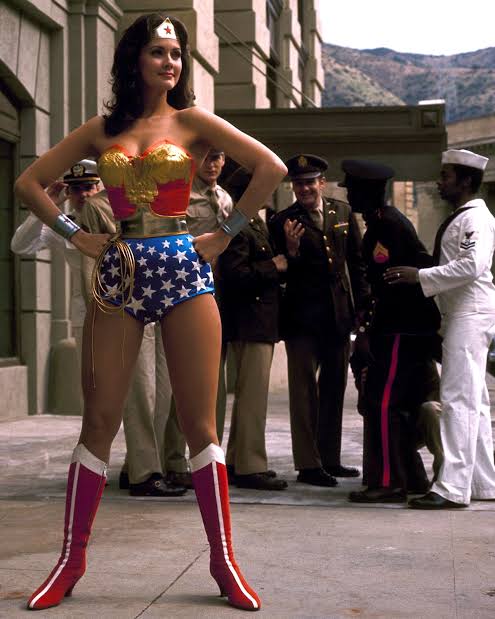
Still, Wonder Woman and Charlie’s Angels were the stuff my dreams were made of. No one seemed more majestically beautiful to me on this planet than Lynda Carter, and I spent many an hour in my beloved Wonder Woman underoos, wrist-repelling invisible bullets and careening around in my invisible jet.
… The fictional world I’d been gazing at with such awe and reverence was, in the eyes of others, somewhere between a turn-on and a joke.
And then there were the Angels.
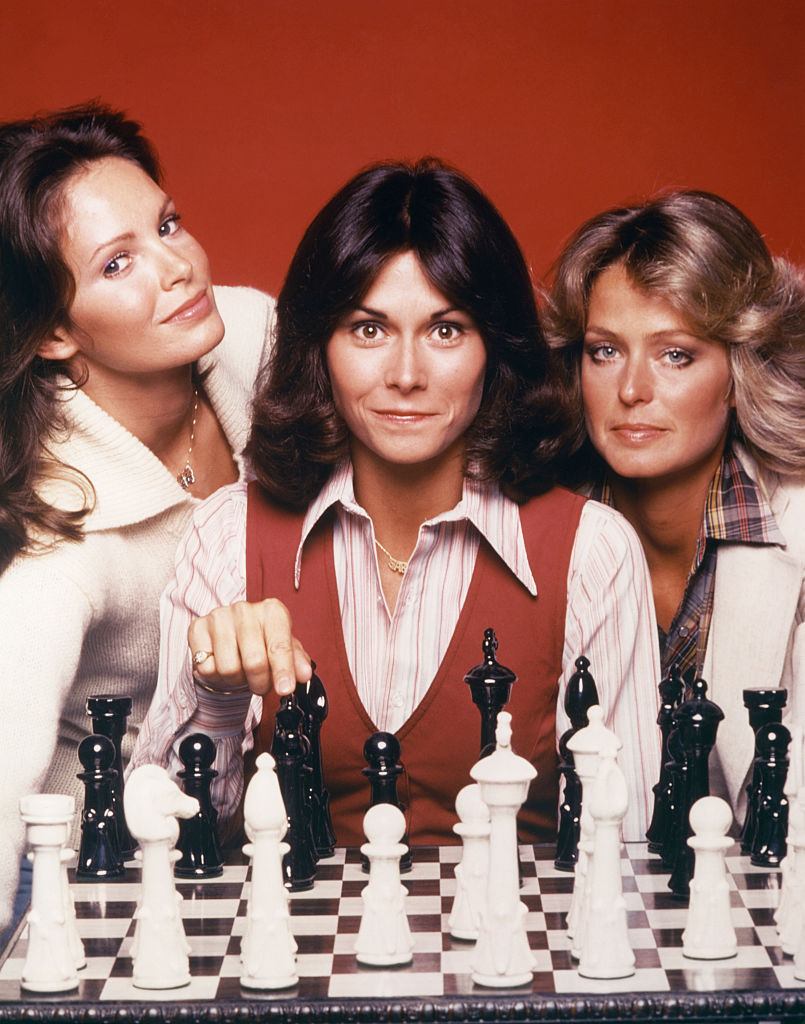
The Angels didn’t have superpowers, but that made them all the more awe-inspiring. They could do anything, without magic or mythos. Dance. Sing. Swim. Surf. Ski. Skateboard. Roller skate. Ice skate. Scale buildings. Crack safes. Hang glide. Sharp shoot. Shoulder throw. They could drive race cars, motorcycles, snowmobiles, speedboats, big rigs—even land a 747, in a pinch.
Plus, there were three of them. Charlie’s Angels cosplay, unlike Wonder Woman cosplay, was inherently a communal activity, a team sport. And it was a sport that my two sisters and I were just the right number for: My older sister always got to play Kelly, my little sister Sabrina and I was always Kris. Not Jill, mind you—to me, it was underappreciated Munroe Sister #2 who was the smart one, the sophisticated one, the sporty one, the funny one, the brave one, the thoughtful one.

But what Kris never was to me—and what Sabrina, Kelly, Jill, Tiffany and Julie never were to me, either—was the “jiggly” one.
Without making a big thing about it, I tucked my childhood obsession away in a remote-storage corner of my brain and, for decades, lived an Angels-free life.
Until this year.
This year, Charlie’s Angels turned the big 5-0, and the internet wouldn’t leave me alone about it. From Cheryl Ladd singing “I Just Want to Be Your Everything” with Donnie Osmond to Kate Jackson, Jaclyn Smith and Farrah Fawcett doing a Three Little Pigs sketch with Captain & Tennille, the wave of kitschy Angels content that flooded my feed was irresistible. How could I help it? I wanted back in.
Never one for TV-consumption moderation, I decided to attempt a full-series rewatch and work my way through as many episodes as I could, in order, before running out of steam. I was curious to see how the show would hit me now—as a grown woman, proud feminist and professor who teaches and writes about the relationship between popular culture and gender politics for a living.
But I also wanted to see if immersing myself in the series again after all these years would pull my memories out of remote storage and give me a more detailed picture of how the show’s storylines and messages had affected my pliable young mind.
What had I picked up and taken away from the show besides starry-eyed fangirl devotion?
The answer was: plenty.
What the Angels Taught Me About Work
Time and again, they had to defend both their right and their fitness to do their jobs—often to their own (male) clients, often through clenched smiles.
On one level, the series taught me that women can do any kind of work they put their mind to—police and P.I. work, obviously, but also all the other jobs the Angels had to master at a moment’s notice when they went undercover. Many of these jobs were clearly meant to appeal to the Jiggle TV crowd—cheerleader, swimsuit model, belly dancer, Vegas showgirl—though plenty of others were not: reporter, financial auditor, business executive, college instructor, circus clown.
The vocational possibilities open to the Angels—and by extension, I presumed, to me—seemed limitless.
But the series also clued me into how much pushback and backlash women in the workforce could expect to receive.
Sometimes the crimes the Angels were hired to investigate provided grisly examples of how far such pushback and backlash could go (like the one where the husband is so bitterly resentful of his wife’s higher salary that he takes to serial-killing women who look like her). Mainly, though, the pushback was seen in the skepticism or outright hostility the Angels experienced in their own professional lives. Time and again, they had to defend both their right and their fitness to do their jobs—often to their own (male) clients, often through clenched smiles.
As fun as it was to see the Angels kick their doubters’ prejudices to the curb by the end of each episode, the procedural format of the show meant that there was always a new batch of guest stars with the same “What?! You’re lady detectives?” energy at the start of the next. From this, I learned how exhaustingly cyclical the fight for women’s equality was—and would continue to be.
There were, however, two men in the Angels’ lives who never needed to be convinced of their capabilities: assistant-sidekick Bosley and boss-via-speakerphone Charlie. The lessons I took from Charlie’s managerial style, in particular, were complicated. On one hand, I could see how imbalanced the Townsend Agency’s workplace power dynamics were, with the women doing all the dangerous, on-the-ground dirty work while the big man in charge phoned in their assignments from the comfort of his grossly Hugh Hefner-esque bachelor’s lair.
… I was floored by the number of times Charlie told the Angels what a fantastic job they’d done, checked in on them emotionally after they’d had a rough encounter, offered them paid time off and vacations to help them recuperate …
On the other hand, these were women who wanted to do the dangerous, on-the-ground dirty work. The very premise of the show, laid out so memorably in the opening credit sequence, was that these “three little girls who went to the police academy” deeply resented the dismissive, patronizing treatment they’d received there and delighted in working for someone who trusted them to do the important and hard stuff, and so clearly valued and respected them.
Watching the series again after spending decades in the workforce myself, I was floored by the number of times Charlie told the Angels what a fantastic job they’d done, checked in on them emotionally after they’d had a rough encounter, offered them paid time off and vacations to help them recuperate and so forth.
I found myself wishing that more bosses of the past half-century (including my own) had taken this lesson from the show and, Hugh Hefner-esqueness very much aside, been more like Charlie.
What the Angels Taught Me About Sex
… The show planted the first seeds in my mind of both the horrific pervasiveness of rape culture in our society and the urgent need to expose and combat it.
Charlie’s Angels premiered three years after the cultural inflection point of Roe v. Wade—and it shows. The freedom and casualness with which the Angels pursued a romantic dalliance with a client here, a potential suspect there while still prioritizing their careers and their independence was very much a product of the second-wave feminist times. These were women who clearly enjoyed sexual intimacy, when it was mutually consensual—an important qualifier for me to see modeled at such an early age—but who didn’t feel the need to put it at the center of their lives.
What the show spent more time focusing on, though, was the ever-looming threat of nonconsensual sex, or what we would now call rape culture. This focus, too, was seen sometimes in the sexually violent crimes under investigation (like the string of attempted rapes in one episode or the string of sex worker murders in another), but more often in the endless bombardment of leering, ogling sexual harassment and occasionally overt sexual assault, the Angels themselves faced as they went about their business.
I was actually pleasantly surprised, during my rewatch, by how little victim-blaming the show’s depictions of sexualized violence engaged in. The criminals who exploited and assaulted women were never excused or defended or painted in a somewhat sympathetic light, and the women were always listened to, believed and treated with sensitivity and care by all members of the Townsend Detective Agency (including Bosley and Charlie). I realized the show planted the first seeds in my mind of both the horrific pervasiveness of rape culture in our society and the urgent need to expose and combat it.
That said, what was much clearer to me this go-round was the role that Charlie’s Angels played in perpetuating the image of women as sex objects, which is itself a foundational aspect of rape culture. This time, I paid more attention to the list of almost exclusively male writers, directors and producers in the opening and closing credits—in other words, the list of men who chose to put the Angels in a never-ending display of skimpy outfits and sexually precarious situations, at least in part because they knew there was a leering, hungry male audience for it.
What the Angels Taught Me About Sisterhood
It might sound strange to say that I learned about sisterhood from watching Charlie’s Angels, given that I was one of three sisters myself. But there’s a big difference between the kind of sistering you do in early childhood (“that’s mine!” “no fair!” etc.) and the kind of unfaltering support, camaraderie and solidarity I saw modeled by the Angels in (practically) every episode.
Forget all the different jobs and high-speed vehicles the Angels could handle. What really made them superheroes, I see now that I saw then, was the way they held up and looked out for one another—and for the dozens of women and girls they fought to protect and empower in the course of their investigative endeavors.
That said, where the original series failed miserably in its portrayal of feminist solidarity was in its blaring, glaring lack of intersectionality. Hardly any non-white or LGBTQ+ characters appeared on the show, and when they did, they were almost always rendered with the casual racism, homophobia and transphobia that pervaded network TV at the time. While later Angels reboots recognized and at least tried to address this problem, the Angels of my youth taught me many lessons I had to actively work to unlearn.
To be clear, I watched a lot of TV shows as a kid, and absorbed a lot of social, political and interpersonal lessons, both good and bad, from all of them. But there was something about Sabrina, Kelly, Jill and Kris—along with their jiggle TV sister-in-arms Diana, a.k.a. Wonder Woman—that made their shows stoke my imagination and shape my budding perceptions of the world more forcefully than the others; more than I have, till now, cared to admit.
We’re all influenced by a barrage of media input in a multitude of ways, some of which we’re cognizant of, some of which we’re not. Paying more careful attention to the media soundtrack that’s always playing in the background of our minds—especially the tracks on it that date back to our earliest, most impressionable years—can give us a stronger sense of where we are, where we’ve been and where we might choose to go from here.
*
A note from Ms. editors: We want to hear from you for The Majority, a new campaign collecting stories about how reproductive freedom has enabled readers to build the lives they want and need. Poll after poll shows a majority of Americans support reproductive healthcare access. Yet public debate overlooks the lives shaped by abortion access, contraception, IVF, miscarriage care, maternal healthcare or comprehensive sex education—countless women who chose to pursue an education, have children, not have children, protect their health and chart their own future. Add your voice and complete the sentence: “Access to reproductive choices gave me the freedom to….” Together, these stories will help show not only why reproductive freedom remains a majority value, but also what it makes possible.