The U.S. ranks as the 31st most dangerous country for women, 55th in maternal mortality, 43rd in closing the gender pay gap, 85th in women’s political representation, and painfully lacks paid family leave and equal access to healthcare. But Ms. has always understood: Feminist movements around the world hold answers to some of the U.S.’ most intractable problems. Ms. Global is taking note of feminists worldwide.
India
+ Protests erupt in eastern Indian state over sexual assault and killing of girl
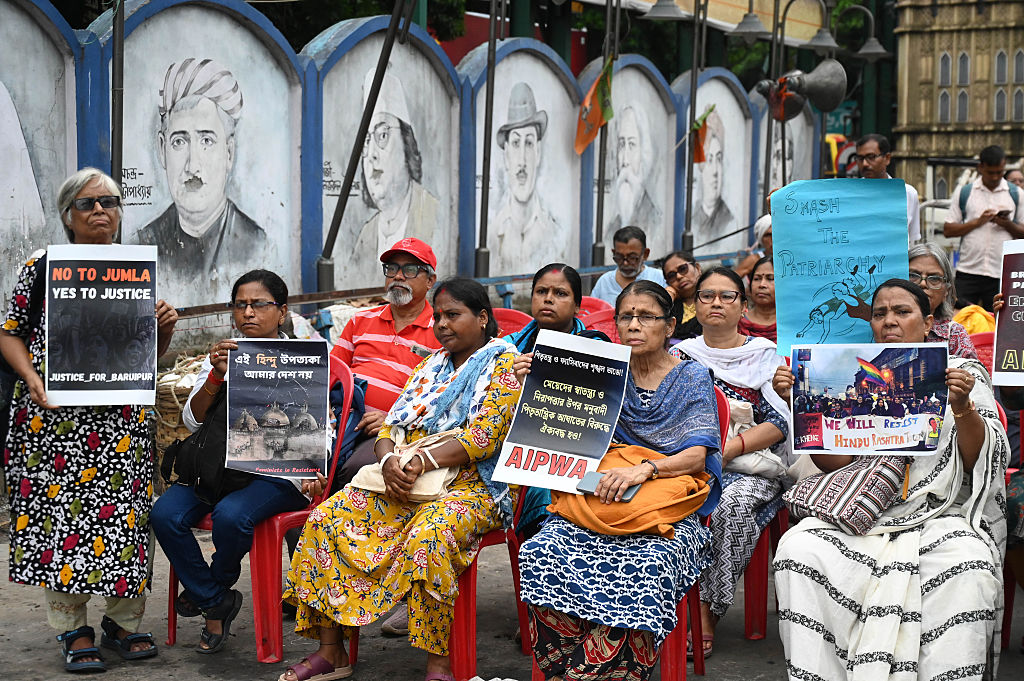
In early July, days of protests erupted in Baruipur, a city in India’s eastern state of West Bengal, following the sexual assault and killing of a young girl. She was believed to have been 11 or 12 years old.
On July 4, the girl, who has not been named, went out alone in the evening. When she did not return home hours later, her family contacted authorities. After examining CCTV footage in the area, investigators arrested Prabhas Mondal on July 5, who then led the police to the girl’s body. Her body was covered in bruises, scratches and bite marks.
Mondal’s interrogation also led to the arrests of three other men. He confessed that they had kidnapped and raped the girl before stuffing her into a sack and throwing her in a pond while she was still alive, according to Indian authorities.
As soon as word spread of the crime on July 5, protests began and tension escalated in the area. Protesters vandalized local shops, torched vehicles, blocked roads and targeted police officers. A man who was falsely believed to be connected to the crime by the crowd was also beaten to death. Indian police reportedly arrested dozens of people for violence and vandalism during the protests.
Tension further escalated on July 7 when Mondal, the main suspect, was fatally shot while in police custody after allegedly attempting to take a gun from law enforcement and escape.
The murder is part of a larger pattern of violence against women and girls in India. According to the National Crime Records Bureau, the Indian government agency that collects and analyzes crime data, more than 80 rape cases are reported every day to the police in India. Many more go unreported due to fear of victim blaming and shaming, according to activists.
After campaigning on promises to better protect women and girls, the state’s newly elected ruling party, Bharatiya Janata Party (BJP), has come under fire for not following through. Critics of the party claim that this case shows how the BJP’s leaders cynically used the issue of women’s safety to win the election.
Although the chief minister of West Bengal, Suvendu Adhikari, told to reporters that his government was “doing everything possible to ensure such incidents don’t happen anywhere in West Bengal,” many remain unconvinced that the state will take action to invoke meaningful change against the high rates of violence against women and girls.
Jordan
+ Years of assault and exploitation allegations from young female factory workers finally results in action
After years of allegations, complaints and a worker suicide, U.S. Customs and Border Protection (CBP) has issued two orders against two garment manufacturing factories in Jordan to seize their imports—effectively detaining their clothing at U.S. ports as of June. As reported by Labour Behind the Label, plus further investigations from The i Paper, at least two years of concerns have been published alleging sexual harassment, forced labor, exploitation, detainment, restricted mobility, health issues and living in employer-controlled dorms.
The majority of the workforce in these Jordanian factories is made up of young women from Sri Lanka and Bangladesh, who have been subject to forced labor. CBP found that the workers were subjected to “seven International Labour Organization indicators of forced labour: retention of identity documents, excessive overtime, intimidation and threats, physical and sexual violence, withholding of wages, restriction of movement, and abusive living and working conditions.” U.S. brands including Under Armour, American Eagle and more have manufactured products in these factories.
Reporting shows the abuses are not confined to certain factories or companies, but rather part of system built on exploitative labor throughout Jordan. Workers are frequently subjected to 14-hour workdays, illegal breaches of overtime work and limited movement, including bathroom breaks.
One investigation into a 2023 suicide revealed that the deceased, 21-year-old Tureza Akter, was unable to meet her daily targets, and had been deducted over two weeks of pay in one month alone—punishments that are common to enforce high targets and demands of the factory. One day, when asking to leave early as she felt sick, a supervisor demanded she take off her clothes and verbally abused her, according to The i Paper. She committed suicide later that day in her communal dorm.
Communal dorms, owned and run by employers, are a common part of the labor system in Jordan: one report revealed that the rooms are often shared by eight workers and can be equally as exhausting as the factories themselves. Jordan also has a sponsorship system that forces residency and work permits to be completely tied to a singular employer, trapping employees in the control of one job or employer, and being unable to leave their job without having to leave the country.
Many countries with established industries provide Jordan’s factories with experienced workers, and The Conversation reports the deliberate recruitment of a mix of nationalities and limited education amongst the majority young women workers, in order to eradicate any semblance of worker solidarity, and due to the fact they are “easier to discipline.” Simultaneously, Jordan’s authoritarian regime offers no support to the workers, having restrictive freedoms for association and assembly and few unions. They are excluded from the minimum wage and health insurance, as well.
Many garment manufacturers originally in Asia have moved to Jordan to meet the demand of global brands, maintaining high outputs with blatant human rights abuses.
Colombia
+ Hit with a devastating earthquake, Colombians search through rubble for loved ones as hope for survivors dwindles
Colombia was hit with a magnitude 7.4 earthquake the morning of August 10, leaving at least 289 killed, 4,200 injured and 379 still missing as of August 18. Hopes of finding survivors under rubble are dwindling. Across western Colombia, including in the cities of Cali and Pereira and the country’s coffee-growing region, schools, hospitals and apartments toppled, and many families are now homeless after their homes were destroyed.
The newly elected conservative government has been praised for its rapid response in cities, while in smaller communities it has been criticized by those who are still waiting for outreach. Some areas did not receive any support from their government, leaving desperate community members stuck digging through dangerous rubble by themselves, facing the danger of aftershocks—which have already numbered 150—while looking for family members. In Buenaventura, some neighborhoods had donations seized by armed groups. International Rescue Committee workers said many residents lacked basic needs such as water and electricity.
The new Colombian President Abelardo de la Espriella has also declined help from many countries besides El Salvador, the U.S., Israel and Ecuador as he said only they had the certifications for rescue that Colombia required. However, they are accepting international aid in supplies.
On August 15, the president publicly requested Trump’s suspension of tariffs on the country on X, saying he “asked him to consider the temporary suspension of the high tariffs that affect Colombian products, in order to provide relief to our businesspeople, who are facing very difficult times due to the effects of the earthquake.” He has also declared an economic emergency to funnel funds toward hospitals, schools and homes.
Now, over a week since the earthquake, hope of finding survivors is nearly gone. The epicenter, in one of the poorest regions of Colombia, Choco, has destroyed nearly 15,000 homes and damaged over 80,000.
Bangladesh
+ Severe flood emergency leaves more than a million Bangladeshis stranded while U.S. wars and aid cuts compound devastation
Early July brought severe flash flooding in Chattogram, Bangladesh, alongside landslides which displaced over one million people throughout the country. Now, coupled with a fuel crisis due to the Iran war, rice is in short supply, and added to the failures of USAID cuts, the flood has become a health crisis. The U.S. has played a role in all three simultaneous crises hurting the country, as the flooding is worsened by climate change, of which the U.S. has contributed more CO2 to the world than any country in history.
At least 51 people died, approximately 30,000 homes were destroyed and 1.1 million people were affected by the floods, which were fed by a monsoon that broke riverbanks and washed away homes in low-lying neighborhoods as of July 12. Nearly 200,000 families were left stranded without food, drinking water or medical supplies in the Chattogram district alone, and 10 districts in total were hit by the floods. Sanitation and hygiene are now top concerns as floodwater seeps into clean water sources, contaminating it with human and animal waste and pesticides, leading to waterborne diseases such as cholera, especially in refugee camps.
Further, at least $207 million in USAID reductions in 2025, plus more anticipated in 2026, has left Bangladesh’s healthcare systems in a dire position: disease tracking, emergency response and coastal water and sanitation moments stopped, even during monsoon months. Previously, USAID funding supported humanitarian assistance, health projects and emergency food access in Bangladesh.
Now, healthcare systems and other infrastructural responses to monsoons are failing, such as emergency response efforts and water sanitation projects that would have helped the country in this moment of crisis. Uncontrolled outbreaks of diseases in refugee camps—where many whose homes have been destroyed by flooding go to—are increasing. Rice crops washed away by floods are compounding food shortages.
In addition, a gas shortage and power cuts due to the Iran war is further affecting the country. As of August 13, shops and markets must close by 8 p.m.
Venezuela
+ Pregnant woman survives being trapped under rubble and another pregnant woman gives birth in the street following nation’s devastating earthquakes in June
Earlier this summer, twin earthquakes with magnitudes of 7.2 and 7.5 hit Northern Venezuela within minutes of each other, killing more than 6,000 people, injuring nearly 17,000 and inflicting catastrophic infrastructural damage.

Amid the terrible tragedy, Darya Morales, a pregnant woman, miraculously survived being trapped under the rubble of a collapsed multi-story building for hours.
“My partner was trapped under the rubble. She was pinned down from her feet downward, and the neighbours immediately began helping to get her out,” Roberto Rodríguez, Morales’ partner, said to the United Nations Population Fund (UNFPA), the UN’s sexual and reproductive health arm.
Morales did not discover she was pregnant until UNFPA examined her. Despite being trapped in a dangerous position, neither she nor the baby sustained any serious injuries. “I consider it a true miracle,” Rodríguez said to UNFPA.
The earthquakes also gave rise to another remarkable story of survival, as a doctor helped an unidentified pregnant woman give birth in the street under the rubble of collapsed buildings. The day after the earthquakes, Dr. María Fernanda Teran shared a video on Instagram in which she is seen kneeling beside the mother and newborn, surrounded by onlookers. According to Marca, both the mother and baby are in good health.
Amid natural disasters, pregnant women are left especially vulnerable, as access to basic necessities—such as food, water and shelter—and adequate medical care becomes scarce or even nonexistent.
Climate change and climate change-related disasters also exacerbate preexisting gender inequalities. As Ms. reports, climate change worsens gender-based violence, accelerates poverty that affects women disproportionally and puts women and young girls at extreme reproductive health risk.
The United Kingdom
+ Domestic violence reports reach record-high numbers during the 2026 FIFA Men’s World Cup tournament
The 2026 FIFA Men’s World Cup was a cause for joyous celebration for soccer fans around the world this summer. However, the quadrennial tournament carries a heightened risk of domestic abuse for many women.
This year, the number of domestic abuse incidents during the Men’s World Cup reached record-high numbers in England and Wales, with 384 cases linked to this year’s tournament, according to figures released by the U.K. Football Policing Unit (UKFPU).
The number does not represent all domestic abuse reports during the designated time period of June 11 to July 20, but merely those where soccer was considered an aggravated factor by the 43 police forces who recorded the data.
The figures from UKFPU also show that the number of incidents spiked at about 300 on the night of the England vs. Norway game on July 11. On this occasion, the government allowed pubs to stay open till 2 a.m. in England and Wales.

Football Policing National Lead Chief Constable Mark Roberts linked the high number of domestic abuse incidents with the increased consumption of alcohol associated with the World Cup and the extended licensing hours. “The greater the alcohol consumption, the greater the problem,” Roberts said. Research shows that consuming alcohol increases risk of perpetration of domestic violence.
The U.K. has a strong historical pattern of increased violence against women during soccer tournaments. According to research by Lancaster University, domestic abuse rises by 26 percent when England draws or wins and by 38 percent when the team loses.
Europe
+ European Athletics and European Broadcasting Union move to limit on-screen sexualization of women athletes
Based on feedback from athletes who said replays and specific camera angles cause discomfort and distractions during competitions, the European Athletics and the European Broadcasting Union (EBU) issued new guidelines on July 14 aimed at preventing the sexualization of women’s athletics.
The new guidelines advise broadcasters to avoid extended close-up shots of an athlete’s chest, buttock and crotch, low-angle footage filmed from behind or underneath athletes and excessive slow motion replays that are not relevant to increasing understanding of the event.
“These choices carry profound implications. They shape audience perception by diverting attention from the remarkable achievements and technical skills of women athletes, and risk perpetuating harmful stereotypes,” said EBU Sport executive director Glen Killane.
English Olympian pole vaulter Holly Bradshaw is among the athletes to advise the EBU. “I first-hand have received social media abuse and witnessed inappropriate videos online of myself and colleagues when slow-motion content of us competing is captured,” she said.

Serbian Olympian long jumper Ivana Španović, another athlete who also advised the EBU, supports Bradshaw’s sentiments, adding that certain camera angles “not only cause discomfort for athletes and unnecessary distractions during competition,” but “can also have serious long-term effects on athlete’s mental health.”
The guidelines also include visuals of the alternative camera angles that will capture athletes’ performances during the various sporting events in a focused way going forward. Španović also suggested “introducing educational graphics during broadcasts, where possible, to explain key success factors and biomechanics” to showcase technique and movement.
Indonesia
+ Indonesia burns as El Niño worsens wildfires throughout the country
In Indonesia, wildfires caused by the recent El Niño have sent over 50,000 firefighters to fight raging fires that have already burned through more than 247,000 acres of land. This season has been unusually dry, and arid conditions have increased the fires’ ability to spread. This El Niño has threatened potential sea-surface temperature rises of over 5 degrees above normal, which will disrupt weather systems and spike temperature around the world.
U.N. Secretary-General Antonio Guterres has warned that this El Niño is “strengthening, adding fuel to a planet already on fire” and insisted on a halt to new oil and gas initiatives.
Children remain out of class as schools have now shut for multiple days due to the poor air quality, and will remain shut as long as necessary. Officials fear the fires may grow as conditions worsen with El Niño’s surge throughout Southeast Asia.
Parks and scenic landscapes distinct to the country are threatened, alongside animals in rehabilitation centers. The natural environment and wildlife are also at risk. Fires that are put out are often able to reignite, and resources are being exhausted.
The first two weeks of August have seen more forest fire hotspots than all of August last year in Indonesia, in addition to a record amount in the first six months of this year.