From voting rights to reproductive freedom, the unfinished work of democracy remains inseparable from the unfinished work of feminism.

As the U.S. prepares to mark its 250th birthday, questions loom over the celebration (UFC Fight Club matches at the White House aside): Whose America gets remembered, whose gets erased? What can modern ebbs and flows of democratic principles teach us? And how do we imagine and build a bold, inclusive democracy that includes us all?
In every way, democracy is a feminist enterprise. Historically, women have participated voraciously in civic life, registering and voting at higher rates than men in every U.S. presidential election since 1980. Black women in this country show up at the polls and in voter mobilization efforts in even greater numbers.
In July 1972, Gloria Steinem wrote for the then-newly launched Ms. magazine, “Black women come out stronger on just about every feminist issue, whether it is voting for a woman candidate, ending violence and militarism, or believing that women are just as rational as men and have more human values.”
The same article by Steinem predicted, “We’ve been delivering our votes [and] now women want something in return. 1972 is just the beginning…”
Sigh.
In many ways, it was. That year, the Equal Rights Amendment (ERA) handily passed the U.S. Senate and seemed destined for swift ratification. Shirley Chisolm’s public service—as the first Black woman to serve in Congress, followed by her groundbreaking 1972 presidential campaign—altered the discourse about whether “White Male Only” remained a qualifier to lead the nation.
And by January 1973, the Supreme Court decided Roe v. Wade, affirming a constitutional right to abortion.
Fast forward to 2026. The U.S. remains far from achieving full representative governance—certainly as compared to women’s actual population footprint, and paling in comparison to peer democracies throughout the world. The ERA, ever vital, still remains unfinished business. And Roe was overturned by the Supreme Court four years ago.
The very text of the majority decision in Dobbs v. Jackson Women’s Health crudely distorts every principle of free and fair democracy, starting with denial of reproductive liberty and bodily autonomy.

Justice Samuel Alito, who authored the majority opinion for Dobbs, had the hypocrisy to call out women’s political advancement as the antidote to the Court’s reversal of a fundamental right. He wrote, “Women are not without electoral or political power. It is noteworthy that the percentage of women who register to vote and cast ballots is consistently higher than the percentage of men who do so.”
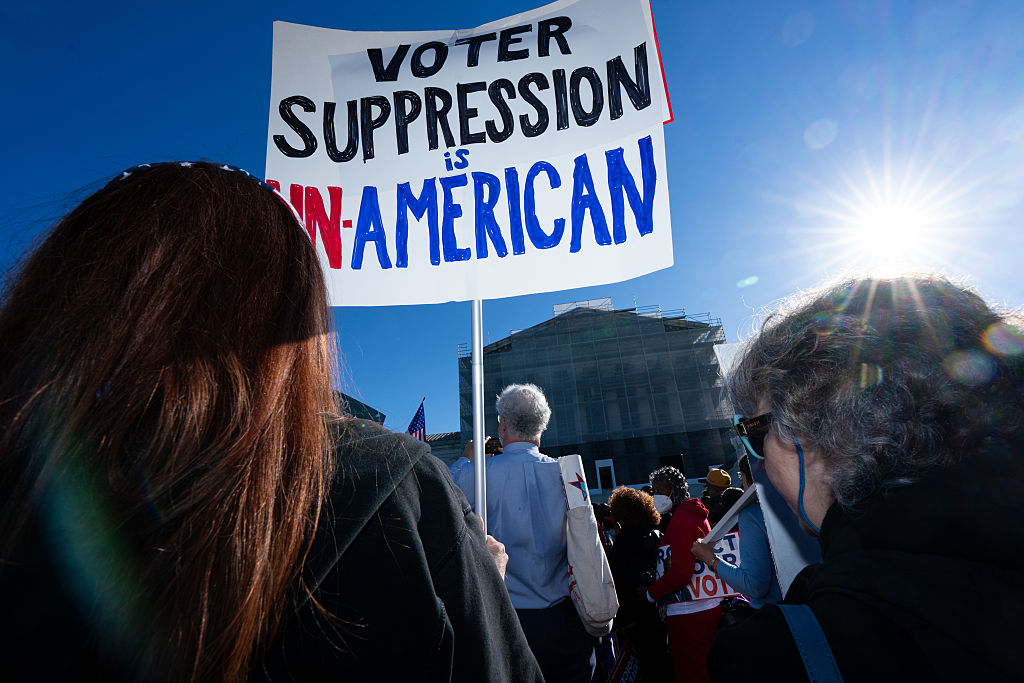
… except it is damn hard for women—or anyone!—to out-run or out-vote the avalanche of anti-democratic maneuvers facilitated by this Court itself, gerrymandering and voter suppression top of list. And we actually are at a moment when members of the current political administration align publicly, gleefully, with those who advocate for repeal of the 19th Amendment.
These are not examples of one-off transgressions or piecemeal degradation of our democratic systems, but rather deliberate and systemic mechanisms for defying the popular will—and precisely why decidedly anti-feminist policy outcomes persist, like this country’s maddening inability to address sky-high maternal mortality rates, advance national universal childcare, and pass common sense gun safety measures.
It is certainly why 41 states now have some form of abortion ban in place, despite public polling in favor of abortion rights reaching record highs.
Which is where FEMINIST 250 comes in.
In a collection called Democracy’s Feminist Future, beginning June 18 and running through Women’s Equality Day (Aug. 26), Ms. magazine set out to tap top thought leaders of today to debut game-changing ideas and propose the next generation of reforms that will catalyze a better future. Their collective wisdom points to how to secure political and social equality, ensure economic justice, codify equality under the law—and finally achieve the American experiment, “a more perfect union” for all.
Among the contributors, LaTosha Brown of Black Voters Matter envisions and maps out a new federal Department of Democracy, “a durable, people-powered, enforcement-capable institution designed to protect voting and civic rights, monitor the conduct of all three branches of government, hold states accountable and serve as a permanent firewall against the erosion of democratic participation.”
Skye Perryman of Democracy Forward points out the urgent need for court reform, putting forth a slate of wholly achievable proposals.
Moms First’s Reshma Saujani makes the case that supporting parents is at the heart of a functioning democracy, while Inimai Chettiar of A Better Balance champions bold paid leave policies.
And these are just the tip of the iceberg.
Please check out the full three-part series, which includes America’s Founding Feminists, a collection of essays and commentary that brings a distinct historical lens to the founding ideas of American democracy; and Feminist Lessons, which explores modern movements over the last 50 years and their foundational work to secure legal, economic and social equality.
The entire FEMINIST 250 series is a reminder that transformative change is not only possible, but our only path forward—and that the fight for robust democracy is, at its core, a central and urgent feminist goal.