Updated June 15 at 8:40 a.m. PT: The White House UFC spectacle has come and gone—but the questions it raised about masculinity, power and political culture remain.
In a post-event column for The Guardian, writer Moira Donegan argued that the event reflected a governing style rooted in spectacle and domination, writing that Trump’s embrace of public displays of violence evokes “the dysfunctional Roman emperor” more than a democratic leader.
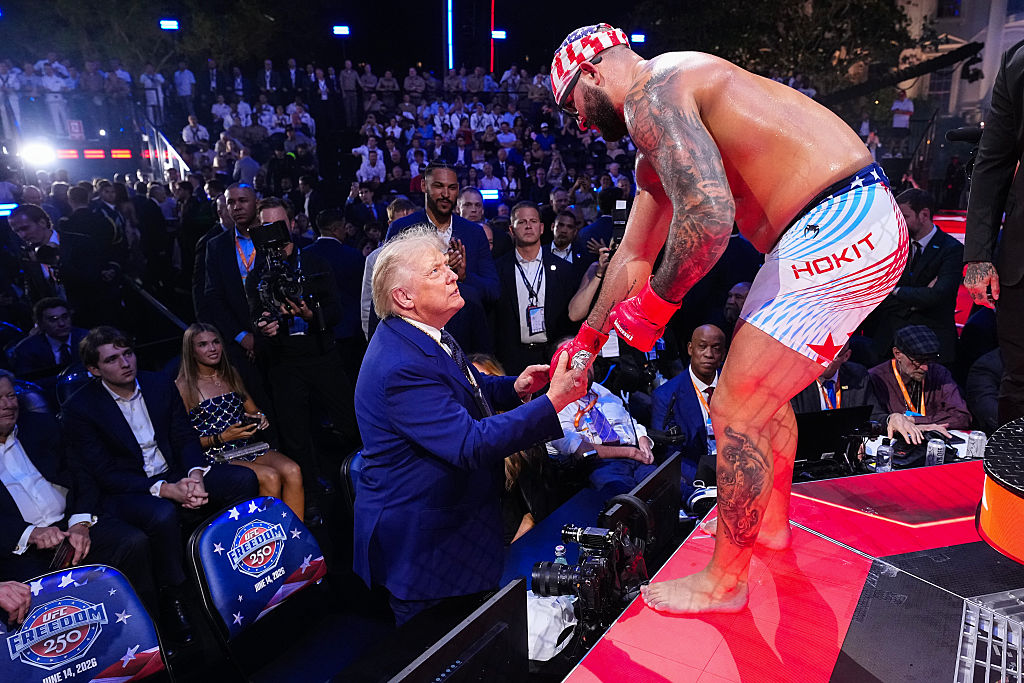
The concern, she suggested, is not simply the fight itself but what it symbolizes: a vision of power that treats aggression, conflict and public humiliation as signs of strength. “The use of government property and national landmarks for a birthday celebration for him—one that was a profit-making enterprise for many of his friends in the private sector—helped further his own efforts to symbolically fuse the federal government with his person, to insist that he is America and is the state.”
That symbolism has resonated with feminist critics who see the event as part of a broader political project. Sen. Cory Booker (D-N.J.) described the White House fight night as an example of “counterfeit masculinity“—a performance of toughness that substitutes grievance and bravado for actual leadership.
The spectacle arrives amid continuing attacks on reproductive rights, gender equality initiatives and social programs that disproportionately affect women and families. In that context, the celebration of cage fighting on the grounds of the White House feels less like a harmless entertainment event than a cultural statement about whose values matter and which forms of power deserve public admiration.
The UFC event was never just about athletics—it was political symbolism. And for many observers, the image of fighters trading blows outside the executive mansion served as a stark reminder that authoritarian politics often rely on spectacles of strength, especially at moments when leaders have less to offer on the material concerns facing ordinary people.
Trump’s White House UFC spectacle is less about sport than about selling a politics of grievance, masculinity and fake populism.

The UFC cage fight scheduled for June 14 at the White House has generated discussion and debate from online influencers and cultural critics alike. The commentary generally falls into two major schools of thought:
The first: It’s largely a benign entertainment spectacle. This view is most famously articulated by Joe Rogan, the popular podcaster and longtime UFC enthusiast and announcer. After initially raising concerns about the outdoor heat and safety of the fighters, he’s pivoted to fully supporting the unprecedented program as a uniquely Trumpian media event.
“There’s no more American thing than having a UFC fight on the White House lawn,” Rogan said. “It’s so American. It’s so Trump. It’s so crazy. You know what I mean? A UFC fight on the White House lawn is bananas.”
The second line of critique is that staging a mixed martial arts fight at the White House is classic authoritarian theater. Trump, like Benito Mussolini in the 1920s, and Roman emperors that hosted gladiatorial battles in ancient times, has long used combat sports to burnish his “strongman” credentials and project a cult of masculinity.
When Trump first announced his plan for this event last year, investigative journalist Karim Zidan wrote in The Guardian that Trump “has cultivated relationships with fighters, leveraging their support to portray himself as a symbolic strongman. He has embraced the UFC’s culture of defiance, machismo and spectacle to help buttress his image as a rebel against liberal norms.”
The White House cage fight, Zidan continued, “has also hastened the replacement of America’s conventional political culture with an abrasive new blend of entertainment and confrontational politics.”
In a later piece, Zidan wrote that with the upcoming White House cage fight Trump is “leveraging the UFC to stage arguably the biggest example of sports propaganda in American history.” He described the planned event as “the culmination of Donald Trump’s fusion of sports, politics and spectacle.”
Harvesting Working-Class Men’s Votes for the Oligarchy
But there’s another way to look at the White House cage fight, which goes beyond the frame of politics-as-entertainment.
The UFC event at the president’s residence is not simply a “bread and circuses” distraction, meant to draw attention away from Trump’s failures in the war with Iran, or his pervasive presence in the Epstein files.
Holding a UFC fight at the White House is a way for Trump to reassure his base (especially working-class white men, but also those from other ethnic/racial backgrounds) that he continues to see and respect them. And that he’s still “one of the guys,” despite the fact that the policies of his administration—on the economy, taxes and spending—decidedly favor the plutocrats over the people.
The cage fight at the White House is the latest instance of Trump—the MAGA King—extending his middle finger to the cultural elite, many of whom are understandably horrified by the blatant financial and cultural corruption that characterizes what political scientists Jacob Hacker, Paul Pierson and others have described as “plutocratic populism.”

What better way for Trump to bolster his cratering popularity than to return to the greatest source of his political appeal: his ability to channel white working-class resentment—especially anti-feminist, white male resentment—through a celebration of good old-fashioned violent masculinity on the hallowed front lawn of America’s most prestigious address?
Republican politicians can’t advocate for better wages or benefits for workers. … What they can give working-class men is supportive words and rhetorical respect.
This is all part of Trump’s version of Richard Nixon’s strategy of “cultural recognition” for the beleaguered working class. First employed by the Republican president in 1972, it has been a staple of right-wing populism ever since.
The idea is that Republican politicians can’t advocate for better wages or benefits for workers, because that would undermine the interests of capital and the profits of the wealthy donors and businesses that support them. What they can give working-class men is supportive words and rhetorical respect.
This is why Trump, at all of his rallies, name-checks and shows love to a list of blue-collar professions that are largely coded as white and male in the American imaginary: We love our truckers! We love our firefighters! We love our coal miners! We love our police! We love our bikers!
When you move beyond rhetoric and look toward policy, you can see how little Trump has done—or even tried to do—to improve material conditions for working-class people. To date, his biggest legislative accomplishment, in both his first and second term, is major tax cuts for the wealthy. Meanwhile, average people struggle with high prices for food and gasoline, mortgage rates remain stubbornly high, and healthcare premiums soar.
The disjuncture between professing to care about workers even as you roll back their rights and quality of life becomes even more apparent when you consider the reasons why Joe Rogan initially expressed doubts about the UFC fight at the White House. Rogan, who endorsed Trump in 2024, attended the inauguration, and is now a major figure in the MAGA media universe, was concerned about unsafe working conditions for the fighters in the June D.C. heat.
Is it possible that it never occurred to the King of Podcasters that there might be a contradiction between supporting Trump and caring about worker safety?
Throughout his first term, and continuing into his second, Trump administration policies have consistently sought to undermine worker protections.
According to The Century Foundation, a progressive think tank, both Trump’s Department of Labor and the Occupational Safety and Health Administration embarked on major initiatives to revise or repeal dozens of workplace safety and wage regulations, affecting industries from construction and mining to agriculture. Federal oversight capacity was severely reduced. OSHA workplace safety inspectors were cut to historic lows, resulting in drastically fewer workplace inspections and citations.
The administration also actively delayed or canceled workplace protections targeting extreme heat, and relaxed standards and retaliation safeguards for vulnerable migrant farmworkers.
In other words, Trump does a good job of pretending to care about working men (and women). But in the real world of class conflict, when push comes to shove, Donald Trump and his party almost always side with the interests of the super-wealthy.
… The desire for a strong, virile man in the White House runs deep in the American DNA.
UFC’s Dana White Makes It to the White House
UFC CEO Dana White claims to be a political centrist, but he has spoken at three consecutive Republican National Conventions. When he introduced Trump at the 2024 RNC, he said: “I’m in the tough guy business, and this guy’s the toughest, most resilient guy I’ve ever met in my life.” On another occasion he said of Trump, “This guy is the legitimate, ultimate American badass of all time.”
White has traveled on Air Force One with the president and produced a propaganda documentary about him, called Combatant in Chief. The relationship between the two men has been, to say the least, mutually beneficial.
Trump has profited politically from his friendship with White and the UFC since his first presidential run in 2016. His identification with the violence and hypermasculine aura of the UFC has been one of the chief ways in which Trump—a pampered child of wealth and privilege who used family connections to avoid military service in the Vietnam era—has sold himself as a tough guy to men and young men, especially working-class men across the ethnic-racial spectrum.
Trump’s image as the “man’s candidate” has long been a major source of his electoral success. As I wrote in my 2016 book Man Enough: Donald Trump, Hillary Clinton, and the Politics of Presidential Masculinity, Trump is not especially ideological or a great political strategist.
But he does understand, implicitly, that the desire for a strong, virile man in the White House runs deep in the American DNA—especially among male voters.
That is one of the reasons why Trump regularly attends UFC fights, where his carefully staged entrances are recorded and circulated widely on social media, receiving many millions of views.
Dana White has also gotten a great deal out of his friendship with Trump. In 2025, White signed a new $7.7 billion deal with the Paramount Skydance Corporation, a giant media conglomerate that was formed after a merger that was approved by the Trump administration. Paramount Skydance is run by Hollywood mogul and Trump supporter David Ellison.
UFC fights—once seen as too violent for primetime—are now available for streaming across multiple platforms. The frequently bloody fights are now broadcast on the venerable CBS network, which is also owned by Ellison. Notably, CBS is the same network where editor-in-chief Bari Weiss just fired longtime 60 Minutes anchor Scott Pelley, after he accused her and CBS management of “murdering” the longest-running and most prestigious program on television news by capitulating to Trump’s influence.
In addition to UFC, White is also the owner of Power Slap, a company he founded in 2022 that promotes the controversial “sport” of slap fighting. In slap fighting competitions, contestants attempt to knock out their opponent by slapping them in the face as hard as they possibly can.
Even many UFC fighters and fans find slap fighting dangerous and disagreeable. In 2023, Dr. Bennet Omalu, one of the world’s leading experts on chronic traumatic encephalopathy, said: “It is a very dumb [sport], very stupid and unsafe. It is primitive. To me, such a sport is inconsistent with the intelligence of humans. It is possible that a participant could die from this. Somebody could die or suffer catastrophic brain damage and become a vegetable … Why is TBS showing such a primitive sport? It should not be on TV.”
Dana White’s response to his critics? “If you don’t fucking like it, don’t watch it! Nobody’s asking you to watch this. Oh, you’re disgusted by it? Watch The Voice.”
When he was asked recently by Rolling Stone magazine how much longer he can keep up the frenetic pace required to run his expanding business empire, White said, “I still love what I do. Every way that you could possibly kick another person’s ass, I’m getting involved in.”
When you move beyond rhetoric and look toward policy, you can see how little Trump has done—or even tried to do—to improve material conditions for working-class people.
The White House event on June 14 represents a marker of sorts in White’s relentless quest to push his brand of violent athletic competition into the respectable mainstream of American entertainment.
The much-anticipated event is set to take place in front of one of the world’s most visible architectural landmarks—a global symbol of America’s frayed and faltering democracy … brought to the public by the president of the United States, a fake populist who neglects or actively subverts the real interests of the working class, as he makes corrupt deals with media oligarchs.