Election Results: Historic Gender Gaps Shape 2025 Outcomes in Virginia, New Jersey and Beyond

We’ve curated the results of all the state-by-state election results that feminists most care about.

Together, the early data from this week’s elections paints a clear picture: Women voters were the decisive force in the 2025 elections, driving sweeping Democratic victories across key states. Women turned out at higher rates than men and made up a majority of voters. Support for women’s rights, reproductive freedom, gender equality and fair immigration policies powered a Democratic sweep this election season.

Historic gender gaps reshaped the political landscape:
—In Virginia, 65 percent of women voted for Democrat Abigail Spanberger for governor, compared to just 48 percent of men, a 17-point gender gap
—In New Jersey, women backed Democrat Mikie Sherrill by 62 percent, compared with 49 percent of men, a 13-point gap that proved decisive in her win. 

Meet Dr. Lincoln, the Internet’s Favorite OB-GYN

You may know—and love—Dr. Jennifer Lincoln already. If you are unfamiliar, she’s a board-certified OB-GYN and a famous content creator with 2.8 million followers on TikTok and large platforms on Instagram and YouTube. Dr. Lincoln is also a practicing OB-hospitalist who works in labor and delivery, night and day.

She makes content to dispel medical misinformation, a frequent tool of the patriarchy. As ‘MAHA’ influencers decry everything from birth control to Tylenol, at the expense of women, she’s pushing back with evidence-based information.

Like most Americans, I felt uninformed about sexual reproductive health, even after my in-school health classes. In high school, I searched YouTube for information about reproductive health, where I found my way to Dr. Lincoln, who not only provided the health class I never had, but also ignited my interest in reproductive justice. Without her influence, I likely would not have become a feminist writer at Ms.

Over Zoom, I had the privilege of chatting with Dr. Lincoln about her journey from OB-GYN to viral educator, how the post-Dobbs landscape has reshaped her work, and why she believes accurate, inclusive sex education is one of the most powerful tools we have for liberation. Our conversation spanned everything from social media strategy to Christian nationalism—and what it really means to fight misinformation with empathy.

Mary Beth Tinker Is Still Teaching the World How Kids Can Change It

Five students, including Mary Beth Tinker, were suspended from school in 1965 for wearing black armbands to support a Christmas truce in the Vietnam War and mourn the deaths of Vietnamese people and U.S. soldiers. Tinker was an eighth grader at the time. Represented by the ACLU, the students sued for freedom of speech after their suspension.

On Feb. 24, 1969, the Supreme Court reached a landmark ruling on student speech in Tinker v. Des Moines, cementing the precedent that students and teachers retain their First Amendment rights in public K-12 classrooms so long as they do not substantially disrupt education.

More than 50 years later, Mary Beth Tinker is still an activist for demilitarization, children’s rights, free speech, LGBTQ+ rights, environmental protection and transnational feminism.

The Antiabortion Movement’s Decades-Long Goal Achieved: Planned Parenthood Defunded

Republicans have finally achieved a decades-long goal: defunding Planned Parenthood. In July, President Trump signed a spending bill that blocks Medicaid reimbursements and federal grants for nonprofit health centers that provide abortions—including Planned Parenthood—even though federal law already prohibits Medicaid from covering abortion. The result is that more than a million low-income and disabled patients who rely on Planned Parenthood for contraception, STI testing, and cancer screenings can no longer use their insurance there. Hundreds of clinics across the country are expected to close, and in many communities, there are no alternatives waiting to replace them.

What does this mean in practice?

It means people like Colleen—who discovered she had breast cancer because of an affordable visit to Planned Parenthood—will face new barriers to care.

It means patients who already struggle to cover basic expenses will be asked to pay out-of-pocket for lifesaving services.

And it means thousands of people living in rural or medically underserved areas may have no nearby provider at all.

The political fight over Planned Parenthood has always been framed as a battle about abortion, but the immediate impact is much broader: fewer clinics, fewer screenings, and fewer chances to catch disease before it’s too late.

‘Protect Medicaid Vigil’ Shows The Power of Grief in an Era of Cruelty

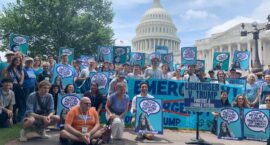
Late last month, a 60-hour “Protect Medicaid Vigil” took place on the National Mall across from the Capitol. Featuring live music, speakers and a collaborative art table, it was a space for collective grief, anger, joy and hope in response to steep Medicaid cuts in the recently enacted Republican spending package.

The event was organized by Caring Across Generations, a national organization of family caregivers, care workers, disabled people and aging adults advocating for social and political change. It spanned 60 hours to represent each year of the Medicaid program to-date. During the vigil, Caring Across Generations lit 8,000 candles as a visual representation of the nearly 80 million Americans who rely on Medicaid coverage for healthcare.

Feminist thought-leaders, including Audre Lorde and Judith Butler, have theorized that emotions (particularly grief and anger) are essential to any successful social movement. By holding a vigil followed by a joyful day of action, Caring Across Generations and its partners showed how emotion can fuel and sustain activism under Trump.

Doesn’t Gen Z Have the Right to Life? Young People Sue Trump Administration Over Climate Catastrophe as State-By-State Battle Continues

At least 137 people are dead after devastating flash-flooding in Texas in early July, including many children. As climate change induced disasters grow more common and the Trump administration rolls back environmental protections, several organizations are pursuing creative legal strategies to defend children’s fundamental right to a safe, healthy and stable natural environment.

On behalf of 22 young people, Our Children’s Trust filed Lighthiser v. Trump in May as part of its multi-case Youth v. Gov effort, asserting that three of the president’s pro-fossil fuel executive orders violate their constitutional rights to life, health and safety.

On July 16, hundreds gathered outside the U.S. Capitol to hear from Lighthiser plaintiffs and members of Congress at a press conference hosted by Our Children’s Trust and several organizational partners.

The same day, the Children’s Fundamental Rights to Life and a Stable Climate System resolution was introduced by Sen. Merkley (D-Oreg.) and Reps. Schakowsky (D-Ill.), Jayapal (D-Wash.) and Raskin (D-Md.). More than 50 additional senators and representatives joined the resolution as cosponsors.

Eva Lighthiser and Lander Busse were also plaintiffs in Held v. State of Montana, in which the Montana Supreme Court ruled that state law restricting consideration of climate change in environmental reviews violated youth plaintiffs’ right to a clean and healthful environment. The suit saw success largely because Montana has a Green Amendment—a constitutional amendment in the Bill of Rights section of the state Constitution explicitly declaring the legal right to a safe, healthy and stable natural environment for all people. Thus far, only Montana, Pennsylvania and New York have Green Amendments. The organization Green Amendments for the Generations (GAFTG) is working state-by-state alongside community partners to get new state-level Green Amendments passed.

No-Rehire Clauses Let Employers Retaliate Against Harassment Victims … Legally

For Charlotte Bennett, alleged harassment at the hands of former New York Gov. Andrew Cuomo (D-N.Y.) led to years of costly litigation and “extraordinary pain.” Bennett’s state-level case was finally settled in April, with a little-known clause included: If a worker settles a case accusing their employer of sexual harassment, discrimination or any form of abuse, their employer may legally include a “no-rehire” clause in the settlement. This clause bars accusers from seeking future jobs with their employer.

No-rehire clauses can also bar workers from employment with any affiliates, subsidiaries or partners of their ex-employer’s organization. If another company hires an employee, and it is later acquired by or merged with a company that employee has a no-rehire clause with, a federal court affirmed in 2023 that the worker can legally be terminated from that new job, too.

In an age of mergers and monopolies, the consequences of a no-rehire clause may follow a victim of workplace harassment forever. Depending on the size of their former employer, an ex-employee could be barred from hundreds of different companies if their settlement includes a no-rehire clause.

New York state Assemblymember Catalina Cruz (D) introduced AB 293 to fully ban such clauses across the state. If the Assembly bill and its Senate counterpart were passed, New York would join California and Vermont as the only states prohibiting or limiting these clauses.

‘They’re Not Following the Law—They’re Imposing Conservative Values’: Key Takeaways From the Ms. 2025 Supreme Court Term in Review

Friday, June 27, marked the final day of the ’24-’25 Supreme Court term. This year brought a series of stunning, high-stakes decisions that delivered major setbacks for reproductive rights and civil liberties—from a landmark case threatening judiciary checks and birthright citizenship and a ruling that expands parental opt-outs in public schools, to the Court’s decision to uphold both South Carolina’s ban on Medicaid funding for Planned Parenthood and Tennessee’s ban on gender-affirming healthcare for trans teens.

On July 2, the O’Neill Institute for National and Global Health Law at Georgetown University hosted its annual Supreme Court Term in Review, co-hosted by Ms. magazine, Ms. Studios, the Brennan Center for Justice and the American Constitution Society. The event brought together legal scholars, litigators, journalists and activists to reflect on the most consequential rulings of the 2024-’25 term.

“We should not have to have seances with slave owners to know what our rights are today.”
—Lourdes A. Rivera

“The president can, with the stroke of a pen, revoke your constitutional right to citizenship.”
—Jamelle Bouie

“The Supreme Court and Congress are basically enabling this. Not just being feckless, but enabling it.”
—Lourdes A. Rivera

“I thought Justice Barrett was extraordinarily disrespectful toward Justice Jackson in that opinion.”
—Mark Joseph Stern

“We get hope from our clients and the communities that are stepping up when many elite institutions are not.”
—Skye Perryman

Men Are Impersonating ICE to Attack Immigrant Women. MAGA Emboldened Them.

Multiple men have been arrested in at least three states since President Donald Trump’s inauguration for allegedly posing as immigration enforcement officers to perpetrate sexual violence against immigrant women.

The Trump administration is emboldening and reinvigorating such violence by providing more tools to harm women of color, including both systemic tools (mass detention and deportation) and a cover for any man looking to kidnap immigrant women in broad daylight.

Trump Is Ending Temporary Protected Status for Haitian Refugees. Here’s What That Means for Women.

The Trump administration announced late last month it will terminate Temporary Protected Status (TPS) for Haitian refugees in the United States. As a result of this decision, thousands of Haitian immigrants with legal status will become undocumented and eligible for deportation in September.

Women and girls face the brunt of violence in Haiti. Without TPS, Haitian women will be arrested by ICE, detained and eventually returned to a country where gangs frequently use sexual violence against women and girls to terrorize communities and gain control.

In 2024, the U.N. logged more than 6,400 cases of gender-based violence in Haiti.