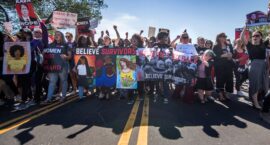
Victoria Nourse Helped Write the Violence Against Women Act. She Knows Policy Change Matters in the Struggle to End Gender-Based Violence.

On the latest episode of Looking Back, Moving Forward, the Georgetown Law professor and vice chair of the U.S. Commission on Civil Rights reflected on how VAWA has shifted culture when it comes to gender-based violence—and what tools activists can use now to continue the work.

“No one would’ve thought someone like me would’ve been able to do the kinds of things I’ve done. My older sisters didn’t have the opportunities I have … but the world opened up. Things can change quite quickly in politics.”

“There’s just many, many reasons why ERA is something not to let go of. … They never really say women are unequal. They believe women are equal, but they say, ‘Oh, but transgender,’ ‘Oh, but something else,’ and so, they divide us. It’s really important for all of us to be united because Congress can change the deadline [in the preamble of the ERA].”

Listen to the latest episode of Looking Back, Moving Forward, “How Feminists are Breaking the Cycle of Gender-Based Violence and Harassment (with Ellen Sweet, Jane Caputi, Vanessa Tyson, Victoria Nourse, and Debra Katz)” on Spotify, Apple Podcasts or wherever you get your podcasts.

‘We Have to Be Relentless’: #MeToo Champion Debra Katz Is Confident ‘There Will Be Wins’ for Survivors in the Days Ahead

In the latest episode of Looking Back, Moving Forward, “the feared attorney of the #MeToo movement” assesses the legal landscape facing survivors—and how activists can continue to hold people in power accountable.

Listen to the latest episode of Looking Back, Moving Forward, “How Feminists are Breaking the Cycle of Gender-Based Violence and Harassment (with Ellen Sweet, Jane Caputi, Vanessa Tyson, Victoria Nourse, and Debra Katz)” on Spotify, Apple Podcasts or wherever you get your podcasts.

Gender-Based Violence Is Everywhere. What Will It Take to Break the Cycle?

In the fourth episode of Looking Back, Moving Forward, advocates and experts name the sociopolitical factors that fuel gender-based violence, and outline what it will take—in the courts, legislatures and our communities—to finally break the cycle.

“What does it mean that so many women, in particular, have to shoulder the burdens of violence and abuse in our day-to-day lives?”

“We’re in the middle of this terrible backlash because patriarchy does feel so threatened … It’s terrible, and it’s getting worse, but it’s because we have been so successful so far.”

Listen to the latest episode of Looking Back, Moving Forward, “How Feminists are Breaking the Cycle of Gender-Based Violence and Harassment (with Ellen Sweet, Jane Caputi, Vanessa Tyson, Victoria Nourse, and Debra Katz)” on Spotify, Apple Podcasts or wherever you get your podcasts.

‘Care Is Baked Into a Healthy, Functioning Economy’: Economists Lenore Palladino and Rakeen Mabud on How to Advance Economic Justice

The experts and Ms. contributors assessed the state of the U.S. care crisis and women’s economic inequality in the latest episode of the Ms. podcast Looking Back, Moving Forward—and broke down why investing in women and care workers is good policy. 

Rakeen Mabud: “We’re at a really pivotal moment and a really complicated moment. We have conservative, pronatalist voices, with more institutional power than they have ever had, at least in modern times. They are advancing an agenda of deep progressive patriarchy, whiteness—and wealth, frankly, is the third prong of that. And they are co-opting progressive policy ideas to do it.”

Lenore Palladino: “There are schools, and there are childcare centers, and there are hospitals being shut down right now. Investing in those would be a really important way to move this whole conversation forward. … Within economic policy, there’s such bifurcation. There’s tax policy over here. There’s care over here. It’s still a women’s issue.”

“Economics is still seen as a man’s game. Women actually make most financial decisions in households, but men are the ones who are seen as the experts, and our financial system is shaped around their life cycles.”

Listen to the latest episode of Looking Back, Moving Forward, “Women Can’t Afford to Wait for a Feminist Economic Future (with Premilla Nadasen, Rakeen Mabud and Lenore Palladino, Aisha Nyandoro, Gaylynn Burroughs, and Dolores Huerta)” on Spotify, Apple Podcasts or wherever you get your podcasts.


‘In Whose Interests Are We Fighting?’ What Historian Premilla Nadasen Learned About Economic Justice from the Domestic Workers’ Rights Movement

Nadasen, who teaches history at Barnard College, offered lessons from the domestic workers’ movement for the current moment in the latest episode of Looking Back, Moving Forward. “We, as feminists today, like domestic workers in the 1970s and in the early 2000s,” she told me, “need to think outside the box.”

Listen to the latest episode of Looking Back, Moving Forward, “Women Can’t Afford to Wait for a Feminist Economic Future (with Premilla Nadasen, Rakeen Mabud and Lenore Palladino, Aisha Nyandoro, Gaylynn Burroughs, and Dolores Huerta)” on Spotify, Apple Podcasts or wherever you get your podcasts.

‘If You’re Not Centering the People Who Are Most Impacted, Your Policy Solution Will Fall Apart’: Gaylynn Burroughs Is Fighting for Economic Justice at the Intersections

Burroughs, the vice president of education and workplace justice at the National Women’s Law Center, connected the dots between poverty, policy and culture change in the latest episode of the Ms. Studios podcast Looking Back, Moving Forward. “Once you start seeing these problems as being problems that policy can solve,” she told me, “a whole world opens up.”

Listen to the latest episode of Looking Back, Moving Forward, “Women Can’t Afford to Wait for a Feminist Economic Future (with Premilla Nadasen, Rakeen Mabud and Lenore Palladino, Aisha Nyandoro, Gaylynn Burroughs, and Dolores Huerta)” on Spotify, Apple Podcasts or wherever you get your podcasts.
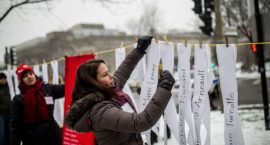
‘Poverty Is a Systemic Failing, Not an Individual Failing’: Aisha Nyandoro Is Seeding a Movement to Liberate Financial Capital and Support Black Moms’ Economic Freedom

The founding CEO of Springboard to Opportunities, home to the Magnolia Mother’s Trust guaranteed income program, called out how our economy has left the women she serves behind in the latest episode of Looking Back, Moving Forward—and how our narratives around poverty and deservedness shape what’s possible in the fight for economic justice.

“What would it look like if we gave Black mamas living in affordable housing the financial resources that they needed to be the author of their own lives—trusting that they know better than anyone else what it is that they need for themselves and their families to be successful?”

Listen to the latest episode of Looking Back, Moving Forward, “Women Can’t Afford to Wait for a Feminist Economic Future (with Premilla Nadasen, Rakeen Mabud and Lenore Palladino, Aisha Nyandoro, Gaylynn Burroughs, and Dolores Huerta)” on Spotify, Apple Podcasts or wherever you get your podcasts.
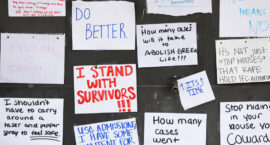
Why Dolores Huerta Is Hopeful About the Fight for a Feminist Future: ‘We’re Going to Be Able to Overcome’

Dolores Huerta has spent 70 years at the frontlines of the intertwined fights for economic justice and women’s rights. Huerta has pioneered campaigns to expand political representation for women and people of color; advance policies that improve the lives of women, LGBTQ+ folks, farmworkers, communities of color, and the poor; and spark dialogue around the intersectional fight for economic justice, and the ways it is intertwined with our democracy.

“This is a very, very scary time—and god knows it’s a time for women to rise up!” Huerta told Ms.

Listen to the latest episode of Looking Back, Moving Forward, “Women Can’t Afford to Wait for a Feminist Economic Future (with Premilla Nadasen, Rakeen Mabud and Lenore Palladino, Aisha Nyandoro, Gaylynn Burroughs, and Dolores Huerta)” on Spotify, Apple Podcasts or wherever you get your podcasts.

Poverty Is a Policy Choice—and Women Deserve More 

In the third episode of the Ms. Studios podcast Looking Back, Moving Forward, economists and advocates break down how our economy is leaving women behind and lay out strategies for advancing a feminist economic future.

“Poverty is the result of systems that have been intentionally put in place that the majority of us benefit from,” said Aisha Nyandoro, founding CEO of Springboard to Opportunities, home to the Magnolia Mother’s Trust guaranteed income program.

“So much of the conversation among economists and among policy people about infrastructure has always been about male-dominated infrastructure,” Lenore Palladino said. “We cannot rebuild our economy or build back better, as it were, with male-dominated sectors and not female-dominated sectors.”

“We have to continually ask: In whose interests are we fighting? Who will benefit from the work that I’m doing right now? Who should we put at the center of our organizing campaigns?” said Premilla Nadasen, labor and women’s historian.

The newest Ms. podcast, Looking Back, Moving Forward is out now on Spotify, Apple Podcasts or wherever you get your podcasts.

‘Our Federal Constitution Doesn’t Protect Us’: How the Women’s Law Project Redefined the Fight for Abortion Rights in Pennsylvania

“We got here because we have the gender ruling class desperately holding onto their privilege—using any means necessary,” said WLP executive director Susan Frietsche on the latest episode of Looking Back, Moving Forward.

Listen to the second episode —”Inside the Feminist Fight to Reclaim Our Reproductive Freedom (with Renee Bracey Sherman, Michele Goodwin, Angie Jean-Marie and Amy Merrill, Susan Frietsche, and Gov. Maura Healey)”—on Spotify, Apple Podcasts or wherever you get your podcasts.