
In this three-part American Autocracy series, we track Trump’s comments on feminist issues.
This installment: Trump’s previous comments on gay and trans rights make him a clear threat to the LGBTQ+ community.


More Than A Magazine, A Movement

In this three-part American Autocracy series, we track Trump’s comments on feminist issues.
This installment: Trump’s previous comments on gay and trans rights make him a clear threat to the LGBTQ+ community.

I’m a women’s health nurse practitioner (NP) and educator at Emory University, teaching the next generation of NPs to care for individuals across the lifespan including for the sexual and reproductive healthcare needs.
From the first over-the-counter birth control hitting the shelves, to attacks on FDA-approved drugs, it’s felt like whiplash for reproductive freedoms in this country.
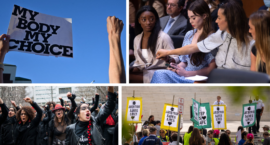
In every issue of Ms., we track research on our progress in the fight for equality, catalogue can’t-miss quotes from feminist voices and keep tabs on the feminist movement’s many milestones. We’re Keeping Score online, too—in this biweekly roundup.
This week: the Supreme Court hears oral arguments on emergency abortion care and criminalizing homelessness; new EEOC and Title IX regulations protect sexual violence survivors, pregnant people and the LGBTQ community; Arizona repealed their 1864 abortion ban, while Florida now has a six-week ban; birth control misinformation goes viral on TikTok; the United Methodist Church repealed their ban on LGBTQ clergy; the chilling effects of the global gag rule; three in five Americans support a national law protecting access to medication abortion; and more.

In this three-part American Autocracy series, we track Trump’s comments on feminist issues.
This installment: the threat a Trump presidency poses for abortion. (Future installments will document Trump’s threats the LGBTQ+ community and his perceived enemies.)
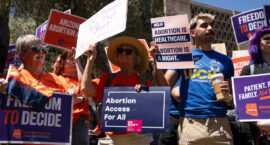
The Arizona Supreme Court’s ruling that reinstated a draconian 1864 near-total abortion ban reveals the disingenuous nature of the “leave-it-to-the-states” positioning of some Republicans.
In response to the state Supreme Court’s decision, Democrats spearheaded legislation to repeal that law, which was recently signed by Gov. Katie Hobbs (D). However, leaving it to the states doesn’t always have such a rosy ending—and, indeed, this is not the end of efforts in Arizona or elsewhere by special interests trying to impose their regressive worldview on us all through law. A closer look into the Arizona abortion case and court that led to the reprise of this antiquated anti-abortion law reveals that some of the same anti-abortion zealots who played a central role in overturning Roe are also playing a role in revoking Arizonians’ access to abortion healthcare.
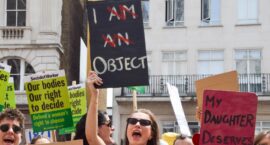
Fighting for better laws and challenging bad laws in the courts are critical parts of the fight for the freedom and dignity of women and pregnant people, but so is the underground abortion pill movement, which enacts that freedom and dignity directly, and resists the “psychology of servitude” and “habitual acquiescence” to unjust laws.
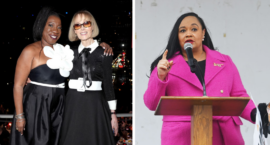
Weekend Reading for Women’s Representation is a compilation of stories about women’s representation.
This week, explore how public funding for campaigns can level the playing field and encourage more women to run for office; learn about the challenges women face in securing local government seats in England; discover what resources can empower mothers to pursue political careers; and examine why gender diversity in corporate leadership positions is still lagging.

Most Americans support the right to abortion. But the fact that we are relying on ballot initiatives to protect and expand abortion access to translate that support into policy—rather than our elected representatives—should call on us to expand our fight.
Nearly every part of our system of government is structured in ways that prevent popular rule.
Can a democracy where women have never been equal ever really thrive? How are attacks on democracy tied to gender equity? What can we learn from past fights to protect and expand women’s rights in order to chart a path forward?
A two-part virtual discussion hosted by Ms. magazine in partnership with NYU Law’s Birnbaum Women’s Leadership Center and the 92Y explored these questions, plus how women’s rights are inextricably tied to the integrity and durability of democratic institutions—featuring Melissa Murray, Alexis McGill-Johnson, Ruth Ben-Ghiat and more.

Florida is ground zero for what is known among organizers and philanthropists as “boom-and-bust” funding—meaning money flows in during big election cycles and dries up immediately after. Yet electoral and issue-based organizing is a 24/7 operation. In recent years, these efforts have led to restoring voting rights to 1.4 million Floridians, raising the minimum wage to $15 per hour, and legalizing medical marijuana. These massive wins were led by the people of Florida, even as the legislature acted against their will.
Boom-and-bust patterns are sure to pose a particular challenge in 2024, given the state’s six-week abortion ban officially taking effect is now coupled with a citizen-initiated opportunity for Florida voters to undo the ban this November and enshrine protections for abortion in the state Constitution.
Rather than funding a single issue or candidate during an election cycle, an integrated voter engagement approach, with year-to-year financial and capacity-building support for gender and reproductive justice groups, is the most essential element of a healthy pro-democracy funding environment.
This essay is part of a Women & Democracy package focused on who’s funding the women and LGBTQ people on the frontlines of democracy. We’re manifesting a new era for philanthropy—one that centers feminism. The need is real: Funding for women and girls amounts to less than 2 percent of all philanthropic giving; for women of color, it’s less than 1 percent. Explore the “Feminist Philanthropy Is Essential to Democracy” collection.