A (Brief) History of Women’s Rights, 1600 to Present

From the Haudenosaunee women who successfully challenged warfare in the 17th century, to today’s feminist organizers defending democracy, reproductive freedom and civil rights, the struggle for women’s equality has never been a straight line. It is a story of persistence, resistance and collective action spanning centuries.

Compiled by editors at Ms. and researchers from the National Women’s History Alliance, this women’s history timeline traces the interconnected histories of feminism, abolition, labor organizing, civil rights, reproductive justice, LGBTQ+ liberation and democratic participation.

No timeline can fully capture more than 400 years of feminist history, let alone every movement, leader, victory and setback that has shaped the ongoing fight for equality. Rather than offering a comprehensive account, this chronology highlights pivotal moments and turning points that help tell the story of how women have expanded the boundaries of freedom, democracy and human rights in the United States and beyond.

The timeline is part of Ms. magazine’s FEMINIST 250: Founding Feminists project, a multimedia essay series marking the 250th anniversary of the Declaration of Independence by examining the women and feminist movements that have worked to make the nation’s founding promises more fully realized. Through reported features, essays, interviews and historical analysis, FEMINIST 250 explores not only where we have been, but where we must go next to achieve true equality.

FEMINIST 250’s Parts 2 and 3—Feminist Lessons and Feminist Futures—drop this month on MsMagazine.com.

The Only Place to Report Police Sexual Violence Is the System That Causes It

Nearly one in five New Yorkers have experienced sexual violence—and a new report finds that 12 percent have also faced sexualized behavior from NYPD officers, ranging from unwanted flirting and requests for phone numbers to catcalling. Across the U.S., police are accused of sexual violence with alarming regularity, yet just over 2 percent of those complaints result in officer discipline.

In New York City, the report finds that officers who perpetrate sexual violence rarely face consequences (less than 1 percent), underscoring that these incidents are not situations of isolated misconduct, but part of a broader pattern of harassment, assault and retaliation.

In highly policed communities, that pattern shapes how people move through the world. Nearly 75 percent of respondents said they go out of their way to avoid interacting with police—changing routes, avoiding certain blocks or staying inside at night.

“They want you to be [scared],” one 22-year-old Black man from Manhattan said. “If you’re not scared of them, then it’s like they’re not doing their job right.”

Others describe a constant state of vigilance: “When you hear a siren, you freeze. … If you see them following you in a car, you slow down and pray they drive past you.”

For survivors, the barriers to accountability are built into the system itself.

“There is this long history of officer impunity,” said Ileana Méndez-Peñate, noting the persistent lack of consequences.

As Priscilla Bustamante put it: “Where can I go? I can’t report police back to police.”

The report argues that meaningful change will require more than internal discipline—calling for independent oversight, reduced reliance on policing, and greater investment in community-based resources.

“This issue really shines a light on the fact that police are not really the answer,” Bustamante said. “They’re part of perpetrating the harm.”

When Reporting Becomes a Crime: Georgia Fort on Her Arrest, Press Freedom and Black Media Representation

The press release in Emmy-award winning journalist Georgia Fort’s inbox was vague, stating only that an event to honor Rev. Dr. Martin Luther King Jr’s memory would be taking place Jan. 18 and asking people to assemble at 10 a.m.

Fort joined protesters in a car caravan that ended up at Cities Church in St. Paul. The site, she learned, had been selected because one of the church’s pastors, Rev. David Easterwood, was rumored to be working as the acting head of a local office of Immigration and Customs Enforcement (ICE). Fort, with camera and mic in hand, recorded everything that was taking place and live-streamed the action as it was unfolding—a routine part of her work as an independent TV and radio journalist. 

On Jan. 30, she was arrested (along with seven others including former CNN reporter Don Lemon) and charged with “conspiracy to deprive the church’s congregants of the right to worship.”

She spoke to Ms. reporter Eleanor J. Bader in mid-April about her work as a multimedia reporter, mentor for Black and brown youth, and critic of the government’s “strategic attack” on press freedom.

“About two dozen federal agents, including personnel from the Drug Enforcement Agency, arrived around 6 a.m. and pounded on the door to my home. … They were really aggressive. … My 17-year-old has been having nightmares, and my 8-year-old cries every day.”

The Antidote to Despair Is Finding our Role in Community Building

In my daily life and organizing, I encounter people of various ages and backgrounds who feel stuck or unsure of what to do in this America. That’s when I recall Mr. Rogers’ wise words: “Look for the helpers”—particularly, the helpers most impacted and closest to the issues. In the quest for basic human rights and justice, I look for the everyday people in my community, across the country, who are carving paths of resistance—often with limited recognition or resources—who hold steady even when comforted with extreme pushback.

In the era of encrypted messaging and social media, mutual aid groups and meal trains offer different ways to plug in and engage. Each of us can play a role, based on our interests and strengths, in co-creating a world where we all thrive across identity, geography and difference.

(This essay is part of a collection presented by Ms. and the Groundswell Fund highlighting the work of Groundswell partners advancing inclusive democracy.)

Reclaiming Phillis Wheatley (Peters): Imagination as a Feminist Founding Project

More than her own failings, perhaps there are times when new nations are just not ready to be called into being.

Although Phillis Wheatley (Peters) is widely known as the first African woman to publish a book of poetry in English, her biography—her forced Middle Passage journey to Boston, her enslavement by the Wheatley family, her rise to poetic celebrity and eventual fall into obscurity—often looms larger than the poems themselves.

But what would it mean to consider Phillis not as a “slave,” but as a poet, writer and critic who was enslaved?

Slavery was not an innate identity. It was a system imposed upon the enslaved. And when we return to Phillis’ work with that understanding, we encounter a writer of formidable imagination—one who envisioned interior worlds of freedom even while living within bondage.

Phillis’ personification of Imagination becomes, in this sense, a founding feminist figure—an “imperial queen” who invites us to leave the rolling universe behind and imagine new worlds. That work of imagination remains unfinished. It is the ongoing labor of love that Black feminist traditions continue to carry forward today.

(This essay is part of the FEMINIST 250: Founding Feminists series, marking the 250th anniversary of America by reclaiming the revolution through the women and gender-expansive people whose ideas, labor and resistance shaped U.S. democracy.)

How Anti-ICE Organizing in Minnesota Reactivated Mutual Aid Networks Started After George Floyd’s Murder

The residents of the  metropolitan area known as the Twin Cities—Minneapolis and Saint Paul—quickly came together to try to prevent their neighbors being caught up in ICE raids.  As well as monitoring ICE activities, block by block, people organized mutual aid for neighbors fearful of going out in case of immigration raids.

Daniel Cueto-Villalobos, a doctoral candidate at the University of Minnesota, who lives in southern Minneapolis and studies race, religion and social movements, tracks the neighborhood groups that have sprung into action in response to the ICE presence, back to mutual networks set up during the 2020 COVID pandemic, and in the wake of the murder of George Floyd by a Minneapolis police officer.

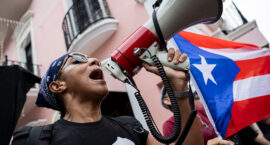
From Minnesota to Puerto Rico: How We Survive Together

In each of our communities, every day seems to announce itself. Whistles and shouts for our neighbors punctuate each hour, as blades of helicopters and flight drills slice through the air into the night. Increased military and federal government presence is visible, splitting images between the corners of our everyday lives and active battlefields. 

We write from two different places, often discussing them separately. We do, however, live as part of the same story.

From Minnesota to Puerto Rico, our struggles are one and the same. So is our strength. We are still here—not because the system is working, but because we work for each other. Maybe this is finally how we usher in a new world order.

(This essay is part of a collection presented by Ms. and the Groundswell Fund highlighting the work of Groundswell partners advancing inclusive democracy.)

bell hooks Taught Us to Imagine Freedom. Universities Are Forcing Us to Fight for It.

On the day bell hooks became an ancestor, four years ago today, my beloved friend, comrade and co-conspirator Black feminist sociologist Shawn McGuffey and I were consoling one another over text when he wrote, “We should do something.” “Say less,” I replied.

We had institutional support from Northeastern University at a time when universities and other institutions were publicly and ceremoniously committing to funding DEI related initiatives in the tidal wave of so-called racial reckoning that occurred in the aftermath of George Floyd’s death. The first symposium took place two months later on a cold and clear February morning in 2022. This annual gathering became an important tradition that we looked forward to each year.

This week, we mark four years since the woman born Gloria Jean Watkins, a Black feminist writer, academic, professor and activist became an ancestor. But in 2026, there will be no bell hooks symposium at my university. Due to university wide fiscal austerity, we will not mark the anniversary this year in any official way. It is a tremendous loss, for our students and for our community locally, nationally and internationally.

As I grappled with my own grief over this loss, I had to also reflect deeply about what it means to be a Black feminist scholar in the academy today.

‘Freeing Black Girls’ and ‘Loving Black Boys’: Tamura Lomax on Revolutionary Mothering During Troubled Times

Tamura Lomax, a trailblazing Black feminist religious scholar, is on a mission to deliver a “Black feminist Bible on racism and revolutionary mother” with two companion books. The first, Freeing Black Girls, was published this year (2025); the second, Loving Black Boys, comes out next year.

Ms. contributing editor Janell Hobson spoke with Dr. Lomax about her latest works and the radical vision of “revolutionary mothering” that guides them.

“Black feminist mothering becomes this experiment. If people can teach sexism and hatred and racism, can we teach Black feminist politics? Is that possible? If we just do it from birth, and it’s just normal everyday talk it’s not this lesson that happens once at the dinner table but it’s just part of our everyday living. Can we do that the same way that we teach hatred?

“Revolutionary mothering is teaching those Black feminist politics everywhere—in the car, on the couch, during movie night, after the basketball game, in the football stands. It’s teaching a radical politics of our rights, our collective right to bodily autonomy first and foremost.”

Complying With Trump Administration’s Attack on DEI Could Get Employers Into Legal Trouble

Since the Trump administration made diversity, equality and inclusion “immoral” and “illegal,” a large part of workplace discrimination in the country still remains to be experienced by women and members of racial minority groups. Now, these groups have less of a platform to make complaints about such discrimination.