In her latest works, Tamura Lomax reimagines mothering as a radical act of Black feminist love.
Black Feminist in Public is a series of conversations between creative Black women and Janell Hobson, a Ms. scholar whose work focuses on the intersections of history, popular culture and representations of women of African descent.
Tamura Lomax is a trailblazing Black feminist religious scholar, co-founder of The Feminist Wire—an independent online publication that offers feminist analysis and commentary on social, political, and cultural issues, aiming to challenge structural inequalities overlooked by mainstream media—and author of the Black feminist religious tome Jezebel Unhinged.

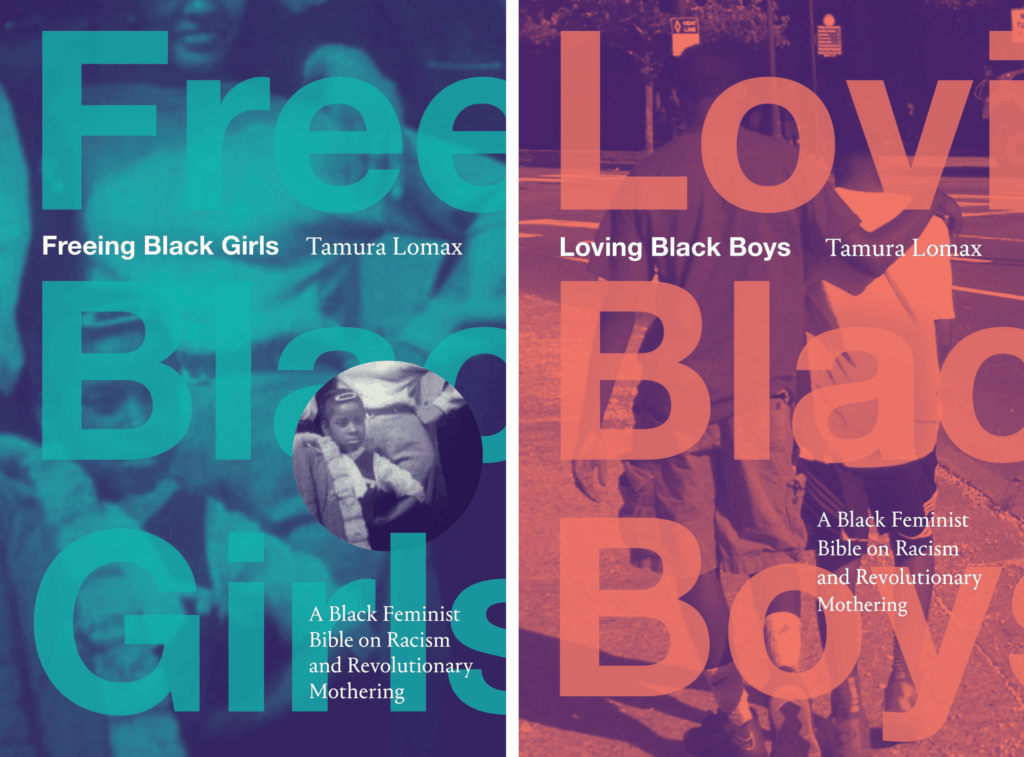
Lomax is on a mission to deliver a “Black feminist Bible on racism and revolutionary mother,” with two companion books. The first, Freeing Black Girls, was published this year (2025); the second, Loving Black Boys, comes out next year (both published by Duke University Press).
Ms. contributing editor Janell Hobson spoke with Dr. Lomax about her latest works and the radical vision of “revolutionary mothering” that guides them.
Janell Hobson: What motivated you to write these pair of books?
Tamura Lomax: Well, in my first book, Jezebel Unhinged, I am the initial subject of that book, but I don’t talk about that. I do in the opening. I talk about myself at 11 years old and what happens to me within the church.
Freeing Black Girls continues the story of that 11-year-old Black girl because the rest of Jezebel is very theoretical and historical and it’s about the people out there, not so much me.
In this book, I center myself. But how I even got there was through writing the book on Black boys—which I felt was very urgent to write about mothering Black sons in this America that kills Black boys. And obviously we know now it’s not just Black boys; it’s Black women and girls too. At the time I began writing around 2014, I began with the book on Black boys and I was writing about policing and the death of Trayvon Martin, then also Mike Brown.
I’m becoming a mother at the same time that I’m becoming a Black feminist. And what I knew is that I wanted something different for my sons.
Dr. Tamura Lomax
Hobson: So, you began writing around the beginnings of the Black Lives Matter movement?
Lomax: Yeah, Black Lives Matter. I really wanted to deal with that. I wanted to explore how do I as a Black feminist raise Black sons with Black feminist politics? How to love themselves, but how to also have a very radical sense of love for others, for community specifically and not be homophobic transphobic or sexist.
How do I do that? Because typically, the politics that are instilled in young Black boys are very heteropatriarchal. When we’re trying to balance power or to raise them up to see themselves as empowered, we typically raise them up with very heteropatriarchal politics. But I wanted to know how do we not do that project? Or how do we do it where they’re still empowered, but they’re empowered with Black feminist politics?
Hobson: I think that’s an important perspective that we don’t often hear when it comes to Black feminist mothers and, specifically mothering sons.
Lomax: Well, once I began writing I couldn’t stop. And I realized, okay, wait. It’s not just about how I’m mothering my sons and what Black boys experience in this America, but it’s what Black girls experience too interracially and intraracially in our communities and how we survive. When I look at both of the books now, they’re very different. I’m talking about our survival in very different ways, and that was not something I did consciously.

Hobson: What are those key differences for Black boys and Black girls?
Lomax: With the book on Black boys, I’m talking about their emotional state. I’m talking about their spiritual state. I’m talking about Black boys and policing and death inter-communal violence and heteropatriarchy. But the book on Black girls, it’s how we are treated and how we interact with not just the state, but within Black communities. That forces a conversation that is really centered on Black women and our bodies. And I didn’t realize that until I was actually finished with both of the books.
When I think about Black boys and their bodies, I’m thinking about the state and state violence. But with Black girls, it’s really what’s happening to us in our communities.
Hobson: With movements like “Say Her Name,” there is a need to highlight that state violence also impacts Black women and girls, but I also recognize that our experiences with intimate violence and interpersonal connections within our communities might bring us into contact with the state.
Lomax: There *is* state violence for Black women, but the first layer of violence that I personally experienced was in my community. It was older boys trying to have sex with me at 11, 12 and 13 years old. It was men who were 24 years old trying to make me their girlfriend at 12. It was sexual violence, which also happened at 12 just before my 13th birthday. But it’s all the encounters even before that, being treated like this piece of meat and being very vulnerable in communities that I love, amongst people that I love.
So, my first interaction with violence was not with the state. And I didn’t initially want to tell that story because it’s so vulnerable. This is the most vulnerable work I’ve ever done on myself, but then also on my sons.
Hobson: In Freeing Black Girls, you framed each chapter with a note to self. It reminds me of the feminist mantra, personal is political.
Lomax: Absolutely! The personal is political.
Hobson: And your experiences made me reflect on what it means to be exposed at age 11 or 12 to sexual violence, and I thought of “Pecola Breedlove” in Toni Morrison’s The Bluest Eye, who was the same age.
Lomax: Definitely.
Hobson: Or even the character “Celie” in Alice Walker’s The Color Purple, who was also the same age.
Lomax: I remember my first act of violence, and there may have been others before that. I mention it in the letter to myself. I talk about it in Jezebel Unhinged; there’s a church leader sexualizing me when I was 11. Well, their son was also babysitting me. And I’ll never forget, I think I was 5, and their son pulls out his penis and he’s like, “Come and touch it.” And I am mortified! I don’t even know what that means. I just know that I don’t want to. I remember freezing. I was saved by someone from another room either walking in or calling out his name. What I learned later is that several people in that family had not only been sexually abused, but they sexually abused other people in the church.
And so, that’s my first memory of assault at 5. It doesn’t matter that I didn’t touch, it’s the fact that the invitation was there at 5. I was exposed to that at 5.
Hobson: And exposed by church folk.
Lomax: Church folk. My parents taught that your body is a temple, according to scripture, and that we’re not going to talk about sex. You just don’t do it because your body is God’s temple. And I’m like, “Do y’all know what has been happening?”
Then, I learned later that my mom experienced some of the same things. But they didn’t have the language to discuss these things. And they weren’t honest about their own experiences. We’re so ashamed of the sexual violence that we experienced on plantations and how we were demonized. And the plantation, what I call in Jezebel, “plantation sexual politics,” we’re so ashamed of that as opposed to being proud of how we survived it—that we have not figured out how to talk about sex and sexual pleasure and sexual violence in our communities and in our families.
My parents taught that your body is a temple … And I’m like, ‘Do y’all know what has been happening?’ … But they didn’t have the language to discuss these things.
Lomax
Hobson: What is revolutionary mothering to you, and how does that address some of these pressing issues?
Lomax: Black feminist mothering becomes a thing before the books, at birth. I’m literally learning Black feminism. I’m in Kimberly Wallace Sanders’ class reading her book [Mammy: A Century of Race, Gender, and Southern Memory], and I’m learning Black feminism while I’m birthing these babies. I’m becoming a mother at the same time that I’m becoming a Black feminist. And what I knew is that I wanted something different for my sons.
Black feminist mothering becomes this experiment. If people can teach sexism and hatred and racism, can we teach Black feminist politics? Is that possible? If we just do it from birth, and it’s just normal everyday talk it’s not this lesson that happens once at the dinner table but it’s just part of our everyday living. Can we do that the same way that we teach hatred?
Revolutionary mothering is teaching those Black feminist politics everywhere—in the car, on the couch, during movie night, after the basketball game, in the football stands. It’s teaching a radical politics of our rights, our collective right to bodily autonomy first and foremost. Because for me, that is vital to freedom. We can’t even talk about freedom if we’re not understanding bodily autonomy. Revolutionary mothering is also understanding that, yes, it’s about creating these radically loving communities, and helping us to be radically loving subjects who can enter into a variety of communities and see other Black folks as our kinfolk.