The Grok Generation: The Consent Crisis No One Is Stopping

Grok, the AI chatbot used on Musk’s platform X, has been under fire for generating nude or sexualized images of real people, including individuals who are minors. In one estimate, Grok produced one nonconsensual sexual image per minute over a 24-hour period. Prompts such as “put her in a transparent bikini” produced altered images that were then circulated publicly, some accumulating thousands of likes. The targets are real women and underage girls whose images were manipulated without their knowledge or permission.

Elon Musk responded by making a joke, requesting a Grok-generated image of himself in a bikini and reacting with laughing emojis. When the platform’s most powerful figure and one of the country’s most powerful men treats the abuse as a punchline, it sends a message about what is actually harmful versus what he thinks should be considered humor—and provides a tacit granting of consent to young men on the platform to keep making these images.

Much of the public conversation about young people and AI has focused on cheating in school or declining literacy. Far less attention has been paid to what it means when a middle school boy can type a sentence and produce a sexualized image of a female classmate in seconds as a joke or for attention—or to pretend he received it from her for status.

For girls growing up in this online environment, the message is unmistakable: Your image is not protected as yours. Your body can be altered, distributed and consumed for entertainment. Its violation can be dismissed as a joke. 

Teachers, parents, lawmakers and platform leaders are behind. The question is not whether this will shape the next generation’s understanding of power and intimacy—but what we will step in to do about it. 

Ms. Global: Iranian Girls’ School Hit in U.S.-Israeli Strikes, Taliban Legalize Domestic Violence, The Netherlands’ First Gay Prime Minister, and More

The U.S. ranks as the 19th most dangerous country for women, 11th in maternal mortality, 30th in closing the gender pay gap, 75th in women’s political representation, and painfully lacks paid family leave and equal access to healthcare. But Ms. has always understood: Feminist movements around the world hold answers to some of the U.S.’s most intractable problems. Ms. Global is taking note of feminists worldwide.

This week: stories from Iran, Afghanistan, the Netherlands and more.

From DM’s to I Do’s: Five Ways Social Media Is Reshaping Child Marriage

As the world goes digital, so does the ancient practice of child marriage. 

More than half a billion women and girls living today are, or were, child brides. Among young adult women aged 20 to 24, one in five was married before age 18.

But that doesn’t mean that child marriage has stayed the same. There has been gradual progress in ending child marriage (around a decade ago, one in four women was married under 18). And technology is playing a growing role, both in cases where girls say “I do” and in cases where they say “I don’t.”

Immigration Detention Is Failing Women and Children—By Design

The South Texas Family Residential Center in Dilley has been the subject of an onslaught of headlines in recent weeks, but the truth is, it’s been routinely criticized for inhumane conditions for years. But what we are seeing now, as Trudy Taylor Smith put it to me, is horror “on a shocking scale.” Children describe being served worm-infested food and dirty water, getting little or no classroom time and being perpetually sick. A toddler nearly dies because of medical neglect. A teenage boy with symptoms consistent with appendicitis is turned away by a nurse. There is no better way to describe it than state-sponsored child abuse.

If this isn’t stomach-churning enough, consider what is happening a few hours south, where girls’ reproductive healthcare and freedom is also in grave crisis. Pregnant and unaccompanied migrant children are being sent to San Benito, Texas.

Why Texas? Why else? … Because it is a place where abortion is illegal and high-risk pregnancy care is unavailable.

“Putting pregnant kids in San Benito is not a decision you make when you care about children’s safety,” one source said plainly.

This is entirely by design, pulled straight from the Project 2025 playbook. The constant split-screen scene in Texas is representative of the nation MAGA wants us to be, “where the cruelty is the point” and where the anti-immigrant, anti-woman, anti-freedom banner is flown.

We have to keep these stories—and all the women and girls in this state, willingly or not—front and center in the democracy movement. Their humanity is at the heart of all of ours.

The Heritage Foundation’s Plan to Keep Women Uneducated, Pregnant and Subservient

Since Trump’s re-ascendance to the White House, the reactionary conservative movement has become the most aggressive and unfettered it has been in my lifetime. And they are getting very, very clear on what they think an acceptable life looks like for women:

—Settle for any man who decides he wants you.
—Don’t go to college.
—Marry early.
—Have as many babies as possible.
—Quit your job (or don’t pursue one in the first place) to stay home full time and depend financially on your husband.
—Shoulder the blame if you wind up married to a jerk.
—Wind up impoverished if you divorce.
—Face social condemnation if you fail to follow the tradwife script.
—Contraception should be illegal or at least hard to get; same for IVF and other fertility treatments.

This isn’t hyperbole. It’s a plan they wrote down and published: Last month, the Heritage Foundation published “Saving America by Saving the Family: A Foundation for the Next 250 Years.” Think of it as Project 2275, a detailed plan that is mostly about how America can spend the next two and a half centuries undoing the feminist progress we’ve made.

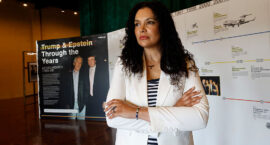
‘We Will Not Be Sidelined Again’: Survivors Respond After DOJ Releases Epstein Files With Unredacted Names and Personal Details

The Department of Justice has released more than 3 million pages of records related to Jeffrey Epstein. For decades, survivors have begged for answers and accountability. But they say the latest tranche of documents—many containing unredacted names, contact information and identifying details—have left them retraumatized, exposed and furious.

Some describe the release as careless. Others call it deliberate. Many say it confirms what they have long believed: that survivors are still not being centered, protected or heard.

Read survivors’ reactions, in their own words.

“My sister Maria Farmer filed a lawsuit against the government for negligence in this case, and really as I see it this is just further examples of that—of the ways that we have not been protected and that DOJ has not done their job.”

“I can’t help but wonder why the DOJ has once again failed us. Again. It feels like they’re ignoring our need for protection, especially when they’ve taken the time to redact the names of powerful individuals … but not ours. This double standard makes it even harder for us to trust them.”

Raped, Recorded, Shared—Then Abandoned by the System: ‘Once It’s on the Internet, It’s Out There’

Survivors of online sexual exploitation and abuse are not just confronting individual perpetrators—they are up against systems that were never designed to protect them.

A new report by Equality Now and the Sexual Violence Prevention Association documents how survivors who report tech-facilitated sexual abuse routinely encounter jurisdictional dead ends, outdated laws and opaque platform policies that leave harmful material circulating indefinitely. For many, the abuse does not end with the assault itself, but continues through repeated viewing, sharing and threats—often with devastating financial, professional and psychological consequences.

The report also makes clear that this harm is not inevitable. Survivors point to concrete policy solutions that could meaningfully change outcomes: consent-based laws governing the online distribution of sexual material, clear and enforceable takedown obligations for tech companies, survivor-centered reporting systems and access to free legal and mental health support.

Accountability is possible, but only if lawmakers and platforms choose to act.

After Decades of Institutional Silence, Survivors of Child Sexual Abuse Deserve More Than the Catholic Church’s PR

When the archdiocese of New York announced plans to raise at least $300 million toward a potential global settlement with childhood sexual abuse survivors, headlines framed it as progress. For those living with the trauma, it landed as a mix of relief, anger, exhaustion and deep skepticism shaped by decades of abuse of power, institutional denial and calculated delay. 

The story isn’t the dollar amount; it’s the decades survivors have waited for justice. They had to fight just to be heard by the very institution that failed to protect them and now must watch that same institution frame overdue negotiations as moral penance. 

Any willingness by the church to engage in meaningful talks is better than silence, but this moment should not be mistaken for accountability. It signals the start of a process survivors should never have had to force through legislation, litigation and relentless public pressure. 

As Wisconsin Democrats Push First-Ever Pregnancy Loss Protections, State Republicans Advance Embryo ‘Personhood’

In late 2025, Wisconsin Senate Republicans passed SB553, a bill that defines embryos, fertilized eggs and fetuses as “unborn children” and “human beings” from the moment of fertilization. The bill passed with the support of every Republican senator and opposition from all Democrats. SB 553 also attempts to redefine the word “abortion,” asserting that a termination performed to prevent the death of a pregnant woman is not an abortion if it is not “designed or intended to kill the unborn child.”

Doctors also warn that SB 553 quietly functions as a personhood law by stating that once an egg is a human being from the moment of fertilization. By granting fertilized eggs status as human beings, the bill is giving those eggs legal rights which are equal to those of their pregnant mothers. While Gov. Tony Evers has said he will veto the bill if it reaches his desk, Wisconsin state Sen. Kelda Roys says its passage reveals Republican lawmakers’ intent.

Roys recently introduced the Pregnancy Loss Protection Act, the first bill of its kind in Wisconsin. Its goal is to prevent overzealous prosecutors or law enforcement officers from targeting people who experience miscarriage or stillbirth, while also pushing back against a broader Republican effort to confer legal personhood on embryos from the moment of fertilization.

Misogyny, Racism, Power: Connecting the Dots in the Violent Far Right

In Part 2 of the Q&A between Jackson Katz and Cynthia Miller-Idriss, the author of Man Up discusses the link of misogynists and mass shooters: “The fact that so many domestically violent extremist attacks have both gendered and racialized dimensions shows that racism and misogyny are inseparable in the minds of many perpetrators.”

Miller-Idriss explains the key role online gaming and chat spaces play within the radicalization of young men and boys.

Misogyny is no doubt threaded through nearly ever mass shooting, and feminists are used as a scapegoat for taking away men’s opportunities.