From Max Miller to a growing roster of elected officials across both parties, allegations of domestic abuse have too often been met with denial, political protection and little accountability.
This powerful political boys’ club in the U.S. seems always willing to embrace new members.
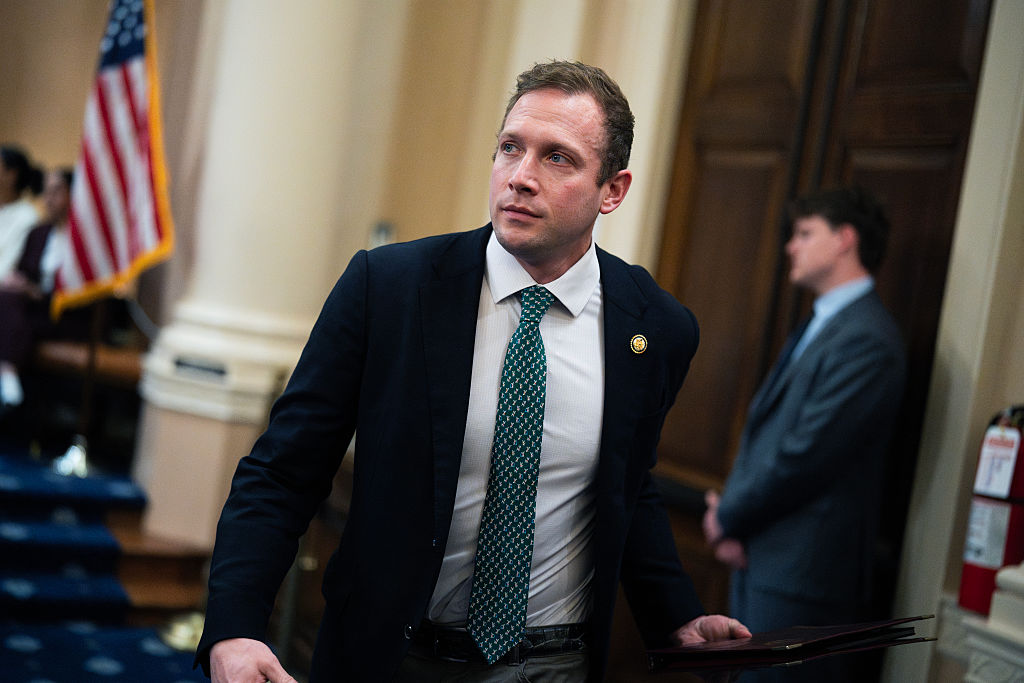
The latest addition—and currently the loudest denier—is Rep. Max Miller (R-Ohio) who denies his former wife’s claims of physical abuse as well as child abuse of their daughter. He also recently claimed it was his former spouse who was violent, not him.
Former spouse Emily Moreno and her father, Sen. Bernie Moreno (R-Ohio), refute his denials, as his former father-in-law is calling for his resignation, and the House Ethics Committee is investigating the charges.
In the meantime, Miller recently maintained his innocence on social media, saying his ex-wife requested making him dinner—supposedly proof he never assaulted her, held a gun to her head and threw scalding water on her.
Research shows abuse survivors—myself included—practice appeasement as a survival tactic and will attempt to de-escalate a tenuous situation with an abusive partner any way they can to stay safe. Dinner included.
Each year 16 million women—and some men—experience a form of intimate partner violence. They know too well that a partner capable of violence can be in any occupation—lawmaker, restaurateur, firefighter, actor, doctor, shoemaker, bus driver—or in my case, lawyer.
But it is noticeable that a number of elected officials and candidates over the past decade have been inducted into the DV Club; those in the club include those accused in both political parties, different generations and in nearly every state of the union.
According to the National Intimate Partner & Sexual Violence Survey of 2023-2024:
“Nearly 43.5 million U.S. women and 20.7 million men experienced one or more forms of violence in their lifetime. Lifetime physical violence by an intimate partner was experienced by 22.5% of women and 13.7% of men, with 18.2% of U.S. women and 8.6% of U.S. men having experienced at least one form of severe physical violence.“
But IPV is not a big deal, says President Donald Trump, and should not be included in crime statistics.
In 2025, he said, “Much lesser things, things that take place in the home, they call crime. You know, they’ll do anything they can to find something. If a man has a little fight with the wife, they say ‘this was a crime, see,’ so now I can’t claim 100 percent.”
Perhaps Trump’s familiarity with marital abuse allegations stem from his first wife, Ivana Trump, who reported in divorce proceedings in 1990 that he had “raped” her. (She recanted in 2015.) She died from a fall in her New York City apartment in 2022.
That effort to minimize intimate partner violence is also visible on the federal government’s own public-health website.
The CDC’s National Intimate Partner and Sexual Violence Survey remains the federal government’s source for its latest national data on intimate partner violence, sexual violence and stalking. But visitors to the site now encounter a political warning from the Trump administration before they reach that research. The page explains that, following a court order, the Department of Health and Human Services was required to restore the website to its Jan. 29, 2025, version. The administration then added this disclaimer:
“Any information on this page promoting gender ideology is extremely inaccurate and disconnected from truth. The Trump Administration rejects gender ideology due to the harms and divisiveness it causes. This page does not reflect reality and therefore the Administration and this Department reject it.”
The notice does not say that the CDC’s intimate partner violence statistics are false. In fact, directly beneath it, the agency continues to describe its reports as providing the latest national prevalence data on intimate partner violence, sexual violence and stalking. But the extraordinary disclaimer now hangs over the federal research documenting the experiences of tens of millions of survivors.
Even without accountability—or even a federal public-health website free from political caveats—there is no denying the prevalence of abuse allegations involving political actors across age, race and party lines.
In 2011, former U.S. Rep. David Wu (D-Ore.) resigned over charges of sexual assault.
In 2016, Trump ally Steve Bannon, also a confidante of Jeffrey Epstein, and CEO of Trump’s 2016 presidential campaign, was accused of domestic violence years earlier with his then-wife. Trump fired him from the campaign (unrelated to DV charges), then pardoned him in 2021 on conspiracy charges. He spent four months in prison in 2024 for fraud and money laundering, where a presidential pardon was not possible.
In 2015 and 2016, state Sen. Troy Brown (D-La.), was arrested and charged with domestic battery on two different partners and resigned in 2017.
In 2018, White House staff secretary Rob Porter resigned his position following accusations of domestic abuse by two ex-wives and another former girlfriend. Trump wished him well.
Former Democratic New York Attorney General Eric Schneiderman in 2018 was accused of domestic violence by four women—ironically the same year he filed a civil rights lawsuit against The Weinstein Company for failing to protect employees from sexual harassment. Schneiderman resigned his post in 2018 and his law license was suspended in 2021.
Also in 2018, then-U.S. Rep. Keith Ellison (D-Minn.) was accused of domestic abuse in 2018 by a former girlfriend. He is now attorney general of Minnesota.
The following year, Rep. Doug McLeod (R-Miss.) faced domestic violence accusations. McLeod resigned.
In 2021, Sean Parnell, running for Republican state senate in Pennsylvania, addressed charges of physical abuse of his wife—including choking her—in a child custody case that he lost. He was named chief spokesperson for the Pentagon in 2025.
In 2025, Secretary of Defense Pete Hegseth dealt with the resurfacing of 2015 physical abuse allegations from his second wife, Samantha. He is supported by Trump and calls himself secretary of war.
Last year, Rep. Cory Mills (R-Fla.) had an emergency order of protection against him after he allegedly threatened his partner with physical abuse. He is under investigation with the House Ethics Committee. Trump supports him.
In April of this year, Rep. Eric Swalwell (D-Calif.) and Rep. Tony Gonzales (R-Texas) resigned amid sexual conduct allegations and abuse.
In May 2026, a former Republican candidate in Texas, Brett Jansen, was accused of strangling his wife on more than one occasion. She survives.
This June, Graham Platner, a Maine Democrat campaigning for state office, faced multiple allegations of domestic abuse from former partners. He ended his campaign in July.
Yes, we are thankfully past the dismissive days of referring to white sleeveless t-shirts as “wife beaters,” and the notorious “rule of thumb” that refers to the 17th century legality that a husband could beat his wife as long as the bat or tool was no wider than a thumb.
But is there progress, really?
In 2021, the Office of Congressional Ethics investigated incidents of domestic abuse, without naming the officials in the report. In 2025, the House Ethics Committee released its 94-page rules, with no mention of domestic violence.
In a case of art imitating life, the 2024 film, It Ends With Us, directed by Justin Baldoni and starring him and Blake Lively, centers on domestic violence and the societal shame associated with the trauma. Lively now seeks $8 million in legal fees in the ongoing legal fight with Baldoni in which she claims abusive behavior by Baldoni whose role in the film was as her abusive partner.
Every minute, 32 people experience intimate partner violence in the United States. Some of those people have partners in politics, who are apparently well-known, well-respected and frequently have the support of a president who doesn’t think anyone in this DV club committed a crime.Their voices must be heard and the actions of those who harmed them must have consequences.
Now with shocking testimony from survivors and little to no accountability for perpetrators, this boys’ club strikes a chord of familiarity in response to another numbing phase in the history of modern misogyny: the Jeffrey Epstein Files.
*
A note from Ms. editors: We want to hear from you for The Majority, a new campaign collecting stories about how reproductive freedom has enabled readers to build the lives they want and need. Poll after poll shows a majority of Americans support reproductive healthcare access. Yet public debate overlooks the lives shaped by abortion access, contraception, IVF, miscarriage care, maternal healthcare or comprehensive sex education—countless women who chose to pursue an education, have children, not have children, protect their health and chart their own future. Add your voice and complete the sentence: “Access to reproductive choices gave me the freedom to….” Together, these stories will help show not only why reproductive freedom remains a majority value, but also what it makes possible.

Support more work like this article
The reporting you just read is possible because of readers like you. Since 1972, Ms. has delivered independent, feminist journalism that tells the stories too often overlooked by other news media, challenges systems of inequality and holds power to account. We have no corporate owners, no advertisers and no billionaires dictating what we cover. Instead, we answer to our readers and our mission. If you value reporting that centers women and girls—and covers the issues others leave out—please support Ms. today by making a tax-deductible donation, becoming a member to receive a magazine subscription, or gifting a membership to a friend. Together, we can continue reporting, rebelling and truth-telling.