When the justice system fails survivors, women become each other’s witnesses.

“Speak, for truth is living yet. Speak, whatever must be said.”
—Faiz Ahmed Faiz, Speak
“As I write this book, I am in active disclosure, coming to grips with the horrible accounts in my old journals, hazy flashbacks, and gut-shaking ugly cries that seem to come from nowhere.”
—JoDee Neil, Outcry Witness
“With privilege comes responsibility—think Spider-Man. If you can, you must. I’ve believed that my whole life,” says JoDee Neil about advocacy to prevent violence against women, as we tearfully share the worst moments of our lives over a spotty internet connection.

One of us is a doctor, the other a lawyer. We’re also members of a club that no woman ever asks to join, but too many are forced into, often by men they loved and trusted.
There is no good way to describe the emotional anguish of abuse, but we understand it in each other without needing to exchange words. The way Neil and I saw it, we had two choices afterward: Succumb to the nihilism that was slowly consuming us, or create a different kind of life—not only for ourselves, but for other women.
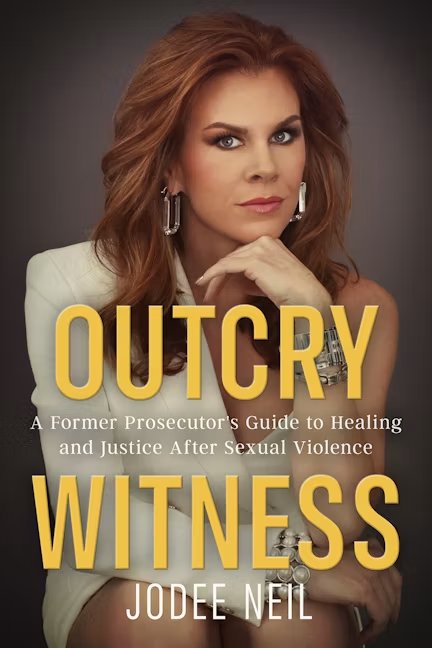
Neil has a significant sexual trauma history that includes rape. A Texan lawyer who fights sexual violence against women and children, she has written her first book, a manifesto entitled Outcry Witness, chronicling her own experience with sexual violence and healing in its aftermath.
“At the time I started prosecuting crimes against children,” she tells me with an impressive composure, given the subject, “I had already been sexually assaulted more times than I can even recall today.”
When she started at 27, Neil was the youngest prosecutor in her office specializing in crimes against children. Her work is deeply personal—more than it might be for the average prosecutor, given her intimate, unwanted understanding of these crimes.
Her shoulders shake with emotion. “The injury that takes place when a crime happens on your body creates despair, and it took me a long time to see it. I couldn’t understand … why am I still wishing that it would all just stop? That I just wouldn’t even be here anymore?”
I remember asking the same question myself after leaving my own abusive relationship. The world seemed a little less colorful, with less meaning. Food I usually liked tasted bland, and sleep (the few hours I could maintain) didn’t feel restful. I would think to myself, I’m not living, merely existing. I’ve lived both too much, and not at all, and I just don’t want to do it anymore.
Many abused women feel similarly, but cannot bring themselves to ask for help in a culture that often shames women after they disclose abuse, with little chance of justice for the victim or arrest for the perpetrator. Judgment-free silence feels psychologically safer, but highly isolating, and the suicide risk amongst these women is noticeably elevated.
Though I am a psychiatry resident who must pathologize these behaviors, the abused woman in me understands the depth of the women’s pain.
Neil understands it too. It fueled Outcry Witness.
The Response to a Disclosure Matters
An “outcry witness” is the first adult to whom a survivor discloses their abuse or assault—and the outcry witness’ response strongly influences how trauma symptoms develop for the survivor. Trauma research shows that negative reactions towards disclosure, including invalidation, imposes shame and a silencing effect on sexual abuse victims.
Research on abuse dynamics by psychologist Jennifer Freyd, Ph.D., indicates that individual-level and systemic victim-blaming can dramatically exacerbate trauma symptoms.
“You feel so disconnected in your body as a trauma survivor. The book’s small enough to hold and just ground yourself with it,” Neil says, referring to psychotherapeutic techniques that rely on sensory input to bring a trauma survivor out of an activated state.
I know too well what Neil means. During our call, I told her, “Sometimes, I get really activated reading trauma narratives, because then I start reliving mine. That didn’t happen with your book. You take pauses to reassure a reader, ‘You’re not crazy. Your sense of self was destroyed. This is a pattern. This is what they do.’”
“There’s nothing else like this!” she declares. “I’ve done every kind of law. I’ve done opioid litigation. I’ve done car wrecks. I’ve done all kinds of interesting stuff, but at the end of the day, there’s nothing that feels as good as having those moments with another person. It’s just pure.”
Though we have found community in each other, the scars of the past are slow to fade—a common experience of patients with PTSD and abuse survivors everywhere that manifests in negative self-talk, self-hatred and shame. If this were my clinic, I would document, “Thought process: ruminative.” But the sterility of clinical language fails to capture the emotional profundity.
Something in me, clinging like a child to kindness where I can find it, makes me want to open up to her as I hear her speak and read her words. Neil inadvertently becomes my outcry witness for this piece of information: “There’s this mean little voice inside me that sounds like his voice that says, ‘You’re not desirable. You’re boring. You’re not enough. There are women who are more outstanding than you.’ That’s the word that got used, not outstanding enough. I trust myself as a doctor. I don’t know how much I believe in myself as a woman.”
She nods. “I think that’s to be expected from what you’ve been through. You know, you’re injured still, and it takes time to heal.”
I nod quietly. I don’t want her to see the tears in my eyes.
Women Talking
Neil hopes women fight for our choices, and she’s furious at male impunity as it soars to greater heights: “We were not supposed to say no, we had a very specific role—that’s what I was taught growing up, and everyone I knew was taught the same things. It’s disappointing that it’s making a resurgence with modern young men. That’s why there’s so much violence against us, because we’re not taking it. We know there’s more to life than serving a man, and they’re real mad.”
Her book could not come at a more important cultural moment, as well-funded forces attempt to coerce women into social roles of subservience and convince us misogyny is mainstream. (In reality, feminism is popular, especially among young women.)
The Trump era welcomed an aggressive resurgence of violent masculinity, casting men as an oppressed American class, rather than the statistically predominant drivers of sexual violence in our nation.
Systemic corruption gives survivors of male-perpetrated abuses few avenues for recourse.
But there is one avenue that remains untouched by the grasping hands of men who would abuse freely and the systems that willfully shield them: women’s narratives. Narrative can take many forms: literature, art, poetry, film and more.
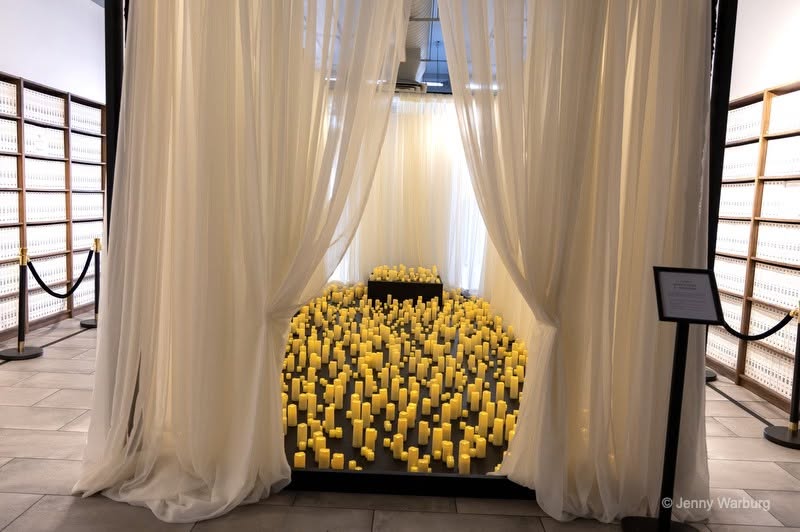
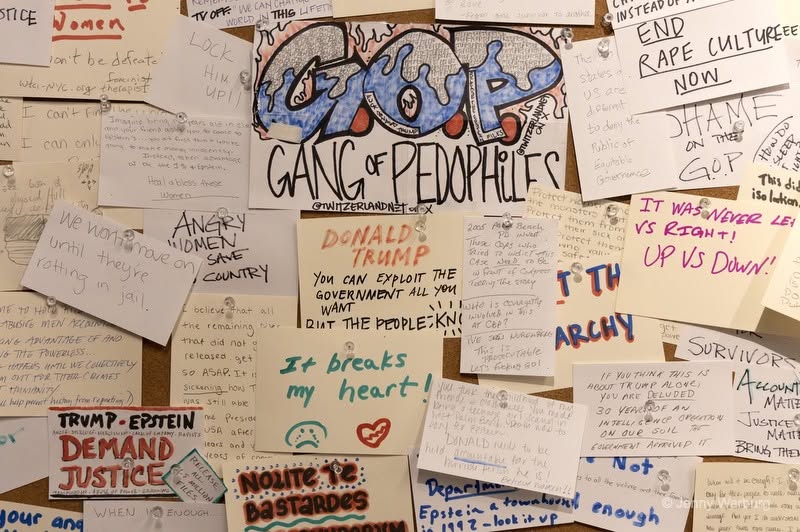
The Trump-Epstein Reading Room, a bold exercise in artistic excellence and public truth-telling, compels spectators to visualize the sheer scale of abuse. It centers the victims and highlights federal complicity with Epstein’s sickening crimes—a stunning visual monument to our president’s legacy.
This is where narrative and art become critical. While survivors may never find justice through the legal system, they may find healing in community and storytelling, where the violations of their body may be witnessed and their trauma recognized.
“We are at the precipice of the dam breaking,” says Neil. “We’ve never been able to communicate in real time with each other, to really put the pieces together. We’ve never been able to do this, and I am so full of excitement to be a part of this movement for humanity.”
Women talking to each other is a powerful phenomenon. Why else would they want us uneducated, choiceless and sequestered in our homes, preoccupied with pregnancy and domesticity? You can’t read the label while you’re trapped in the jar.
What Is a Predator?
Neil wants to absolve women and girls of the shame and stigma associated with abuse, the demonic spawn of pervasive societal mythology that a woman somehow invites her own abuse.
I learned from my own experience, as Neil learned from hers: Anyone, including those you love and trust, can betray and violate you at any time. It’s an unnerving thought that belies the myth that rapists and abusers are somehow visually identifiable.
If you asked the Trump administration, I imagine they’d say that the most likely perpetrator is a mentally ill pervert, lurking in the bushes. He’s probably uneducated, an immigrant or at least Black or brown. He looks evil. Women must know to avoid him, and if they don’t, it is their own failing. The ideological prejudices of the administration become codified into policy, discarding data for bigotry.
In reality, over 95 percent of sexual abuse perpetrators are U.S. citizens and, when stratified by race, white men comprise the majority.
Yet immigrants, broadly castigated as “rapists and pedophiles,” remain political targets—ICE recently received $70 billion in federal funding, while no arrests have been made over the Epstein files by a Department of Justice that is increasingly viewed unfavorably amongst the American people.
But global statistics don’t support the myth. Women are most at risk of violence in their own homes, and most perpetrators of abuse or assault are known to their victims.
Neil’s account humanizes the statistics, making the raw data deeply personal.
“My first rapist was a military pilot, jet pilot, okay?” says Neil with renewed vigor after nearly an hour and a half together. “My most recent rapist is also a pilot, and had served in a major army elsewhere in the world. These are high-functioning dudes. A predator is just a man.”
My abuser wasn’t a random Tinder date or club hookup; on paper, he was excellent, with prestigious schooling and a promising future. My colleague’s abuser became the chair of orthopedics at an academic medical center after abusing her and their children. Abusers are your neighbors, your bosses, your classmates and even your friends. Monsters walk among us—an uncomfortable reality that we have not yet acknowledged fully, despite the wealth of data.
A Community of Women
Neil calls on us—the women, the survivors—to rely not on the (in)justice of men, but on each other, and hopes that her book can be a catalyst for American women to build community and solidarity against abuse.
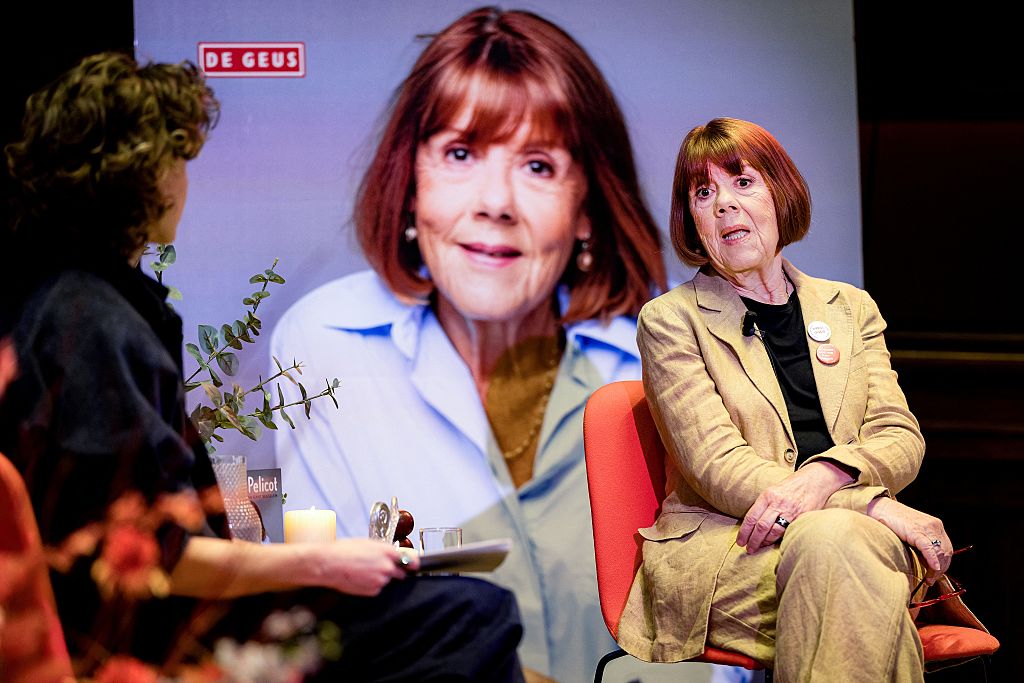
She cites another famous survivor, Gisèle Pelicot: “I finished A Hymn to Life, and [Pelicot] describes these … I assume they’re survivors. They’re women, and they showed up at the courthouse. She was very focused on keeping her dignity. She wanted it to be a dignified process, because so much was taken from her, and these women came to the courthouse and would walk with her into the courtroom.”
Both of us are in tears at this point, shame be damned. “What are you feeling in your body right now?” I ask, my psychiatrist persona taking over.
“I just feel … like a flow, and it’s these moments that you have with other survivors that really are the most meaningful healing you can have, and that is 100 percent what my book is designed to do, is to get people to have these discussions.”
I’m crying in New York, she in Texas, and the tears won’t stop.
She continues: “You have to feel the pain of the other person, and when I would try cases, I would. You have these moments where you just feel truth, you know? It is through this pain and through these moments with one another.”
We fall silent and hold the weight of the truth between us. A connection more tenable than most has formed as we contemplate the release of Neil’s narrative to the world, and we wonder, will it reach out and touch someone?
Sometimes, when I fall into my existential moods, I imagine there is a desperate woman whose battered body is too tired to go on and who feels that life isn’t worth living. I think of my writing, of Neil’s, of the powerful female advocates who have turned their trauma into their personal origin stories. I hope that the desperate woman reads one of those narratives, or walks through the corridors of the Trump-Epstein Reading Room. I hope the souls of the women who have once traced those steps reach out to her through narrative and art, whispering, Don’t.
I hope she hears it. We’re waiting with open arms for her.
Views expressed above belong only to those of the author, and not to any institution with which she is affiliated.
Look to these trusted groups if you or a loved one needs to know more about reliable abortion care:
- A one-stop-shop for abortion seekers: I Need An A
- Other websites to explore all your options for abortion care: Plan C Pills, Abortion Finder
- Safe websites to buy abortion medication: Aid Access, Massachusetts Medication Abortion Access Project, Hey Jane
- If you need help affording abortion care, tell your telemedicine provider or contact an abortion fund near you.
- To protect your digital privacy when planning your abortion, click here.
- For free legal help as a patient or doctor, call If/When/How’s Repro Helpline—844-868-2812—or contact Pregnancy Justice.
- For medical advice, contact the Miscarriage & Abortion Hotline: 833-246-2632.
- If you need to know the abortion law in your state, look to the Center for Reproductive Rights. or Guttmacher Institute.